In-house Training vs Outsourcing Employee Development
Understanding In-house Training vs Outsourcing Employee Development
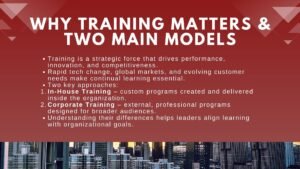
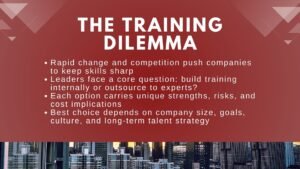
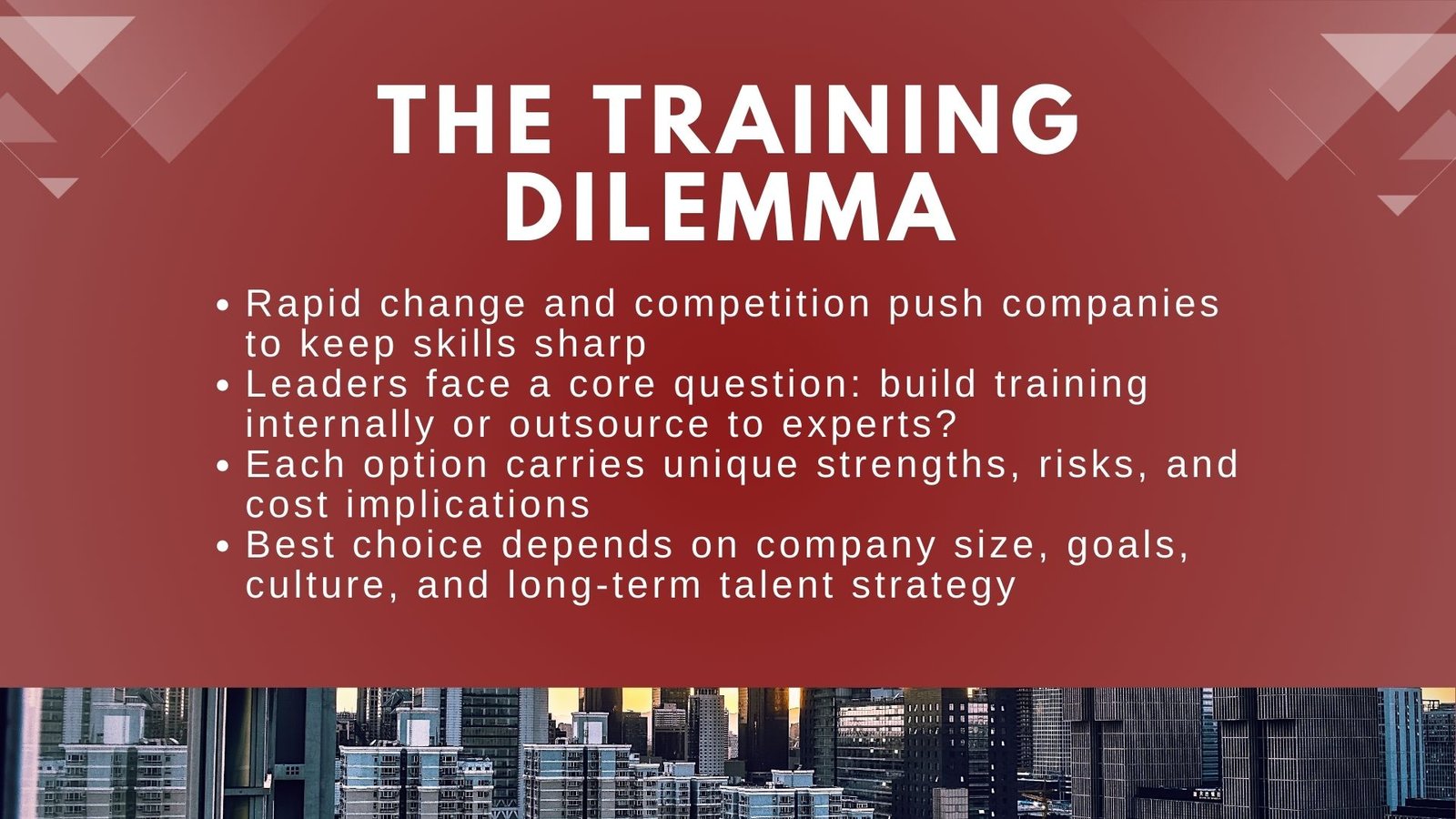
Companies are now experiencing more pressure to change fast, stay competitive and make sure that employees have the appropriate skills needed to bring results. Training is a key element of this process, yet the leaders face an important question, whether they should train themselves, or outsource it to an external service? Both strategies have particular pros, cons and cost implications, which complicates the selection more than it seems at first. The correct option is based on the size of the company, its budget, goals, culture and the long-term talent strategy. The discussion of In-House Training Singapore and outsourcing nuances provides some enlightenment to organizations that aim to design learning programs that are effective, sustainable and supportive of business objectives.
Understanding In-House Training: Control and Customization
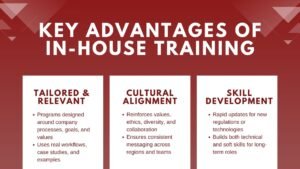
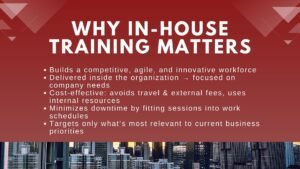
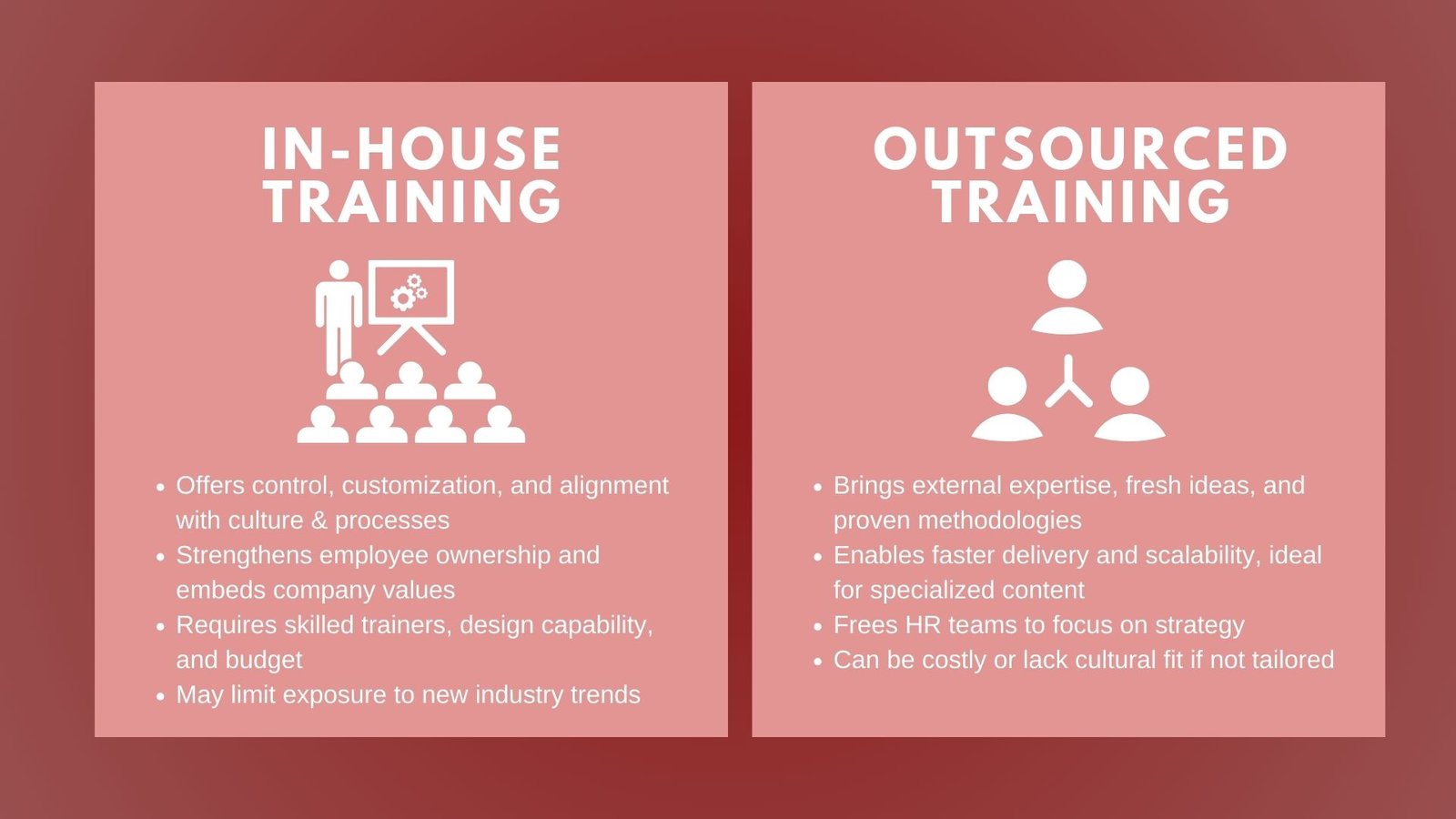
In-house training In-house training is training created and executed by a human resources department, learning and development professionals, or internal subject matter experts of a firm. The main benefit of this solution is a high degree of control and customization. The content used in training can be customized to include organizational culture, industry practice and unique processes so that the employees acquire skills that they can apply immediately to their jobs. Many organizations look to the best in-house training programs in Singapore Riverstone as a benchmark for effectiveness.
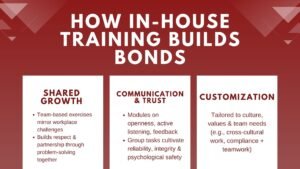
The model enables the organizations to incorporate their core values and mission in training, which brings about uniformity among the employees. As an example, customer service training that is created in-house may be directly based on the brand voice and service quality of the company. The In-House Training Singapore will also create a feeling of ownership and a feeling of belonging because employees will realize that the organization is investing in them internally. This highlights the importance of in-house training for businesses Singapore that want to align employees with their culture and strategic goals.
Nevertheless, internal training may be resource consuming. It needs experienced trainers, sound instructional design and development budgets. Small to mid sized businesses cannot afford to have high quality programs without placing undue strain on their resources. Moreover, the use of internal trainers might fail to expose them to industry trends, which might be a limitation to the innovation in training design. This is why comparisons such as Riverstone in-house training vs external training Singapore are essential when businesses decide which model best suits their needs.
Exploring Outsourced Training: Expertise and Efficiency
Outsourcing training is the process of calling upon third parties, consultants or specialized companies to implement learning programs. This is a style that is of interest to organizations that want to gain expert knowledge, proven methodology and have access to the latest tools without developing all of them in-house. External trainers usually introduce new ideas, benchmarking information, and industry best practices and can become quite valuable to the learning experience.
Efficiency is one of the most definite pros of outsourcing. Rather than spending months in internal content development, organizations can use the pre-built programs or highly-tailored training packages through specialists. Training that is outsourced, especially around specialized content, like regulatory compliance, new technology, or advanced leadership development, is quite effective because outside trainers can be more knowledgeable.
Outsourcing also helps in the reduction of workload on the internal teams as the HR and learning professionals are able to concentrate on the strategy and implementation instead of content development. Nevertheless, outsourcing does not have any flaws. It may also be costly, particularly where programs are to be highly customized. Also, in cases where the training that is outsourced is not connected to the organizational culture, it is at risk. When the external providers do not include the company values and practices in their materials, the employees are likely to have issues applying the learning to their everyday tasks.
Cost Considerations: Short-Term Savings vs. Long-Term Investment
Cost is one of the most controversial considerations in the decision making between in-house and outsourced training. On the face of it, outsourcing turns out to be a costlier choice because of the fees paid to the consultant or licensing expenses, or the price of packaged programs. Nonetheless, in-house training entails huge upfront expenses in instructional design tools, salaries of trainers and content development, which can also become expensive in the long run.
Organizations should understand the training needs as either a single or a continuous process. On short-term or specialized requirements, outsourcing can be much cheaper as it does not require the cost of in-house expertise utilization in a limited use case. Conversely, when the training needs are constant and repetitive, e.g. onboarding, compliance update, or customer service standards, organizations might discover that a robust In-House Training Singapore can be less expensive in the long-term.
Cost is also about value. Although outsourcing may give access to global best practices, In-House Training Singapore offers a better fit with business objectives. A hybrid model is usually the most viable option regarding cost-effectiveness, as companies can optimize their effects and use external resources to reduce costs.
Flexibility and Scalability: Meeting Organizational Needs
Another important factor that needs assessment in the decision between in-house and outsourced training is flexibility. In-house programs are more flexible concerning altering internal priorities. As an illustration, when the executives of any company resolve to implement new policies or change the strategic orientation, internal trainers are able to easily adapt the training material. Although they are flexible, the outsourced programs are normally attributed to contractual procedures and higher expenses of making significant revisions.
Scalability also matters. Big companies that have a global presence tend to find outsourcing to be advantageous because external vendors can more effectively expand programs to different regions and languages. Internal resources might not have the capacity or the knowledge to handle large scale rollouts on a regular basis. On the other hand, In-House Training Singapore can be feasible in small organizations which have tight teams because without forming external relationships, there is flexibility.
Finally, the appropriate balance will be determined by the priorities of an organization to agility and alignment with cultural inclinations (in-house training) or breadth, scalability, and expert knowledge (outsourcing). A combination of blending between outsourced programs and core training programs has become a common practice at many organizations.
Cultural Integration and Employee Engagement
The aspect of culture of training must not be underestimated. The very nature of In-House Training Singapore is that it conveys the organization values, behaviors, and expectations, which strengthens company identity and employee engagement. Internal programs are created and administered within a company indicating to the employees that the organization has a direct interest in their development, which may enhance their loyalty and motivation.
Although expert-based, outsourced training may miss that human touch or may even appear generic or not in touch with the culture of the company. This threat is, especially in those spheres as the development of leaders or customer service, where the correspondence to the organizational values is the key. Nonetheless, competent external suppliers can counter this through close working with the company, customization of content and incorporating local aspects into their programs.
The choice finally comes down to the extent to which training will have to relate to organizational identity. In case it is critical to integrate culture, in-house programs can be more powerful. Provided the emphasis is placed on special knowledge or skills, outsourcing could achieve better outcomes without negatively affecting the engagement of the employees.
Making the Right Choice: Aligning Strategy with Training Approach
The choosing of In-House Training Singapore versus outsourcing is not a case of deciding on either of the two in general. Rather, it must be aligned to the organizational strategy, resources and long term vision. Firms have to consider their priorities: is it to develop internal resources, to propagate culture and sustain ongoing learning, or it is to tap specific know-how, to grow fast and to make sure that standards of the industry are met?
A mixed approach is, in most instances, the best approach. Basic programs like onboarding, training on internal systems and cultural integration programs can be done in-house, whereas specialized or advanced programs can be outsourced to professionals. Such a mixture enables organizations to take the best out of both models, which are flexibility, cost-effectiveness, and alignment of strategic direction.
Conclusion After all, it all depends on the ability to realise that training is not a universal fix. Every organization should consider the advantages and disadvantages of in-house and outsourced systems according to the objectives, resources, and the requirements of the organization in terms of its workforce. Through intentional, conscious actions, organizations are able to shape learning initiatives that will enable employees, reinforce culture, and create long-term growth.
Conclusion: The Balance Between Control and Expertise
There is no clear winner in the debate between in-house training and outsourcing because the two training methods can be used in different contexts in the development of an organization. Control, customization and cultural fit comes with in-house training whereas outsourcing introduces expertise, efficiency and scalability. Those organizations that transcend the dichotomy and adopt a hybrid model and use the best of two worlds are the most successful.
Effective training is also crucial as long as the businesses are still learning to cope with the speed of change. Training, be it developed in-house, outsourced or blended, is about making sure that training is strategically aligned, involves employees and produces measurable results. Ultimately, the most appropriate model of training is the one that does not only impart knowledge but also enhances organizational capacity to survive in a competitive and ever-changing environment.