Operational Risk Management: Internal Training Modules for Corporate Teams
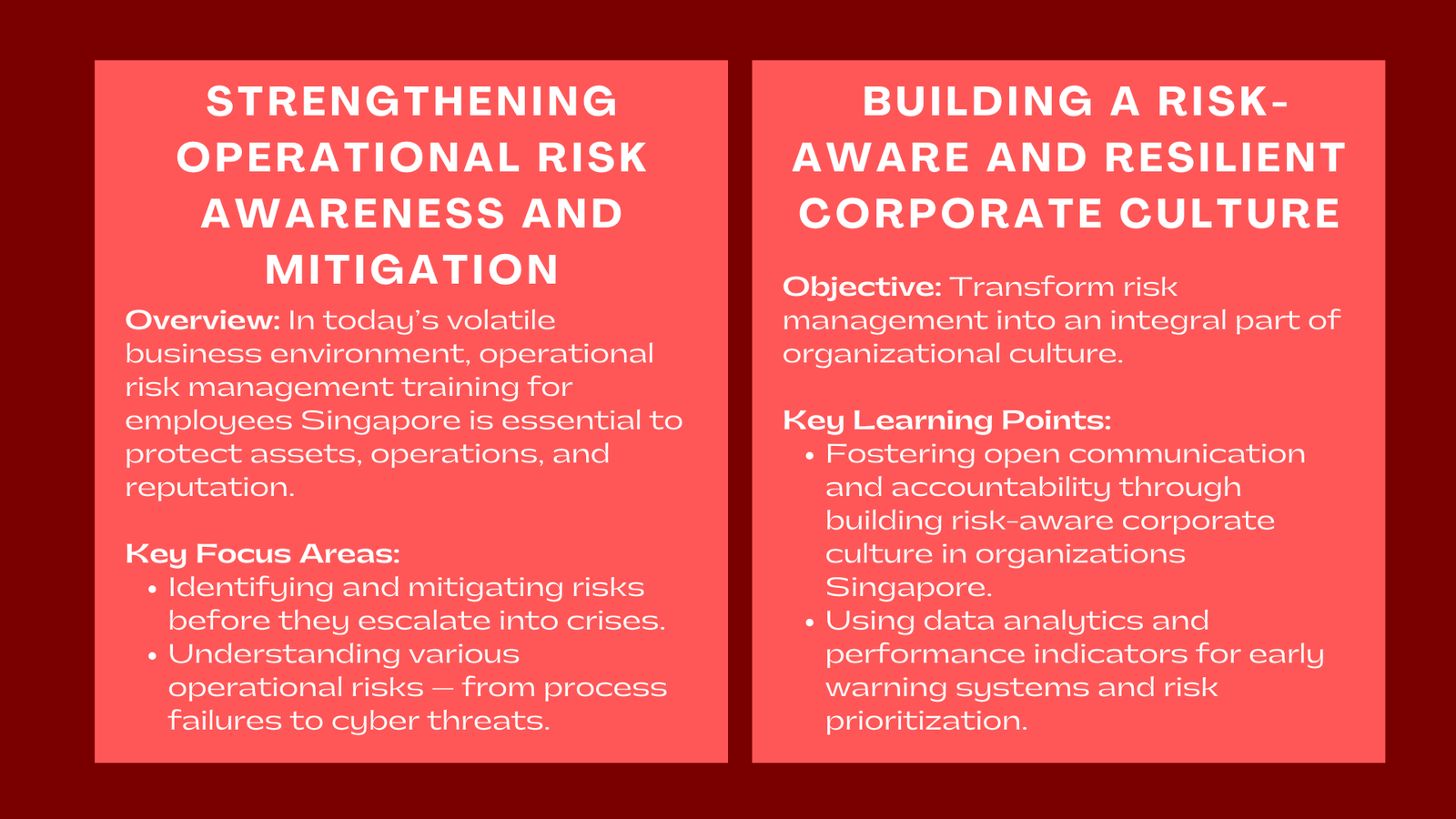
operational risk management training for employees Singapore is no longer an option in the world of business, where the business environment is unstable and the world is uncertain. Corporate risk mitigation, identification, and monitoring programs enable internal teams to improve the protection of operational, asset, and reputation. This kind of training enables the employees to identify its possible areas of amusement before it grows into a crisis.
The participants are taught about operational risks, which may include the failure of certain processes, to the potential cyber threats, and how they can affect organizational performance. The training develops a preventative thinking towards preparedness and constant enhancement. Through interactive case studies, simulations, and real-world examples, participants gain hands-on experience in project evaluation techniques such as cash flow analysis, discounted cash flow (DCF), sensitivity testing, and scenario planning. They also learn how to identify potential financial risks early, develop mitigation strategies, and implement monitoring mechanisms to ensure that projects remain on track financially and operationally.
Developing Risk Identification and Assessment Skills
Risk management begins by being aware. The training takes the involved participants through organized structures of identification and evaluation of risks in reciprocal business functions. Through in-house training courses Singapore for risk management, participants gain practical exposure to real-world scenarios that strengthen their ability to assess and manage risks effectively. Using the scenario-based practice, the teams get to understand how to analyze the probability and consequences of the possible risks, how to manage the prioritization, and how to work out the mitigation behaviour. Participants learn how to prioritize risks according to their severity and likelihood, and how to design and implement appropriate mitigation strategies that safeguard business continuity and organizational performance.
Another point that is brought out in this module is the role of data-driven decision-making in risk management. Using analytics and performance indicators, the participants can obtain the opportunity to track the early warning signals and avoid the operational disruption. By combining structured risk assessment frameworks with analytics-driven monitoring, participants acquire the skills to anticipate, evaluate, and manage operational risks effectively. The program equips employees to not only respond to potential threats but also to embed a culture of risk awareness and resilience within the organization, ensuring long-term stability and continuous performance improvement.
Creating a Risk-Aware Corporate Culture
The operational risk management is best managed when it becomes an organizational culture. All the workers, irrespective of their rank, should know their part to play in ensuring compliance, standards and integrity of the processes. The building risk-aware corporate culture in organizations Singapore promotes a free flow of communication within which any suspected problem would be brought forth minus fearing reprisal and thus promoting transparency and accountability.
With the ability to detect and then take care of risks, the workers will help an organization to attain efficiency, reduced losses, and better reputation management. With time, the culture of vigilance is one of the competitive advantages. By promoting open dialogue, employees become active participants in identifying and addressing operational vulnerabilities before they escalate into significant problems. This not only reinforces accountability but also strengthens trust across all levels of the organization.
Through the ability to detect, assess, and respond to risks proactively, employees contribute to enhanced operational efficiency, minimized financial and reputational losses, and improved stakeholder confidence. Over time, this culture of vigilance becomes a strategic advantage, positioning the organization as resilient, responsive, and capable of navigating uncertainties while maintaining sustainable performance.
Conclusion to Operational Risk Management Internal Training Modules for Corporate Teams
Once it is an organizational culture, the operational risk management is best dealt with. The workers, regardless of their levels are supposed to be informed of their role in ensuring compliance, standards and integrity of the processes. The training enhances free flow of communication in which all the suspected issues would be tabled without fear of reprisal and thereby enhancing transparency and accountability.
Having the capacity to identify followed by the management of the risk, the workers will assist an organization in achieving efficiency, minimization of losses and the handling of the reputation. Culture of vigilance is among the competitive advantages with the time. Beyond immediate risk reduction, this approach builds organizational resilience. Teams become more agile in responding to unexpected events, maintaining business continuity even under challenging conditions. Over time, a culture of vigilance evolves into a strategic competitive advantage, as employees collectively contribute to safeguarding assets, enhancing performance, and preserving the organization’s reputation.
Ultimately, operational risk management as a cultural principle ensures that risk awareness, accountability, and proactive decision-making are woven into the daily activities of the organization. This creates a sustainable framework for long-term efficiency, improved stakeholder confidence, and overall corporate success, turning risk management from a compliance obligation into a cornerstone of strategic growth.