Brand and Reputation Management: Professional Development Workshops for Staff
Introduction: Brand and Reputation Management Professional Development Workshops for Staff
Brand and reputation are some of the most valuable resources of a company in the present globalized world. Customers can no longer be judging organizations based on their products or services but also based on values, ethics and public perception. Their effective control cannot be done without knowledgeable accountable employees that are aware of how their action is portraying the brand.Our Brand and Reputation Management: Professional Development Workshops to Staff are created so as to empower organizations to enhance their internal brand alignment, improve communication, and preserve reputation in an increasingly fast-paced and digitally-driven world of business. These trainings, delivered as customised in-house corporate training Singapore, will enable the employees to be true brand ambassadors who can be used to depict the company, its values and promise in a consistent and professional manner.
The importance of Brand and Reputation Management.
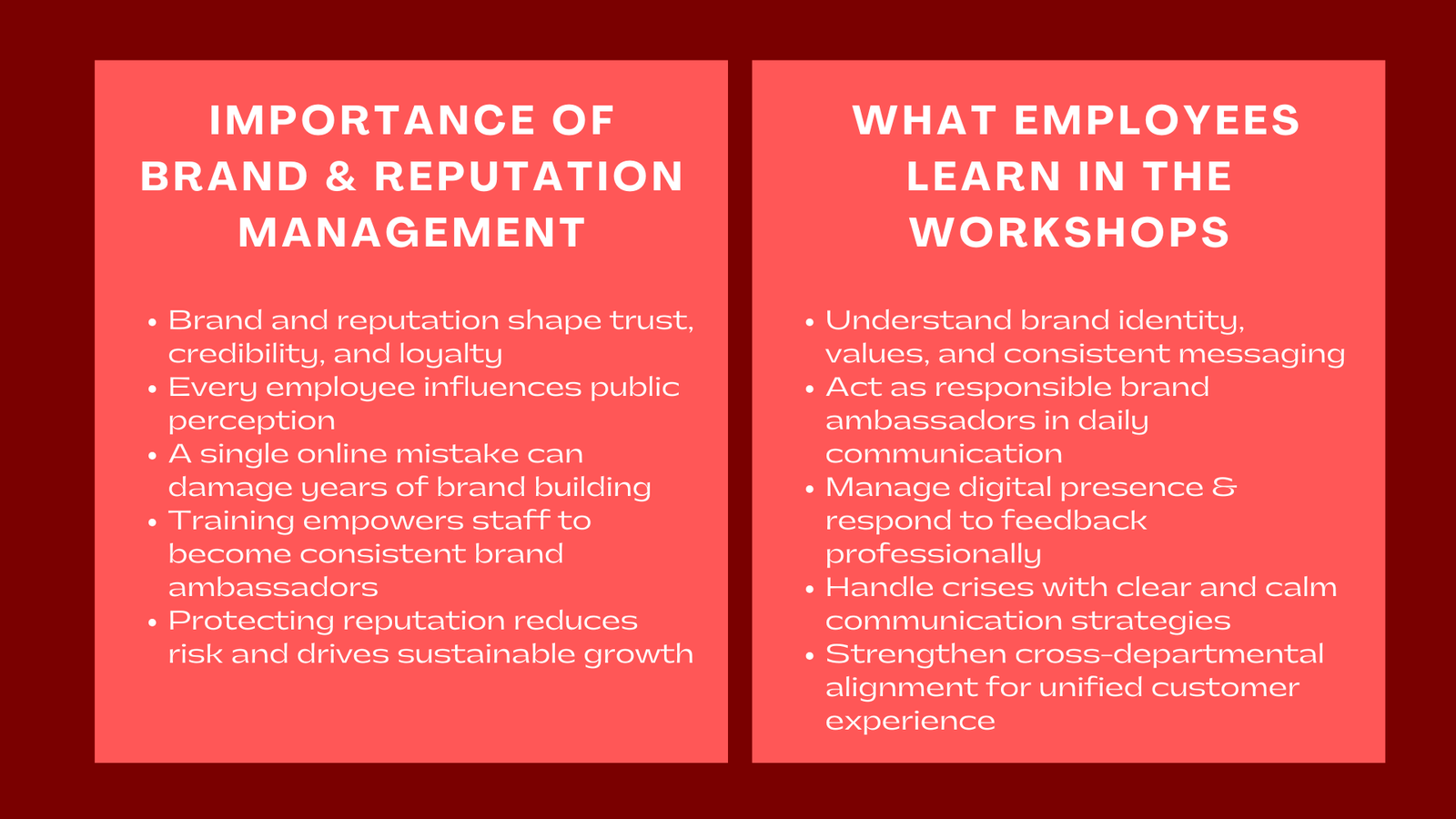
Good brand ownership creates a sense of trust, credibility and long term loyalty. It appeals to the customers, investors, and the best employees. On the other hand, a single wrong move, such as a social media post that is not appropriate, a poorly addressed customer complaint or an inconsistent brand message can ruin years of development. It is no longer the marketing or communications department that has a sole responsibility in terms of reputation management. Every employee plays a role. Whether the staff makes contact with the clients or communicates over the internet, every move will make a difference to the perception of an organization. Investing in organized training helps the company to make the employees aware of the value of brand integrity and able to defend and improve the brand integrity. Good brand and reputation management builds customer confidence, reduces risks and ensures long term growth.Key Learning Objectives
These trainings will develop consciousness, competence and responsibility of the employees. Participants are also provided with strategic understanding and specific skills on how to manage reputation, ensure continuity, and create positive brand experiences.Knowing Brand Identity and Values.
People discuss what makes a brand other than a logo or marketing campaigns. They get to know how to express the missions, values, and tone of voice of the organization- making sure that the same goes across all the touchpoints.The contribution of employees as brand ambassadors.
All employees are the embodiments of the values of the company. Participants, through discussions and case studies, get to understand how the brand is perceived, both externally and internally, in the way of everyday behavior, communication and decision-making.Reputation Management in the Digital World.
Criticism as well as praise can be increased through social media and online reviews. Respondents learn the ways to be responsible on online platforms, to work with the negative feedback, and to be professional in their interactions with others.Crisis Management and Communication.
Reputation risks may occur unintentionally. This module educates the staff members on how to react in a calm and proper manner whenever a sensitive situation arises. They also get the main principles of communication in safeguarding the brand in case of problems.Developing Coherence between Teams.
Unified messaging is the key to the brand reputation. The participants are taught how to coordinate their communication and organizational activities across the departments so that the customers get an integrated experience no matter who they will deal with.What Makes This Workshop Unique
Our brand and reputation management training for employees program goes beyond theoretical lectures—it focuses on real-world challenges that organizations face today. The participants internalize the best practices in building and protecting the brand value through interactive sessions, role playing, and case analysis.Interactive to Your Organization.
Every single workshop is made to show your company brand guidelines, culture, and industry realities. Our facilitators hold a consultation session before the program to find out critical risks, communication gaps, and areas of improvement.Practical, Hands-On Learning
The participants are required to solve real life case studies and simulated scenarios to practice the concepts of reputation management. They are taught how to react to speculative crises, analyze communication options, and develop responses that support the image of the company.Led by Industry Experts
Our trainers have profound knowledge in brand strategy, communications and corporate governance. They unite the academic concepts with practical experience to provide high impact sessions applicable to a contemporary organization.Core Modules Covered
Meaning of Brand and Reputation.
- Comprehending the brand equity and the perception of the stakeholders.
- Separating brand image and corporate reputation.
The Psychology of Trust and Credibility.
- The role of trust in making buying choices and loyalty.
- Developing authenticity and transparency to create credibility.
Online Image and Internet Presence.
- Social media engagement best practices.
- Online feedback monitoring and response.
Communication Strategies in Facing Crisis.
- Misinformation and media relations management.
- Establishing an internal response system.
Employee Engagement and internal Brands.
- Building pride and ownership in personnel.
- Building brand behavior by aligning employee behavior.
Ethical Brand Management and Sustainability.
- The effect of corporate responsibility on brand strength.
- Reporting sustainability.