Emotional Intelligence and Interpersonal Skills Employee Training Workshops

Emotional Intelligence and Interpersonal Skills: Employee Training Workshops

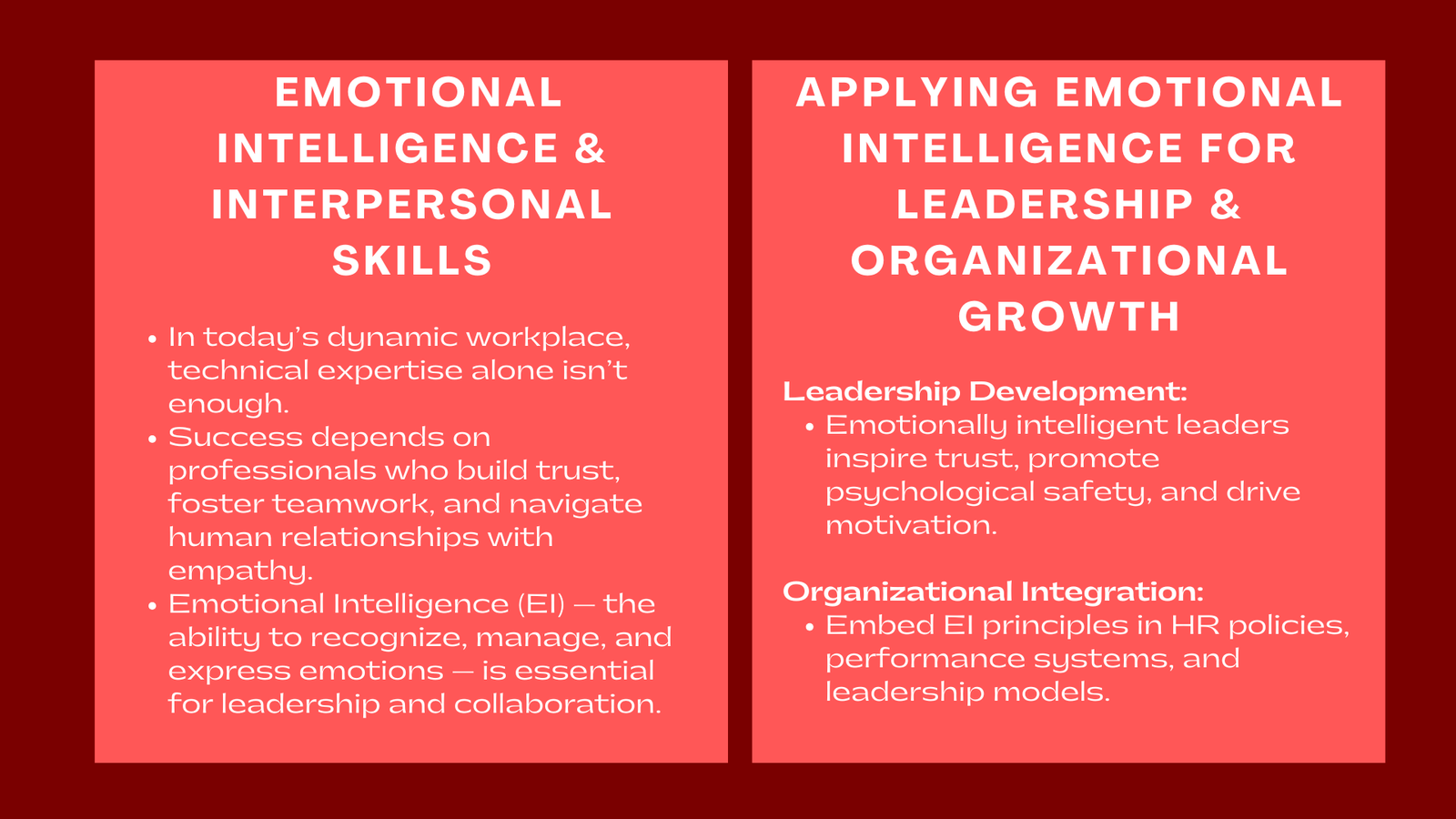
In the current world of business that is dynamically changing, technical knowledge and professional expertise is no longer a guarantee of ultimate success. The current organization requires professionals who can establish trust, encourage teamwork, and find their way through the world of human relations with compassion and understanding. Employees and leaders who can recognize the emotional signals and control interpersonal relationships and communicate in a manner that reinforces comprehension and involvement are the most effective people. In this regard, emotional intelligence and interpersonal skills training for employees in Singapore have come as essential competencies that define leadership potential, effective teamwork and harmonious working environment in the workplace generally.

Emotional Intelligence and Interpersonal Skills: Employee Training Workshops will help to develop these necessary skills within the employees of any level. The program also teaches the participants to think, sense, and process emotions, both their individual emotional state and the emotional conditions of other people, in order to improve communication, teamwork, and productivity. The practical approach accompanied by the application of theory makes the workshop provide participants with the instruments to build empathy, manage emotions in stressful situations, and solve the conflicts in a constructive way. With such development, interpersonal interactions are also made places of trust, innovation, and personal development, which are more emotionally intelligent and resilient concerning the workplace.
Emotional Intelligence and Interpersonal Skills Employee Training Workshops

The Importance of Emotional Intelligence in the Workplace

Understanding Emotional Intelligence

The key to successful interaction of humans is Emotional Intelligence. It is the skill of identifying, perceiving, and controlling feelings within self and other people. According to psychologist Daniel Goleman, there are five important aspects of EI namely, self-awareness, self-regulation, motivation, empathy and social skills. All these factors are critical success factors in the profession. An individual with the ability to self-assess understands their emotions and the way they shape their actions and choices. A person who has effective self-control is able to keep his head even in times of stress. The high level of empathy allows being a real participant together with colleagues, whereas the advanced level of social skills is how to engage and make a difference. Such essential soft skills are often developed through on-site and virtual in-house training Singapore tailored courses, which help professionals enhance emotional awareness and interpersonal effectiveness in real workplace contexts.

Using this workshop, the attendees get to appreciate the science of emotional intelligence, how emotions win over behavior, judgment and influence interpersonal relations. They are taught to be aware of emotional triggers, there is a difference between reaction and response, and emotional awareness is to be applied in making decisions that are more thoughtful. Employees are able to change their automatic emotional reaction into conscious history, which would lead to a healthier and cohesive workplace culture.

The Link Between EI and Performance

Due to its direct and measurable effects on performance at individual and organizational levels, emotional intelligence has direct effects on performance. Most of the studies have indicated that EI is a greater predictor of professional success as compared to IQ or even technical ability. Stress levels: High EI employees are able to cope with stress levels, be able to communicate efficiently and adapt to changes fast which is very important in the current work environment which is quite fast and unpredictable.

Certainly, high-EI professionals are more likely to establish good relationships, solve conflict situations more easily, and stay inspired even in times of stress. They have knowledge of how to strike a balance between logic and empathy when making decisions so that it does not affect the team work or morale of the business enterprise. This module shows the effect of EI on the productivity, customer satisfaction, and staff engagement in a team. Emotional awareness helps organizations to develop a culture in which individuals feel treasured, listened to and are keen on giving their utmost.

Core Components of the Emotional Intelligence and Interpersonal Skills Training

Building Self-Awareness and Self-Regulation

The two main pillars of EI, which are self-awareness and self-regulation, are first nurtured at the beginning of the training. The subjects will be involved in systematic practices aimed at enabling them to know their eliciting area of emotions, the ways in which they tend to respond, and the way they behave. They employ self-assessment forms, guided journaling, and 360-degree reviews to reveal their blind spots as well as knowing the effect of their emotions on their choices and relationships.

Self-awareness is first determined after which the participants are taken through the process of self-regulation, i.e. learning how to control their emotions in a real-time scenario. Such techniques as mindfulness, cognitive reframing, and deep-breathing exercises are presented in order to make the participants stay calm and collected, particularly when the situation is extremely tense. They get to know how to convert frustration into attention and anxiety to action. This has enabled the employees to not only remain professional under the pressure but also makes them appear reliable and confident as a way of reinforcing their credibility among both the colleagues and clients.

Developing Empathy and Active Listening

Emotional intelligence and interpersonal effectiveness revolve around empathy. It enables one to perceive other people as they view a situation and react differently but not in a judgmental way. During this part of the training, the participants are taught how to hone their empathetic skills by using the practical exercises that were aimed at active listening, perspective-taking and emotional recognition.

They even learn to read between the lines and listen to tones, body language and nonverbal communication which in many cases can tell more than what is said. By means of paired conversations and role-play, the employees learn to withhold assumptions and respond in a manner that makes the emotions of others right, but without crossing the boundaries. Such a practice will minimize the number of misunderstandings and enhance effective inclusion and trust within teams. Empathy is not only a valuable tool of communication; empathy is a foundation of management and customer relations; hence, empathy is one of the skills that cannot be overlooked in contemporary offices.

Enhancing Communication and Conflict Management

Good communication must extend much beyond the simple skill of expression. It is the ability to decipher emotional background, to change the type of tone and language to suit the audience and to transmit the information in a manner that will inspire and not suggest. This module trains the participants on the ability to communicate assertively but in a non judgmental manner whereby their message is both meaningful and understanding.

Some of the frameworks introduced in the training include the assertive communication model and nonviolent communication, and they are used to make participants know how to express their needs and opinions without being aggressive and passive. They also get to know how to give feedback in a constructive way whereby the criticism should be viewed as a way of improvement and not as an insult.

Another very important focus is conflict management. The participants provide real-life simulations based on which they need to negotiate, show empathy, and wield emotions. They also investigate the contrast between constructive and destructive conflict, having learnt to release tension and direct discussions at cooperation and settlement. Such skill to resolve the interpersonal tension well eliminates the friction at work place and enhances the overall team cohesiveness.

Application and Leadership Development

Cultivating Emotionally Intelligent Leadership

Although emotional intelligence is beneficial in all the levels of the employees, it is extremely crucial in the leadership and management employees. Highly EI leaders have the ability to inspire trust, psychological safety and develop an environment where their teams feel empowered to take responsibility. During this part of this workshop, the participants explore the issues of how leadership guided by emotions is different as compared to the traditional command-and-control leadership.

Interactive discussions, case learning, and reflection enable leaders to examine the application of emotions as a motivational factor, teamwork, and team morale. They are taught how to recognize signs of emotional withdrawal and how to recognize them early enough to react in an understanding and decisive manner. The training will influence leaders to abandon the direct approach of management, and apply relational leadership -where assumptions, power, and mutual cause are motivational.

Using Empathy as a Leadership Tool

By means of empathy, participants learn a strategic leadership skill – knowing the individual and professional motivations behind team behavior. Leaders also become able to communicate in an authentic and influential manner by trusting and not by directing the members of their teams through authority but by linking their interest with the objectives of the organisation. This compassionate system enhances customer loyalty, minimises employee turnover and inspires people to work hard discretionally.

The show emphasizes the fact that being a leader does not mean giving orders, but being influential. Successful leaders who use emotional intelligence are able to deliver outcomes using authentic relationship, authenticity, and awareness. Once these principles are incorporated into the everyday leadership practice, participants are put in a position to be role models in matters of emotional balance and interpersonal integrity.

Reflecting on Leadership Style and Growth

In this module, the participants will participate in well-organised reflection exercises that will provoke them to self-examine their individual leadership approaches. They will discover the areas of their emotions that they are not aware of, assess the ways their actions impact the teamwork, and draw the particular plans to engage and boost morale. This thinking approach will produce another breed of leaders who perform efficiently besides foster trust, cooperation and well being in their department.

Integrating EI with Organizational Culture

Embedding Emotional Intelligence into Core Processes

Emotional intelligence has to be entrenched within the structural and cultural aspect of the organization, to create a long lasting influence. This module is concerned with employing EI principles to adapt into the central HR and management structures. The participants study the application of emotional awareness to improve recruitment, onboarding, and performance appraisal changing the concept of technical competence to a complex of values, attitude, and people skills.

Companies are advised on how to come up with policies and recognition systems that define behaviors that are considered to be emotionally intelligent like teamwork, sympathy, and positive feedback. Such systems make certain that emotive intelligence is one of the primary performance indicators and organizational goals.

Sustaining EI Through Mentorship and Technology

To ensure continuity after the workshop, the participants will be presented with mentorship and peer-coaching initiatives that will support the behaviors that are emotionally intelligent in the long run. Those programs which continue to be executive make the difference so that emotional intelligence is not only learned, but experienced in the workplace.

Digital tools, e.g., emotional assessment surveys, feedback analytics, and learning management platforms, are also incorporated in the module to monitor the progress. These systems allow both the workers and the leaders to track the growth, define areas of improvement and hold them accountable. Organizations can institutionalize EI by providing feedback and recognition based on the organizational culture, of which there should be a culture that cherishes people over performance.

Creating a Culture of Respect and Inclusivity

Emotional intelligence will change the culture of an organization when it is one of the organizational values and not the individual attribute. As teams go to work with empathy and respect towards one another across the boundaries of hierarchies, teams will be able to engage in open dialogue and collaborate. This team ethos develops inclusiveness, psychological safety and resiliency, which are the main features of successful organizations in the modern dynamic business environment.

Benefits of Emotional Intelligence and Interpersonal Skills Training

For Employees: Personal and Professional Empowerment

The advantages of EI training can go far into personal performance and wellness. When workers are able to boost their emotional intelligence, their relations become better, communication is more effective, and workers feel much more confident. They are also kinder, flexible, and calm in stressful situations, all of which predispose them to become problem-solvers and team players in nature.

Such people also become agents of positive change and bring in the spirit of team work and minimize the tension in the workplace. This is because of their emotional sensitivity that enables them to deal with many personalities and resolve conflict in a diplomatic and understanding manner.

For Organizations: A Culture of Trust and High Performance

In the case of organizations, it is transformative. Teams having a higher EI have less conflicts, have a better cohesion, and morale. There is increased openness in communication and the level of inefficiencies and miscommunication is reduced. Leading managers are more balanced in the decisions they make using their emotional intelligence abilities that bring about a sense of empathy and accountability in order to foster sustainable performance.

In addition, emotionally intelligent companies are stronger when it comes to overcoming crisis. When they are pressured, they do not end up being fragmented; instead, they come together in order to work together around common objectives and trust. Studies always associate the connections of the emotionally intelligent cultures with the higher level of client satisfaction, better brand image, and employee retention standards.

Positioning EI as a Strategic Competitive Advantage

The focus on EI and interpersonal skills as the a priori helps the companies stand out as the progressive and people-driven employers. They attract, retain the best of the best, encourage innovation by working together and create an ethical and compassionate leadership image. Essentially, emotional intelligence does not merely emerge as a developmental factor but also as a strategic resource, which determines the ability of the organization to succeed in a business environment that is increasingly becoming complicated and people-friendly.

Conclusion to Emotional Intelligence and Interpersonal Skills Employee Training Workshops

Corporate workshops for developing empathy and leadership communication will enable the employees to engage emotional awareness into professional power. Learning to transform emotions into strategic resources and not hindrances, by learning how to convey oneself, empathize, and gain self-awareness, the participants learn how to foster high-level relationships. This training is used to establish workplaces that are respectful, cooperative and human as well – attributes that are critical in an era where efficiency is not the only thing that ensures organizational prosperity but it is also necessary to be emphatic and authentic.

Emotional intelligence is not just an option, it has become a necessity in the world which is human-connected. Through investment in EI growth, an organization would develop a worker and a leader who not only perform exceptionally in their duties, but also builds people. Finally, emotional intelligence is the raft, on which emerging, innovative, and benevolent organizations rest.

Related Posts

Complete Guide to In-House for Companies and Teams

Best Training Company for your inhouse courses and customised programĀ