Adaptability and Resilience Training: Professional Development for Dynamic Workplaces
In a world which is characterized by a high level of technological development, interconnectedness and continuous alteration of organizations, adaptability and resiliency have become inevitable professional capabilities. Being able to adaptability and resilience training for employees in dynamic workplaces in a short period of time, stay calm in stressful situations, and have the capability to bounce back after failures is now becoming the hallmark of personal success and a healthy organization. Companies live in the world of nonstop disruption, whether it is digital transformation and market instability, evolving workforce relationships, and staff need to be prepared to counterintuitively and change swiftly and with confidence.
The Adaptability and Resilience Training: Professional Development in Dynamic Workplaces includes the attitudes, behavior-based tools, and emotional theories that participants can use to survive in unpredictable environments. Employees are led to embrace change, build stresses resilience, and grow mindful to facilitate change through experiential learning, reflective practices as well as simulations, based on scenarios. At the culmination of the program, the participants not only have a clue on how to respond to change but also on how to anticipate and use change as an opportunity to grow and become a leader.
The Importance of Adaptability and Resilience
Thriving in a Changing Environment
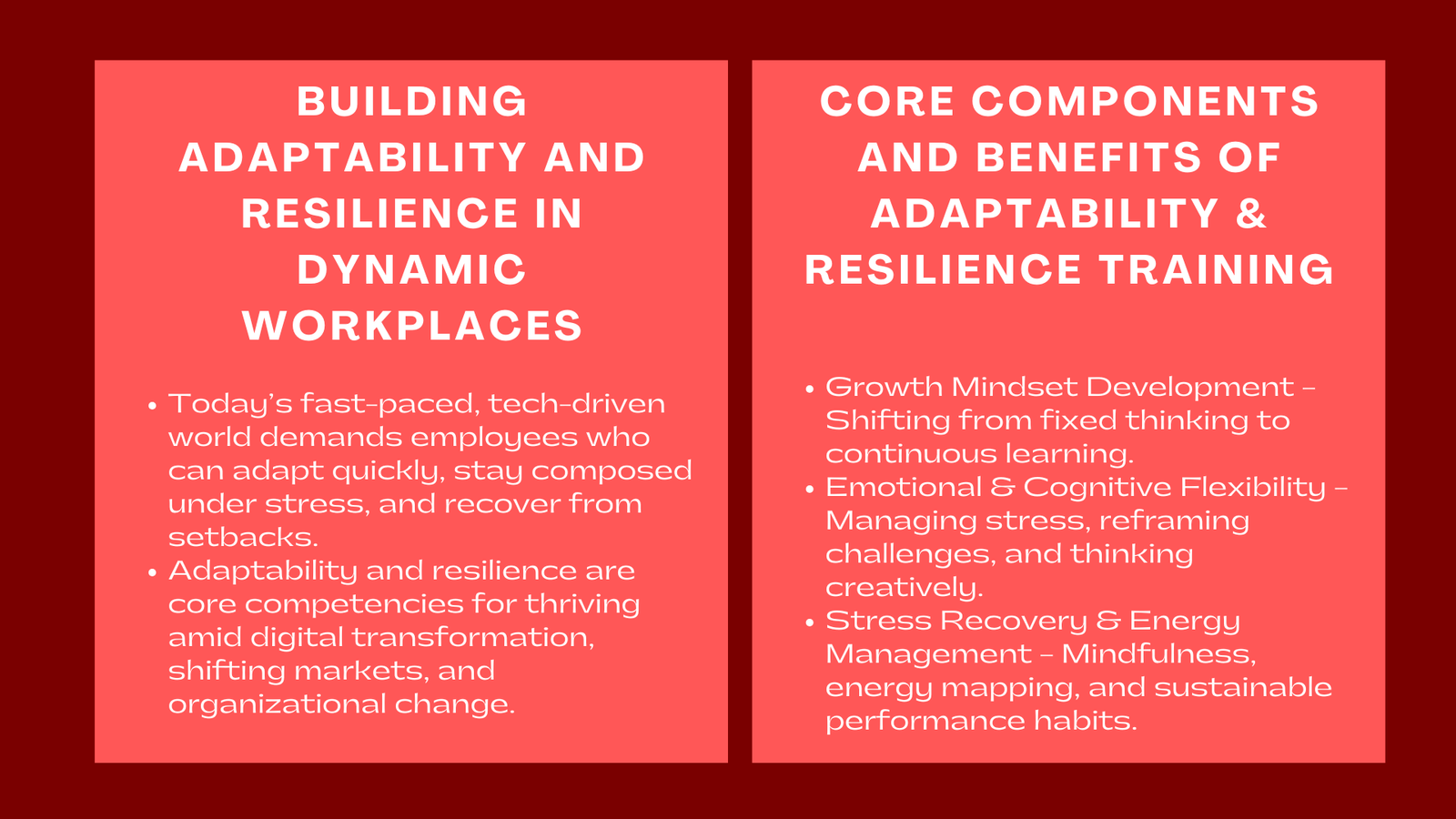
Adaptability and resiliency are now among the professional abilities in a world where we can describe the aspect of technology development as high in nature, interconnected and experiencing constant change of organizations. The ability to adjust within a short time frame, remain composure even when things get stressful, and the ability to recover once failures have occurred is now becoming the signature of personal achievements and positive organizational environment. The companies exist in the realm of constant disruption, be it digital transformation and volatile markets, the shifts in the relationships between the staff workforce, and the employees have to be ready to act counterintuitively and react to change with swiftness and self-confidence. To support these capabilities, organizations often invest in in-house training Singapore soft skills & technical skills customized programs that enhance both individual adaptability and team resilience.
The Adaptability and Resilience Training: Professional Development in Dynamic Workplaces also has the attitudes, behavior-based tools, and emotional theories that the participants can apply in order to survive in the unpredictable environments. Through experiential learning, reflective practices along with simulations, based on scenario, the employees are influenced towards accepting change, developing stress resilience and becoming mindful to help the change. Upon the climax of the program, not only does the-participants have a clue on how to react to change but also how to predict and embrace change as an opportunity to develop and become a leader.
Resilience as a Strategic Advantage
Although adaptive ability is independent, resilience is based on recovery and long term performance. It does not deal with escaping difficulties but stronger coming out of defeat. This section of this program assists the participants in coming to terms with the resilience of resiliency employees who can cope with any adversity they undergo without losing sight or hope. Based on the case studies and reflective dialogs, some of the techniques that employees cover include mental reframing, emotional regulation and goal redefinition.
Another important idea that resilience and leadership are connected to in the program is that emotionally stable and positive professionals can assist in morale and cohesion maintenance in their teams during uncertainty. The participants are taught that one cannot be born with a sense of resoluteness; the process can be achieved by practicing regular self-awareness, reflection and stress management. Development of this skill transforms obstacles to learning experiences, which develops stamina and confidence in the long run.
Core Components of the Adaptability and Resilience Training
Developing a Growth Mindset
The initial fundamental aspect of the training is on changing of mindset. The participants are taught to be able to differentiate between the concept of a fixed mindset, i.e. assuming the abilities are unchangeable, and the concept of growth mindset, i.e. when one takes the challenges as an aspect of learning and changing. With the help of discussions and small activities, the employees investigate how their own beliefs concerning ability and intelligence affect behavior, motivation and the final results of performance.
Through a growth mindset, the participants would start seeing the challenges as temporary and therefore solvable instead of viewing them and being threatened. This change is a source of innovation, investigation, and doggedness. Reflection exercises are also part of training since employees examine the previous experiences, discover the situations when adaptability proved to be helpful, which proves the usefulness of constant learning and adaptation.
Building Emotional and Cognitive Flexibility
Flexible professionals are able to adapt faster since they intellectually think. This part of the training presents the audience to cognitive reframing or seeing things in a variety of ways in order to find an alternative solution. Open-mindedness is practiced by way of the scenario exercises that make participants question their default assumptions and think creatively in finding solutions.
Adaptable reaction of emotions is also highlighted. Workers are taught how to handle feelings when change occurs to them with the understanding of the impact of stress and uncertainty on decision-making. By means of emotional awareness methods, they learn to be calm and adjust the style of communication and collaboration to changing circumstances. This cognitive and emotional flexibility spurred two-fold leads the employees to be ready to react positively to whatever challenge there may be irrespective of how uncertain it is.
Stress Recovery and Energy Management
The concept of resilience is closely connected with physical and emotional energy. During this module, the participants are taught how to control the level of their energy using science-based methods of stress recovery which include controlled breathing, brief mindfulness practice, and goal recalibration. It centres on ensuring that factual clarity, emotional stability, and steady performance are followed in trying to work under conditions that are pressuring.
Best practices are presented, such as micro-breaks, energy mapping, and task rotating, to avoid burnout and engage really long. Participants realize that being resilient does not mean having to work hard all the time but rather consciously, that is, really knowing when it is time to rest, that is, replenish and refocus in order to give every possible performance its best.
Application and Organizational Impact
Simulating Real-World Scenarios and Challenges
The program incorporates real world skills in the form of practical simulations that resemble common disruption in the workplace through simulation like crisis response, quick implementation of new technology or a change in policy. The practice partners learn to use the resilience and adaptability equipment in such situations and gain experience in how to help oneself remain self-positive, make decisions, and lead others through uncertain situations.
These activities facilitate the gap between the learning in a classroom and real life performance so that those involved can use its skills in practice. Feedback is given in the form of real-time by the trainers, pointing out the strengths and aspects to change, thus enhancing behavioral adaptability in mainstream situations.
Building Resilient and Collaborative Teams
There are also specialized sessions through which the managers and the supervisors come together to shape the adaptability at the team level. They are taught new approaches towards creating psychological safety, promoting experimentation, and building the space in which open communication flourishes. Leaders are instilled on how to notice at the early stages those who show signs of resistance or burn out and how to act in an emphatic and guiding manner.
Companies that impart flexibility and robustness through organizational culture have it easier as they have to transition during a merger/restructuring or shift in the market. What comes out is the ability to have a workforce that can maintain high morale and productivity even in unstable conditions which makes the company best positioned to succeed competitively in the long-term.
Integrating Technology and Continuous Learning
Harnessing Digital Platforms for Growth
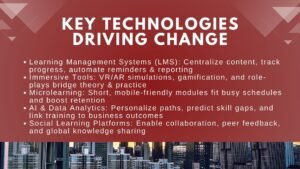
Digital tools are now an extremely crucial facilitator of flexibility in the world where technology is changing at a faster rate than conventional forms of learning. This module will expose the participants to online learning portals, performance dashboard, and analytics platforms that would enable them to monitor their progress, personal adaptability objectives, as well as learning opportunities in real time.
Staff members are introduced to the process of integrating technology into their working process, where collaboration tools, as well as artificial intelligence-based insights, are used to keep staff informed and dynamic. This makes sure that leniency is not handled as a single competence but as an ability constantly enhanced after the changes in technology.
Promoting Lifelong Learning and Future-Readiness
In addition to digital items, the program establishes the culture of improvement. The participants are also advised to perceive flexibility as a life long process and not a stop-gap measure. Online modules and peer forums, mentorship programs help in continuing the learning past the workshop and help with the continued reflection and development.
Through integrating humanity with technological dexterity, individuals will be future prepared players capable of surviving in the swiftly and dynamically changing technology driven economies. They embrace change, capitalize on innovation and constantly upgrade themselves in an attempt to remain relevant and effective.
Benefits of Adaptability and Resilience Training
Enhancing Individual Agility and Confidence
After this training, employees are seen to enhance their engagement, self confidence, and ability to withstand stress. They are change agents, they take new challenges with interest and creativity solutions to new challenges when there is pressure. Such agility promotes not only individual career development but also the work of teams since the employees emulate constructive and flexible behavior to others.
Strengthening Organizational Competitiveness
In the case of organizations, promoting flexibility is associated with promoting operational flexibility and expediency when adapting to change. Actors work together in more efficient teams, there are less problems with transitions, and innovation is integrated into the company. The resilient culture will minimize turnover, boost morale and enable employees to make the change with a little bit of shocks. What is produced is a business, which does not just survive the change, but makes it a sounding-board of progress.
Conclusion to Adaptability and Resilience Training Professional Development for Dynamic Workplaces
Corporate professional development programs for building resilience and adaptability develops the attitude and ability needed to work sustainably in the present-day dynamic work places. It will enable the employees to stay firm amidst the uncertainty, shift challenges into opportunities and motivate others with power, calmness and hope.
In a world where change is inevitable, being flexible and resilient is no longer the choice, but it is an indispensable survival/success skill. When invested in, such competencies allow organizations to develop a workforce that is responsive, as well as, future-ready, i.e., able to respond in the face of disruption, clearly, creatively, and confidently.