
Benefits of Customized In-House Training on Employee Productivity
Benefits of Customized In-House Training on Employee Productivity
Learn Benefits of Customized In-House Training on Employee Productivity
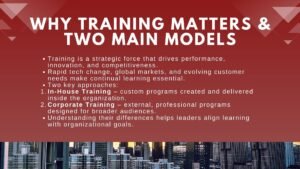
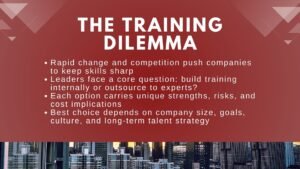
The current world that organizations find themselves operating in is that of a world that is rapidly evolving in terms of technology, global competition and changing customer expectations. Within such a setting, the performance of employees no longer concerns technical skills but flexibility, creativity and team spirit. The core component of this change is training that prepares employees with skills and mindset that make them successful. Whereas most companies have been using external training programs, in-house training has become a growing trend as a more strategic and personal training.
In-house training, such as the best in-house training programmes in Singapore Riverstone, can enhance performance, but also a long-term growth and a resilient organization when tailored to meet the requirements of the organization, and team dynamics. This highlights the importance of in-house training for Singapore businesses, especially when designed as tailored in-house training Singapore for employee development.
The Strategic Importance of Employee Performance
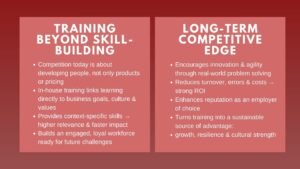
Organizational success is frequently said to be pegged on employee performance. Employees who perform well are not just bringing with them their own productivity but also enhance the performance of their departments and teams. Performance can be a major point of distinction in industries where customer experience, operational efficiency and innovation are paramount. Training is not luxury then, but an investment in the competitive advantage of the company. Old fashioned, off the shelf training is sometimes inadequate in dealing with certain organizational issues or industry gimmicks. This is where the issue of customized in-house training comes in where learning is directly defined with the goals, processes and culture of the company.
Customization: The Core Advantage of In-House Training
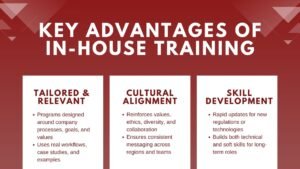
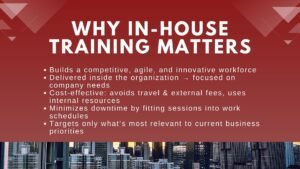
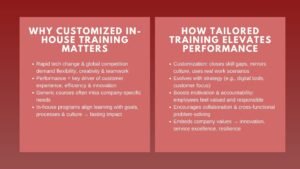
The flexibility of in-house training is what makes it especially efficient. In-house training, unlike standardized training modules that are provided outside the company, can be customized to the exact needs of employees and the company at large. The content used in the training may fill urgent skills gaps, mirror the culture of the organization and bring real-life situations as directly as the employees deal with in their daily work. This also makes training not abstract but at once relevant and applicable.
Training is also customized which enables training to develop with the organization. As an example, when a business is moving toward digital change, internal education can be aimed at digital literacy, new software, or agile project management. On the same note, should a business desire to enhance its customer-focused strategy, training may embrace role play activities and case studies that are directly related to the customer base of the company. This fitting design will provide the environment in which employees will feel that the training was designed specifically around them and this will increase engagement, knowledge retention and, eventually, performance.
Enhancing Motivation and Accountability Through Tailored Learning
The effects of training on employee motivation is one of the most ignored issues of training. In case the employees attend external courses, they tend to view such courses as generic and not related to their actual job. In-house training that is customized, however, does reflect an investment of time and resource by the organization in building something that recognizes their unique roles and challenges. Such a sense of recognition improves employee motivation and results in increased commitment during and after the training sessions.
Further, accountability is promoted by in-house training. Since training is synchronized to the organizational objectives, managers and leaders are in a position to effectively monitor performance improvements. Employees know that they are not just in the process of fulfilling the training quotas but also in a process of enhancing the growth of the organization. This two-pronged approach to motivation and responsibility gives rise to a motivation-accountability cycle, in which employees feel both empowered and accountable and this translates into actual performance gains across departments.
The Role of Collaboration and Culture in Driving Results
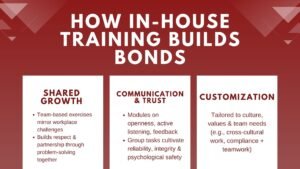
Performance of employees cannot exist on its own, it is influenced by the environment of the team and organizational culture in general. In-house training provides the platform in which the employees not only get to learn skills but also the ability to communicate, work and solve issues together. Activities and role-specific simulations in groups also assist in silo breaking, reinforcing cross-functional relationships, and fostering interaction of ideas.
In addition to teamwork, organizational culture is strengthened through in-house training. The values, mission, and vision of the company are also exposed to the employees in a deliberate manner. As an example, when innovation is one of the values, brainstorming exercises or design-thinking workshops may be incorporated in training modules. When customer service excellence is in focus, the employees can be trained about the situation that describes how the company interacts with customers in reality. This reinforcing culture makes the performance improvements sustainable and in tandem with long term strategic objectives.
Measuring the Impact of Customized In-House Training
There can be no training program that is complete without assessment and tailor-made in-house training has apparent measurement prospects. Since there are performance goals that the programs are designed on, organizations are able to monitor results in a better way. The common KPIs that are useful to determine training effectiveness include the rate of productivity, score of customer satisfaction, or even delivery time of projects.
In addition to quantitative measures, qualitative feedback provided by employees also speaks of the importance of training. When employees are prepared to take on the pertinent skills, they tend to be more satisfied with their job and reduce turnover intentions. These results over time build a positive feedback loop in which improved performance leads to business growth and that business growth enables further investment in people.
Conclusion: Building a High-Performance Future Through In-House Training
Enhanced HR training Customized in-house training is not merely an HR move, but is a performance and organizational strength driver. Organizations can achieve maximum potential of their workforce by customizing the learning experiences to meet individual needs, encouraging teamwork and training aligned with the cultural value. In an ever-changing international economy where talent and innovation are the key determinants to success, any firm that welcomes in-house training will not only enhance individual performance, but also ensure long term growth and flexibility. The future of performance enhancement is not generic but rather customized, strategic training programs, which are developed internally.