How In-House Training Creates a Competitive Advantage
How In-House Training Creates a Competitive Advantage
Learn How In-House Training Creates a Competitive Advantage
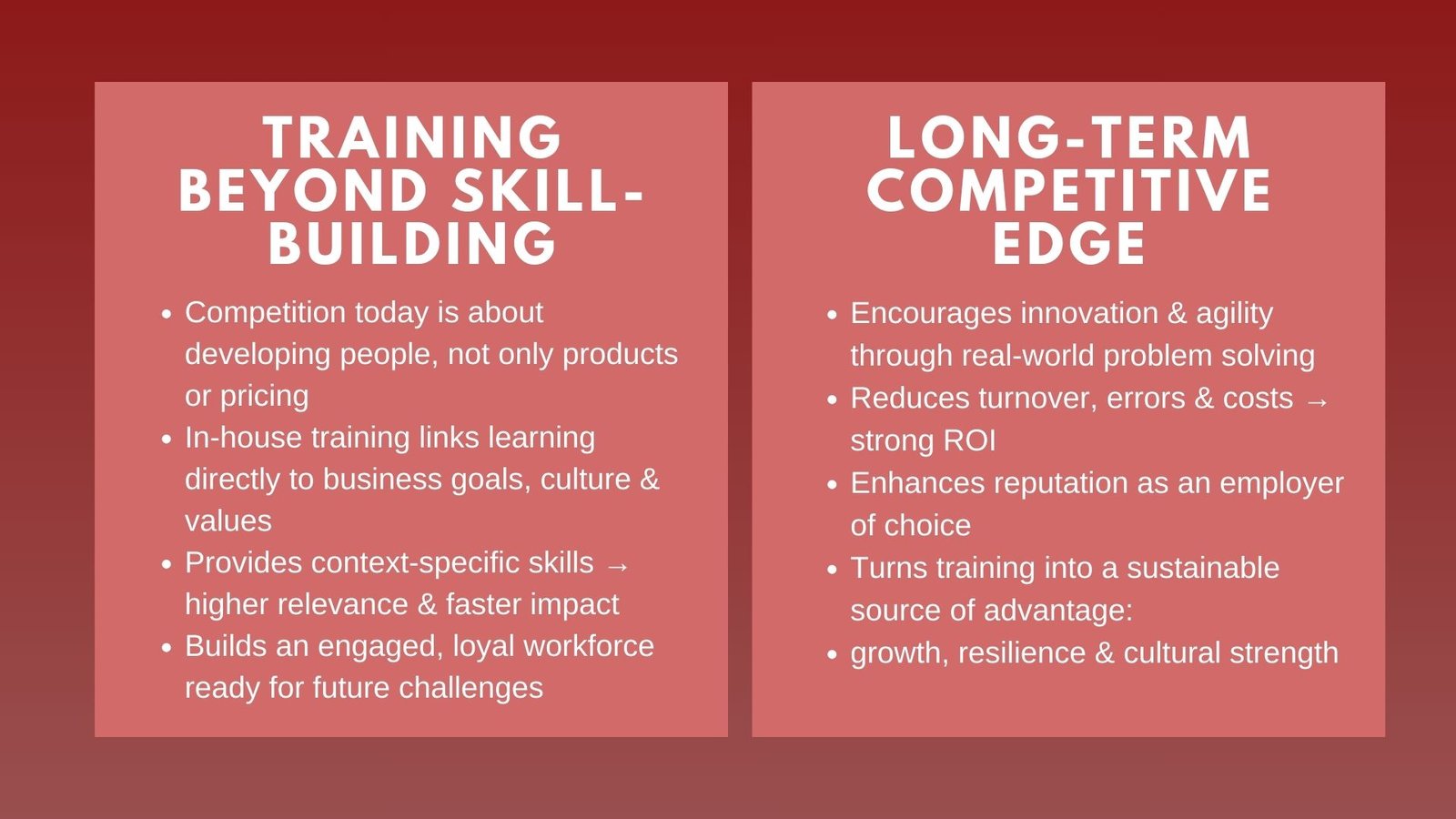
The competition in the modern business world is not confined to products, services and pricing policies. It is further becoming linked to the effectiveness with which organizations are developing their people. The employee is not only an operating source anymore, but creative, intellectual, and strategic capital to obtain long-term success. With the high rate of technological change, globalization and changing customer expectations, agility, adaptability and innovation should be given prior concern by companies. A good internal learning culture, which is developed and maintained through in-house training is one of the most effective methods to do so.
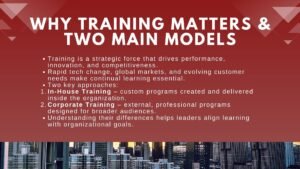
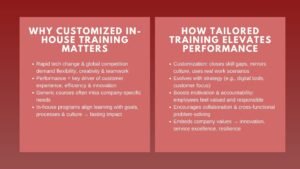
In-house training is a method of training, as opposed to external workshops or outsourced learning programs, that can be geared towards the objectives, values and challenges of a particular business. It does not produce generic skill-building but instills the knowledge in the specific context of the organization in its operations and cultural context. This direct applicability increases the training effectiveness and in the long-term, it can be a competitive advantage. This ensures that employees are not only able to maintain performance, but also develop a workforce that is engaged, loyal and able to face future challenges by aligning employee development with business strategy.
Understanding the Strategic Value of In-House Training
The old fashioned view of training is usually confined to skill development or conformity measures. This is necessary but is just the tip of the iceberg of what can be provided by in-house training. Competitive advantage can be created through in-house training that is tactically designed to increase organizational efficiency, align staff members to organizational objectives and foster innovation.
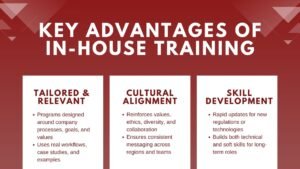
In-house training is more realistic because unlike external training programs, the former lacks context. To illustrate, a retail organization can educate the staff about particular customer-facing techniques applicable to its clients, whereas a technology organization can concentrate on in-house systems or tools that cannot be trained via third-party software. This accuracy has helped in making sure that the employee is acquiring the skills that are directly relating to the improvement of the business and not some type of an abstract idea that may or may not be relevant to the job.
Flexibility is also the value in in-house training. The programs can be changed within a short period of time based on the change in market conditions, regulatory needs, or organization priorities. This flexibility helps keep the companies at par since they constantly prepare their work force with the latest knowledge and skills. This in the long run produces an organization which is not only well trained, but also resilient and future oriented.
In-House Training and Workforce Engagement
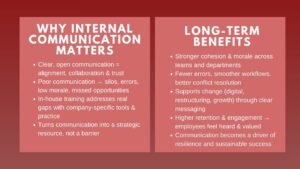
A highly engaged workforce is one of the distinguishing features of the organizations that consistently perform better than their rivals. Engagement is not just employee satisfaction but commitment, motivation and willingness to go the extra mile to ensure that the company succeeds. The importance of in-house training lies at the heart of the engagement process since it shows that the organization cares about the professional development of its employees.
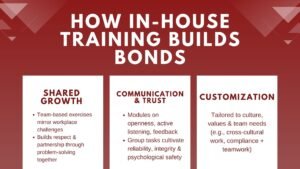
Employees would feel more appreciated and related to the mission of their company when they receive opportunities to learn and develop in the environment of their work. In-house training programs tend to establish collaborative learning situations where the colleagues have an opportunity to share ideas, resolve problems, and establish better relationships. This does not only enhance teamwork and communication but also a sense of belonging.
Moreover, in-house training can be modeled to meet career developmental directions. Using the case of leadership development, employees might feel that they have a direct correlation between the accomplishment of a leadership development module and their engagement in a management position. Such openness improves loyalty and minimizes turnover that in turn improves the competitive position of the company in terms of preserving institutional knowledge and limiting the recruitment process expenses.
Building Innovation and Agility Through Learning
In such a disrupted, constantly changing, marketplace, one requires innovation and the ability to move with agility to survive. It is not just that companies react to industry changes but it is also imperative that they anticipate them. The in-house training emphasizes creating a good platform to promote innovations as employees are able to think, generate new ideas and question the current operations.
Since in-house training can incorporate the real company challenges in the course, the workers can apply theoretical knowledge on actual problems. Such a strategy will turn training sessions into innovation incubators, in which workers will be able to suggest and experiment with solutions in a safe and conducive setting. The resultant effect is the culture of encouraging but of systematic development of creativity.
Another factor that agility relies on is the rate at which a company is able to revise skills with regard to the event of change. The training in-house also enables quick acquisition of new knowledge whether this is the adaptation to new emerging technologies, new regulations, or the realignment of strategies in line with the market changes. Increasing the speed of the transfer of information between the realization of the need and the training process results in a critical advantage over the competitors using slower and more cumbersome external training programs.
Leadership Development and Succession Planning
Without good leadership there is no way sustainable competitive advantage will be attained. However, one cannot be a leader; he or she has to be a developed one. The in-house training gives the organization the capability to facilitate leadership course for managers Singapore programs that represent the organization culture, values, and strategic vision. In contrast to generic leadership courses, the programs have the capability to respond to the specific skills that future leaders in the organization will be in need of.
The importance of in-house training for leadership skills has become inevitable in areas such as succession planning. Organizations create successors by recognizing the high potential employees and training them on specific skills, thus continuity and stability in leadership. This minimizes the risks involved in change-over of leadership, including loss of direction or loss of morale. Furthermore, the workers who are placed on a definite leadership development trajectory are likely to stay longer with the firm knowing that their long term development is assured.
In-house training that emphasises leadership has the added advantage of strengthening decision-making throughout the organization. Other areas of training that can be used to the benefit of even the non formal employees include communication, conflict resolution and strategic thinking. This expands the pool of decision-makers and allows teams to work more autonomously and efficiently and increase organizational agility. For this reason, tailored leadership training in-house Singapore companies find it an invaluable investment.
Long-Term Business Advantages of In-House Training
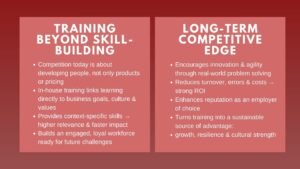
Immediate advantages of in house training such as enhanced skills, improved communication and increased involvement are quite considerable but the long term benefits are even more convincing. The net result is that over a long-term, organizations investing in in-house training will have a workforce that is not only skilled but also very much aligned with the mission and strategy of the company. This congruence translates into competitive advantage that cannot be easily duplicated by the competitors.
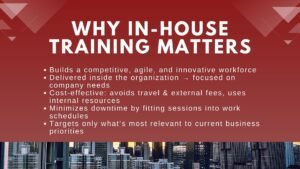
It can also be financially more cost effective in the long run, in-house training. Although the initial cost of development of training material and programs might prove to be high, the fact that they can reuse and change the materials so that they suit different cohorts is a permanent asset. Also, employee turnover, errors and inefficiencies are minimized hence a good return on investment.
There is another long-term benefit, and it is reputational. Organizations that are reputed to invest in employee growth become more appealing to the best talents. In a competitive labour market, this reputation can be a key point when it comes to attracting highly skilled professionals who are not only after a paycheck but also opportunities to grow, and develop. When such professionals enter and remain in the firm, the circle of competitive advantage is strengthened.
Conclusion: From Training to Strategic Advantage
In-house training is much more than that of employee development. It is one of the pillars of competitive advantage when created and enacted in a strategic manner. Individualization of training to organizational requirements, employee engagement, development of innovation and agility, and developing future leaders help companies to develop a strong foundation that can be used in the long term to be successful.
The organizations that will flourish in the next few decades are those organizations that will not consider training as an extra cost but an investment. Training in-house means that knowledge, skills and culture are nurtured within the company, forming a committed and aligned workforce, which is not only competent but also committed and aligned. This combination of learning and strategy will turn in-house training into an engine of growth, innovation, and competitive power.
When the world is dynamic and competitive, in-house training is one of the ways that the companies have a long-term competitive edge that is not easily imitated. It empowers employees, solidifies culture and it places organizations in a position to not only survive disruption but also dominate disruption.