How In-House Training Improves Internal Communication in Companies
How In-House Training Improves Internal Communication in Companies
Learn How In-House Training Improves Internal Communication in Companies
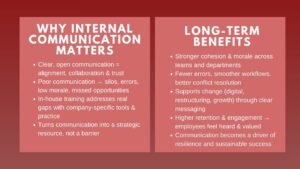
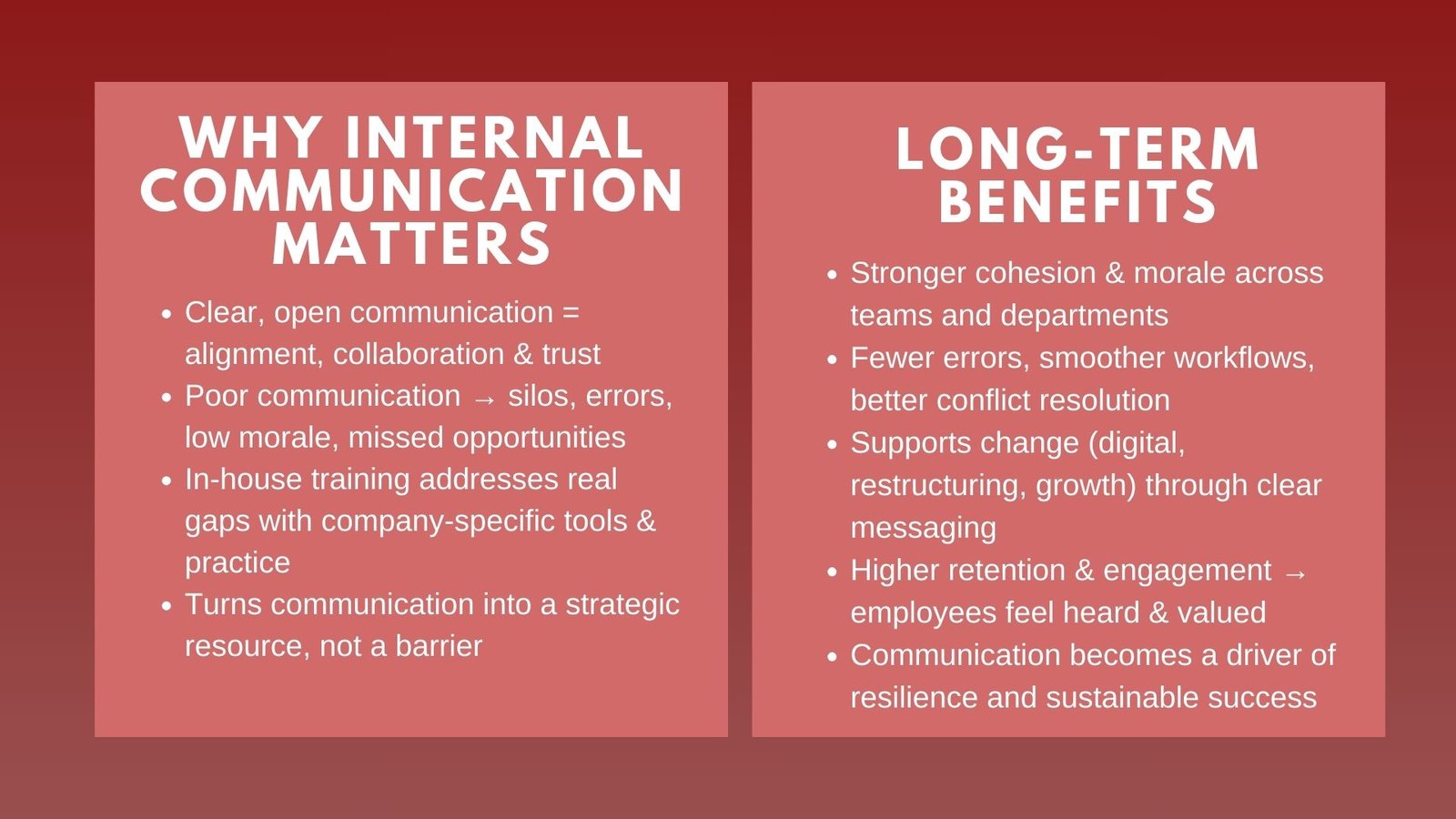
Internal communication is the lifeblood in any organization that succeeds as it makes sure that employees are aligned, collaborate and trust each other. Effective communication will get teams working as a team and facilitate a reduction of misunderstandings, get an organizational culture in which ideas and concerns are openly shared across the board levels of the business. However, regardless of its significance, internal communication is a problem most organizations have difficulty addressing including the siloed departments and lack of clarity in instructions and information overload. Such difficulties tend to lead to inefficiency, low morale and growth opportunities.
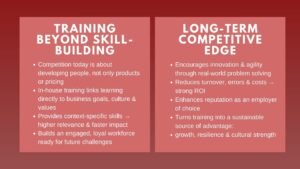
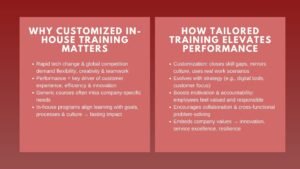
One of the best solutions that have turned out to deal with these challenges has been in-house training. In-house training is however tailored to the needs and culture of a firm unlike the external training programs which may offer generic advice. In-house training helps improve the efficiency of a work place by equipping employees with the tools, techniques and practice of effective communication thus building interpersonal relationships among teams. The outcome is a better integrated, open, and strong organization in which communication has become a strategic resource and not a hurdle. Many firms are now adopting customized leadership training for Singapore organizations to ensure communication skills and leadership styles are aligned with local business needs.
Understanding the Communication Gap in Organizations
The problem of internal communication can take up various forms as it can be as straightforward as misunderstanding of the instructions or complex as interdepartmental conflicts or lack of interest towards leadership. Information that flows through multiple levels of hierarchy may become diluted or distorted in big organizations, whereas in smaller organizations, the converse problem may occur, namely, the lack of structures of communication, which results in the lack of clarity. In both of the mentioned cases, lack of communication affects performance, morale of the employee and customer satisfaction.
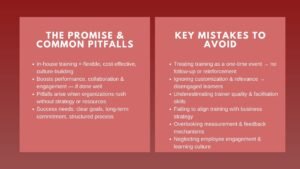
The primary cause of communication gaps that continues to exist is that most organizations believe that employees have effective communication skills in place. It needs, however, good and effective communication that is practiced and structured. Employees can be very knowledgeable in their areas of expertise but can fail to communicate, work effectively with different departments or constructively handle conflict. These gaps continued to expand without a focused intervention, resulting in siloed operations, mistrust and inefficiency.
Herein lies the need to have in-house training that is indispensable. In-house programs also provide employees with the skills and strategies required to bridge these gap by connecting the issue of communication directly and as applicable to the specific environment that the company operates. More to the point, they give them a common platform to practice communication as a team to make sure that the lessons acquired become organizational-wide.
In-House Training as a Catalyst for Better Communication
In-house training offers a controlled yet malleable atmosphere in order to enhance communication at all the levels of the business. Given that the training is modeled and implemented internally, it indicates a reality of the challenges and incorporates pertinent examples which the employees can relate to. This makes the process of learning more interesting and instantly relevant.
As an example, role-playing exercises, simulating real scenarios in the workplace, e.g. cross-departmental cooperation, project reporting, or conflict management, may be included in in-house workshops. These activities will make employees focus on active listening and speaking clearly and changing their communication style to suit the different listeners. The significance of non-verbal communication, cultural awareness, and the etiquette of digital communication can be also emphasized during training sessions in a world where virtual teams are becoming more and more widespread.
Through this learning, the employees will become aware of what constitutes successful communication in their particular organizational environment. They do not only develop personal skills, but they also develop a group determination to enhance communication practices within the board. This shared learning creates a level of consistency and the message is conveyed and uniformly transmitted between teams and departments.
Enhancing Leadership and Employee Dialogue
The relationship between both the leadership and employees is one of the most imperative areas of internal communication. Leaders lead the way in communication but unless they are consciously trained, a very well intended leader will find themselves establishing barriers. As an example, the managers can be very strict with instructions and fail to provide their employees with a chance to share feedback and feel used or uninterested. Instead, workers might not be able to raise issues or ideas because they are afraid of being judged or punished.
In-house training equalizes this imbalance by providing leaders and employees with the means of encouraging open dialogue. Modules that concentrate on leadership usually focus on transparency, empathy and active listening, so that managers can be able to convey messages in a manner that evokes trust and interest. On one hand, workers are educated to express their needs and concerns in a positive way so that their voices are used in making decisions. This is why many organizations choose leadership development programs inhouse Singapore as part of their strategy to improve communication effectiveness.
This bi-directional communication is essential to organizational well-being. Employees will feel listened to and respected when communication lines are open, and this enhances productivity and morale. In their turn, leaders can acquire more knowledge about the challenges of operations and the views of the employees and make more informed decisions. The gap between leadership and employees that in-house training fills is what turns the communication process into a collaborative process instead of a hierarchical process, which makes tailored in-house training options for businesses Singapore a critical component of sustainable growth.
Building a Culture of Transparency and Collaboration
Other than personal talent, in house training is important in helping to develop organizational culture. The internal communication can truly work well in the settings where transparency and collaboration are trusted, yet they will need conscious focus. These values can be inculcated in normal operations in-house training as it gives employees a continuity to apply them.
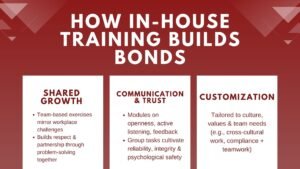
One illustration is when training activities are organized in teams, where employees can express themselves freely, give constructive feedback and work to achieve shared aims. With time, they develop into the culture and more transparent workflow and stronger team dynamics take place. Training may also be made to highlight the importance of honesty and accountability in communication in order to minimize chances of misunderstanding or mistrust.
In the business world today, which has become very fast-paced, collaboration does not necessarily take the form of a team but can be an outward looking cross-functional or international team. Internal training will make sure that the employees are skilled in how to handle these complicated interactions. Training is a way of promoting inclusivity and adaptability, which in turn make organizations develop a culture of communication that is not only transparent but also resilient in responding to change.
Long-Term Benefits of Communication-Focused In-House Training
The effect of in-house training on internal communication is far far-reaching than the direct benefits in clarifying and collaborating. In the long-term, organisations gain a better feeling of cohesion, increased engagement and better resolution of problems. Communication helps teams to deal with conflicts, deal with emerging challenges, and seek out innovative solutions.
Efficiency of operation also increases as a result of better communication. Clarity causes minimal errors and unnecessary repetition, whereas an open conversation prevents possible problems before they get out of hand. In organizations that are going through a period of change, e.g. going digital, restructuring or growing large, good internal communication is the difference between adapting successfully and disruption of the organization.
The other long-term benefit is employee retention. Employees would be retained and will be more engaged in the organization when they feel that they can communicate and that their contribution matters. This lowers the turnover and gives a more stable and experienced workforce. Moreover, effective communication leads to the building of trust in relation to the external, starting with clients and ending with partners, the company strengthens its reputation and competitive advantage.
Conclusion: Communication Strengthened from Within
Internal communication is something that is too important to be left to chance. Failure of communication may spoil projects, relationships and undermine performance in the organization whereas effective communication may enhance trust, cooperation and resilience. In-house training is resourceful, tailors and effective way of enhancing communication at any time anywhere at the organizational setting.
In-house training would not only develop communication skills, but also engrain them within the organizational structure by customizing the content based on the company-specific issues and nurturing a shared learning experience. It fills the gaps between management and the workers, establishes transparency, and the culture where teamwork is successful.
Over the long term, organizations that invest in communication-oriented in-house training will be in a more favorable position to compete in the volatile markets, change and maintain top talent. In-house training makes internal communication no longer a possible impediment but a strong force of growth and integrating capability, as a result, organizations are able to attain not only short term objectives but also long term sustainability