
How to Avoid Mistakes in Customized In-House Training Programs
How to Avoid Mistakes in Customized In-House Training Programs
Learn How to Avoid Mistakes in Customized In-House Training Programs
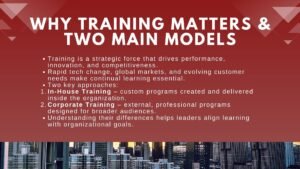
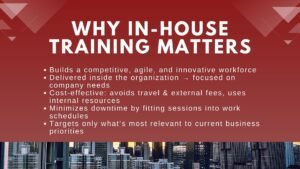
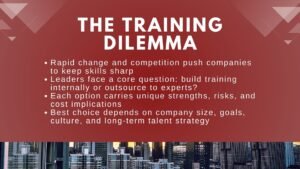
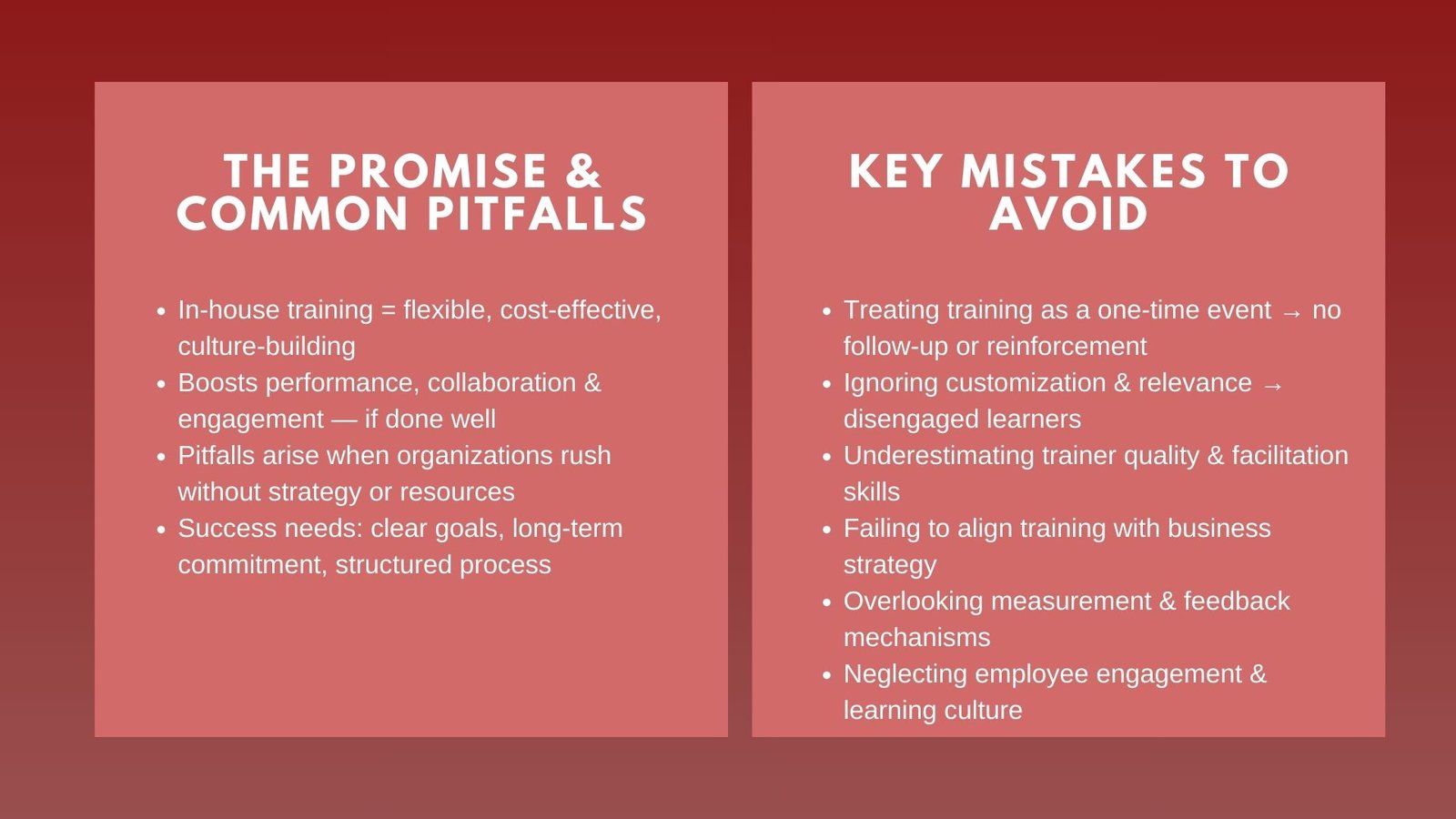
In-house training has become an indispensable factor in an organization that intends to instill the relevant skills on its workforce and remain in tune with the business goals. In-house training has flexibility, cost-effectiveness, and the option to use the content to suit the needs of the organization unlike generic external programs. Properly done, it improves performance, builds culture and enhances collaboration. This highlights the importance of in-house training for businesses Singapore that want to grow sustainably. Nevertheless, it is the same flexibility which makes in-house training so potent which can have serious pitfalls when not handled appropriately.
Most of the enterprises are in a hurry to develop training programs without having the full picture of what is needed in terms of strategic planning, resources and long-term commitment. To optimize the payback of investment and make sure that the training activities lead to the meaningful performance results, it is vital to be aware of and prevent the most widespread errors that organizations commit in the process of in-house training. Leveraging the power of best in-house training programs Singapore ensures that organizations avoid wasted resources and gain maximum impact. By adopting customized in-house training solutions for Singapore organizations, companies can design learning experiences that are practical, goal-driven, and aligned with their specific challenges.
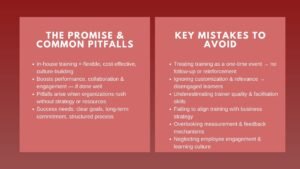
Mistake One: Treating Training as a One-Time Event
The common mistake that is committed when offering in-house training is the fact that it is not treated as a continuous process instead of a one-time event. Most organizations develop workshops or seminars and they anticipate immediate change without looking at the aspect of reinforcement, follow up and constant development. This short term strategy frequently causes employees to forget most of the things they had learnt in few weeks, and hence having little influence in performance.
A proper in-house training must be incorporated in the long-term learning strategy of the organization. It is supposed to look more of a journey, rather than a one-time event and it should change continuously in line with the changing objectives of the company, as well as, the needs of the employees. On-the-job coaching, follow up sessions, and digital learning resources will help make sure that knowledge retention and application proceed long after the initial session. Those organizations that are unable to adopt this spirit of continuous learning are likely to use time and resources to train employees who forget the lessons too soon.
Mistake Two: Ignoring Customization and Relevance
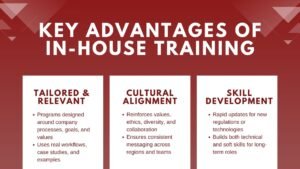
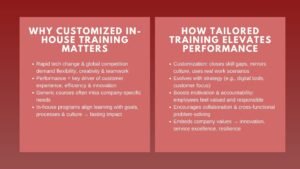
The other mistake that is mostly made is to take a one size fits all approach. Although the external training providers may offer generic programs, the leverage of the in-house training can be found in the fact that the training can be customized. However, not all organizations invest in training customization to their own needs, rather they reuse general modules that are not relevant to the specific job of the employees. The consequence of this is disengagement where the employees fail to recognize how the training is relevant to their day to day duties.
Individualization extends past modifying some examples in the curriculum. It involves matching the training goals to the business objectives, application of real world case studies within the organization and tailoring the content to the skills and challenges of the workforce. Failure to do this nullifies the usefulness of in-house training because the employees can leave the training place with theoretical knowledge that may be hard to put into practice. The key to the success of any training initiative should always be relevance in case one is aiming at enhancing performance.
Mistake Three: Underestimating Trainer Quality and Facilitation Skills
A well-designed training program might fail, even when the trainer is not able to engage the participants. Other organizations can make the wrong decision of entrusting subject-matter experts to undertake training without regard to whether they have the right facilitation and teaching skills. Although knowledge is indispensable, the skills to present ideas clearly, handle people and facilitate discussion are, also, vital.
The in-house trainers, who use lectures as the only mode of presentation, find it hard to capture attention thus resulting in passive learning. Conversely, good facilitators make the sessions interactive, promote inquiries, and modify materials on-the-fly according to the needs of the participants. Organisations who pay little attention to the quality of trainers are likely to see their training sessions turn dull and useless, having minimal effect on the behaviours and skills of employees. Preventing this error by investing in development of the trainers, be it in the form of coaching, train-the-trainer, or engaging professional trainers will go a long way in helping improve the outcome of the training.
Mistake Four: Failing to Align Training with Business Strategy
Among the best things with in-house training is that it may be directly related to organizational strategy. It is unfortunate that most firms fail to take advantage of this because they only apply training without considering the bigger business goals. The disconnect comes about where HR or learning teams come up with programs without the input of the leadership or without the alignment with the key performance indicators.
Unless training is related to strategic objectives, the effects of training become hard to quantify, and it is hard to prove the value of the investment. To say the least, in case a company has to undergo the digital transformation, then training employees in general leadership skills might not provide the expected outcome.
As an alternative, the programs must be tailored to cover those skill areas that require one to achieve success like data analytics, agile project management or digital collaboration tools. Training strategy-building makes sure that employees are learning and not merely learning, but learning in the manner that leads to organizational competitive advantage. When this alignment is not taken into consideration, it makes the training irrelevant and less valuable in perception.
Mistake Five: Overlooking Measurement and Feedback Mechanisms
Many organizations invest much in the preparation and provision of in-house training and do not bother to measure its effectiveness. The absence of the evaluation techniques will ensure that we cannot understand whether the program actually enhanced employee performance or business results. This error generates an area of blindness in which training proceeds without responsibility or evidence of achievement.
Participant satisfaction surveys are not the only aspects of measurement that should be done since only the surface impressions are taken into consideration. Rather, organizations ought to monitor the performance, productivity and other essential measures related to the training objectives. Post-training tests, peer reviews, and manager’s feedback are a good source of information on the extent to which training is converted into practice. On-going feedback is also used to streamline and enhance training programs in the long run. In absence of such systems, the in-house training becomes a costly undertaking with an undefined outcome.
Mistake Six: Neglecting Employee Engagement and Learning Culture
The last yet very important error is to expect that the employees will automatically accept training. Even the well-considered programs may fail in case the participants are not engaged or they are seeing training as something irrelevant or stressful. Organizations that fail to create a culture of learning usually face resistance, and the employees will perceive training as a work disruption instead of a growth opportunity.
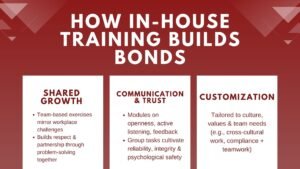
In order to prevent this, companies should pay special attention to establishing a conducive environment in which learning is stimulated, noticed, and rewarded. These are involving employees in the planning process, explaining the importance of the training to them and connecting it with opportunities in terms of career development. The employees would be more motivated to get involved in the training when they have the sense that on top of contributing to the organization, it is also helping them in their development. The lack of engagement will not only underpin the effectiveness of the training process, but it will also weaken the culture of continuous improvement as a whole.
Conclusion: Building Success Through Thoughtful Implementation
The in-house training has massive possibilities to increase the workload of the employees, create the team spirit, and promote the development of the organization. Nonetheless, its effectiveness can be successful only when it is not subjected to the pitfalls that sabotage its efficacy. The process of training should be seen as a lifelong process, customization, investing in competent facilitators, alignment with strategy, measurement of impact, and engagement are all essential parts of training as a process to achieve material outcomes.
Even organizations which treat in-house training as a serious matter can turn it into an effective means of success over the long term. Through the experience of the pitfalls to which other businesses have fallen, they can develop training programs that not only develop skills, but also enhance culture, motivation and provide tangible value. In a competitive world where talent and dynamism are the key success factors, these errors may spell the difference between resource wastage and growth.