How to Strengthen Team Bonds Through In-House Training
How to Strengthen Team Bonds Through In-House Training
Introduction on How to Strengthen Team Bonds Through In-House Training
In the contemporary business world where teamwork and flexibility is the key to success, companies are gradually realizing that effective teams are the pillars of a long-term growth. Technical skills are crucial, but it is also very important to work as a unit, communicate and have trust in each other. In-house training has become one of the best methods to develop these attributes and impart to the employees common learning experiences that not only enhance skills but also help to strengthen family ties among the team members. Businesses can design a culture-reflective training process that involves values, goals, and culture and thus, professional development and cohesion of the team can work together.
Why Team Cohesion Matters to Organizational Success
Powerful teams are not merely teams of people who have been brought to work together; they are networks of trust, accountability to each other and purpose. When the employees work in unity, there is an increase in productivity, innovation and enhancement of satisfaction in the workplace. Cohesion minimizes conflicts, and promotes problem-solving and alignment of employees to organizational goals.
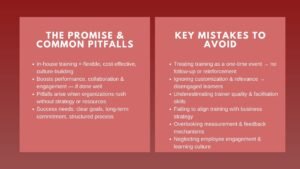
Organizations run the risk of being bifurcated in terms of communication, inefficiencies and disengagement without a conscious effort towards team building. The teams can work in their personal worlds where individuals are more concerned with themselves than group objectives. In this respect, in-house training can be a strong intervention which should be aimed not only to improve technical competence but also to strengthen the behaviors and attitudes which form the basis of effective teamwork.
Through offering employees chances to learn through structured activities collectively, organizations promote the idea of collaboration, empathy, and respect which cannot be developed when training is based on individual principles. That is why the best in-house training programs in Singapore Riverstone highlight not just technical learning but also collaborative skills. By leveraging the power of best in-house training in Singapore, companies can align employee growth with shared goals. Furthermore, adopting custom in-house training solutions Singapore businesses can ensure that programs fit unique workplace needs while reinforcing unity and sustainable success.
In-House Training as a Platform for Shared Growth
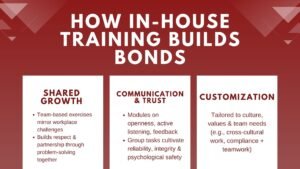
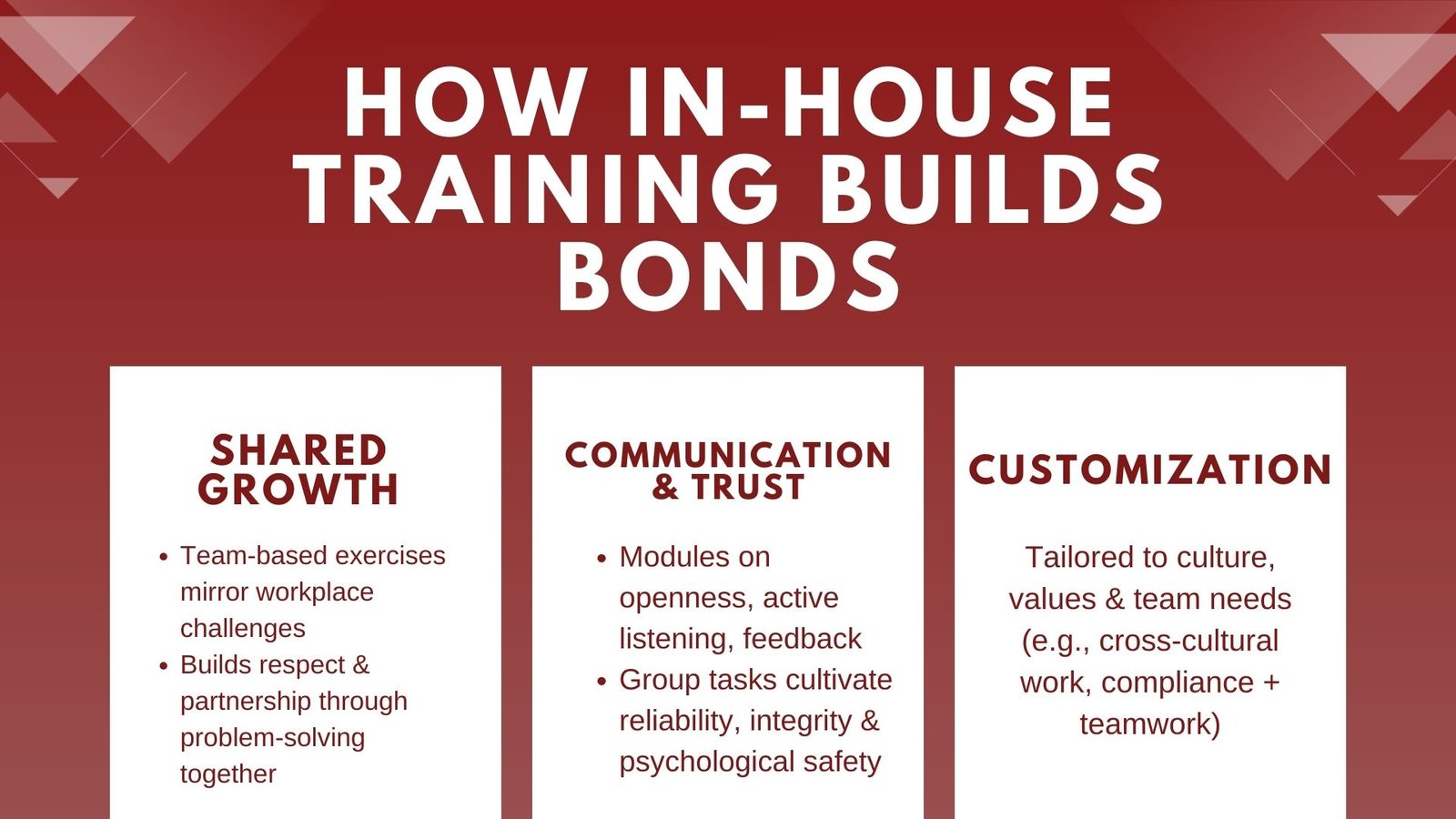
In-house training provides a special environment where employees get to learn together in an environment that is familiar to them. In contrast to external training programs, which are usually concentrated on individual knowledge transfer, in-house programs are concentrated on the collective learning that reflects actual dynamics in the workplace. Training sessions can be modelled to provide real life like challenges that the teams have to endure and this may require the team to work together, plan and solve common problems.
As an example, project management workshops may include the exercises that recreate the interaction between the departments, emphasizing the role of communication and trust. Likewise, innovation training may involve brainstorming in which group members are encouraged to think in different directions and be creative. Such common experiences create a stronger interpersonal relationship and enable the employees to view each other as partners, as opposed to as a mere colleague.
Team bonding is also supported by the setting itself. Since in-house training is done in the environment of the organization, the staff will have a more sense that they own the process. The lessons can be easily related to their jobs and used in current projects and this increases relevance and interest. With such experiences, over time, there is the development of a culture where teamwork is not only promoted but integrated in the day-to-day activities.
Enhancing Communication and Trust Through Tailored Programs
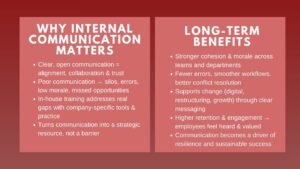
Poor communication is one of the biggest obstacles towards successful team work. The misunderstandings, unclear explanation, or reluctance to share ideas may provoke working flows, and cause tension among the staff. This can be overcome through in-house training which should include modules that emphasize on openness, active listening, and constructive feedback. Once these skills are practiced in a controlled setting, the employees become habitual and this translates into the more open and productive interaction in the workplace.
Strong team bonds also rely on trust. When employees trust their co-workers, they are more ready to help or cooperate, take risks and support each other. The trust can be enhanced through in-house training because it will provide the employees with a situation when they can depend on one another so that they could achieve success in a group problem-solving task or a role-playing activity where interdependence is highlighted. Specialized training provided may also emphasize on company-specific values leading to the development of trust, which include integrity, accountability, and respect.
The initiatives eventually alter relationship dynamics in the workplace and make it a psychological safe space where the employees feel safe to share their ideas and question assumptions without fear of being judged. This does not only build team bonds but innovation and continuous improvement.
Customization: Aligning Training with Organizational Culture and Team Needs
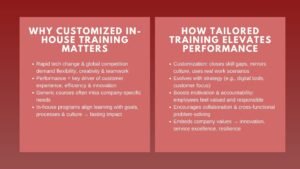
Training that is in-house has one of the strengths that are unique to it: it is customizable. In contrast to generic external programs, in-house programs could be shaped such that they are specific to the dynamics of an organizational workforce. This makes the team-building efforts abstract and unrelated, but rather provides them with clear linkage to the problems the employees are dealing with.
As an example, companies having a diverse workforce can develop training that focuses on cross-cultural communication and inclusiveness- so that the employees understand how to work together irrespective of cultural or generational differences. Training in very regulated businesses may combine compliance training with team building drills, not just to ensure that the technical knowledge is passed on, but also to inculcate a sense of collective accountability in ensuring that the standards are maintained.
Through organization culture driven content, in-house training builds not just the individual skills but also the group values. This gives the employees a sense of belongingness and strengthens the connections that would not be limited to the training room. When employees realize that training directly addresses them, that is, it talks to them, they become more appreciated and involved, and this enhances their loyalty to the team and the organization even more.
Long-Term Impact: From Team Building to Organizational Resilience
The advantages of team bonding training in-house go way beyond individual trainings. In the long-run, organizations that invest in shared learning will develop a strong workforce able to adapt to change, deal with conflict and work towards shared objectives. Training together leads to mutual understanding and respect among the employees that ensure collaboration is less strained even at times of pressure.
This strength is particularly valuable when faced with an organizational change, i.e., restructuring, expansion, or digital transformation. When teams have been formed on a strong bond, they will tend to stick together, embrace change and continue to be productive in the face of uncertainty. You also find that in-house training breeds a culture of constant improvement and employees see challenges as learning opportunities instead of as obstacles.
This also has a long-term effect on employee retention and engagement. Employees will enjoy job satisfaction and organizational loyalty when they feel to be in a team that works together. This minimizes the turnover and improves the retention capacity of the company of the best talent which adds more strength to its competitive advantage.
Conclusion: In-House Training as a Strategic Tool for Team Bonding
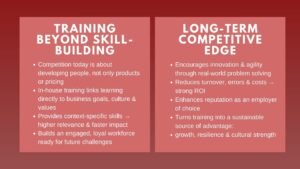
In-house training is not just a cost efficient method of acquiring skills, it is also a strategic instrument of building company team bonds which leads to organizational success. In-house training increases the level of communication, develops trust and matches the employees with business culture and objectives by offering them common learning opportunities in a comfortable and customized environment.
As work environments keep becoming dynamic, organizations keen on team integration via in-place training will be in a better position to overcome challenges, innovation, and sustain growth over the long term. Powerful team players do not only perform better but they also provide an encouraging good atmosphere at work where individuals are able to flourish. By doing so, in-house training will be not only the driving force of professional growth, but also a platform of organizational resilience that is sustainable