Strategic In-House Leadership Development
Introduction to Strategic In-House Leadership Development
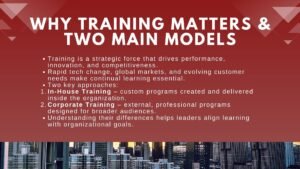
In the contemporary competitive corporate world, organizations are supposed to work more rapidly, adjust more swiftly and keep the workforces functioning in a highly restless environment. Leadership training in house whereby organizations produce leaders within their company using custom designed learning programs that suit their operations is one of the most efficient methods of accomplishing this. In contrast to generic training workshops, in-house leadership development is more compatible with the company culture, business objectives and facts of the workforce.
Nevertheless, achieving anything will not happen as a result of merely organizing a seminar and hoping that everything will change. Organizational needs should have a clear understanding of in house training needs, which can be planning, structure, facilitators, and outcome of in house training. These basics are essential without which even the programs with great funding can be unable to have a significant impact.
The paper discusses the strategic relevance of leadership training within a house, offers a systematic scout of the requirements of training in house, and offers high impact in house training concepts that companies can adopt to develop effective leadership pipelines.
The Business Value of Leadership Training In House
Companies tend to underestimate the extent to which leadership loopholes silently kill performance. Team productivity can also be hampered when employees are well skilled, poor decision making, weak delegation, poor communication and low accountability can be involved. This is why leadership training in house is not merely a development activity it is a long-term investment in operational resilience.
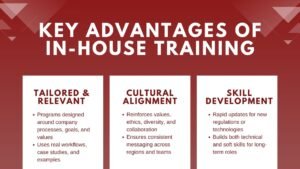
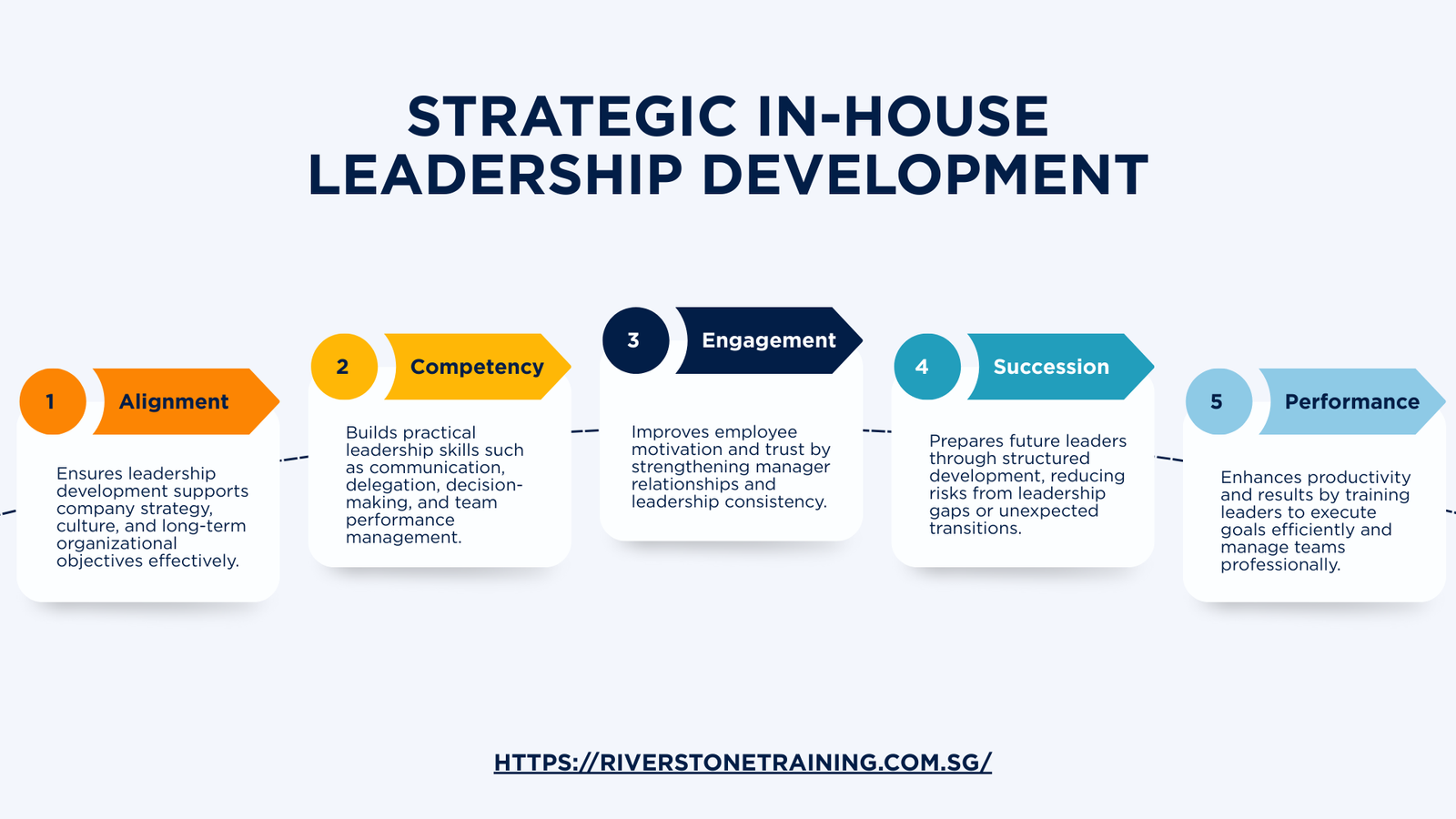
Customization is one of the biggest benefits of house leadership training. The companies can also address the leadership issues that are really significant, which include managing conflict, implementing projects, cross-functional working, and engaging employees. The alignment also thrives in this form of training since leaders are able to convey the same standards and to make the same performance expectations spread throughout departments.
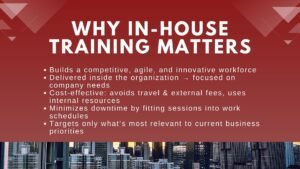
The other advantage is long-term cost-effectiveness. Although an external program can be prestigious, it can be quite costly and unrelated with the actual working situation. The opposite is true with leadership training within the firm, as it allows an organization to establish an internal learning program that can be enhanced annually.
Most importantly, retention is enhanced by internal leadership development. The employees would be willing to remain in organizations with clear career development opportunities. By offering structured leadership training within the company, the companies show the interest in the long-term employee development, as well as, the professional trust.
Understanding the Core In House Training Requirements
Businesses will have to establish the baseline before employing in house training requirements. Most organizations do not succeed due to poor content, but rather due to the lack of attention given to the structure of the running of the training. The program is sustainable, measurable and relevant owing to strong requirements in house training.
One of the significant sections of in house training needs is to determine the target audience. There is no universal leadership training. The novices are required to have a different kind of development compared to senior managers. The companies should divide the participants into levels of leadership to make sure that the content suits their roles.
Objective definition is another important constituent of in house training needs. Leadership development should be related to business results, e.g. better teamwork results, lower turnover, better customer service, or quicker project completion. In case of vague training objectives, it is impossible to evaluate.
Essential in house training requirements also include time allocation. Organizations should decide on whether the training would be done on regular working days, weekends, or under blended learning. A leadership program that interferes with operations will not be welcomed and on the other hand a leadership program that is too minimal will not instigate change.
Lastly, good governance is relevant. A big portion of in house training requirements is to have clear accountability that includes, who designs the program, approves it, delivers, and evaluates it. The lack of training in responsible hands will make the training inconsistent and lack credibility.
Structuring Leadership Training In House for Maximum Impact
In order to bring about actual change, the firms need to be systematic and progressive in its approach to leadership training internally. Leadership cannot be developed in one sitting. It is constructed based on repetitive exposure, reflection, and practice.
One of the best programs will consist of learning modules, interactive discussions, real workplace case studies, coaching support, and performance evaluation. In the case of leadership training within a company, companies must make sure that it is training on both hard and soft leadership skills. Hard competencies consist of planning, delegation and KPI management. Communication, emotional intelligence, and conflict resolution are some of the soft skills.
Behavioral reinforcement is one of the most neglected success factors leadership training in house. After the classroom session, training should not stop. Leaders will have to be able to practice what they learn by using real work assignments, after which they will be given a response by their mentors or supervisors.
This is the reason why most businesses that have been successful with leadership training within their organization tend to combine the training results into the performance management systems. In the case of evaluation of leadership behaviors, leaders do not skip training and adopt new habits more readily.
Essential Operational and HR In House Training Requirements
HR wise, companies should have to satisfy the professional standards prior to the initiation of training programs. Most companies believe that training is not a formal process, yet serious leadership training should be conducted with the necessary preparation.
Competency mapping is one of the key elements of in house training requirements. The HR teams must determine the leadership capabilities in each managerial position. This will make sure that training material is not general motivational but is also in line with what is required of the job.
The other significant issue in in house training requirements is training documentation. The companies are required to record attendance, completion of modules, scores of the assessment, and performance improvement. This is necessary in monitoring ROI and making sure that the leadership development is not just on the surface.
The companies also need to assign facilitators. No matter who is conducting the training, be it the internal managers of the HR professionals or external consultants, the readiness of the facilitator is a significant portion of in house training needs. As a facilitator, one is expected to know the strategies of adult learning, workplace psychology, and communication techniques.
A further operational part of in house training requirements is budget planning. Training, be it internal or not, requires the companies to be financed on materials, training rooms, digital learning platforms, and assessment tools. Lack of proper resources will result in poor quality of the program.
Designing Leadership Modules Based on Real Company Challenges
The leadership training in house should be developed on the basis of real challenges in the workplace. The content of generic leadership might be sounding professional, however it seldom does anything to alter behavior.
The leadership modules in organizations should be constructed based on the universal management pain points including:
- Dealing with naughty employees.
- Non-micromanaging delegation.
- Managing task force conflict.
- Leading under pressure
- Setting expectations properly.
- Providing feedback not to demoralize employees.
This is because when leadership training within an organization is founded on actual internal issues, leaders quickly become aware of applicability. This makes it more engaging and less resistant especially to the experienced managers who tend to think that training is an unnecessary thing.
Internal case studies of previous incidents involving project failures, customer complaints, and disruptions to the operations of the firm can also be utilized by companies. This will enhance credibility, and learning leadership will become more practical.
Best In House Training Ideas regarding Leadership Training.
Companies are frequently inquired, how to make leadership training interesting, topical and outcome-oriented. Effective house training concepts need to be well-rounded between the theoretical framework and practice.
Scenario-based learning is one of them. It is among the most viable in house training concepts since the leaders will learn through examining work-related situations and making decisions. Participants have a chance to role-play conversations on performance reviews, conflict mediation or crisis communication.
Leadership simulation exercises is also another effective approach. Simulations are one of the most effective in house training concepts of the modern world as they allow recreating the conditions of pressure in the workplace. Leaders should collaboratively resolve problems, delegate roles and manage time limitation as well as proposing solutions.
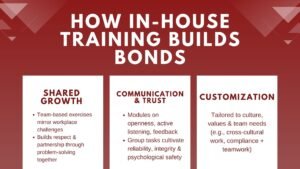
Another idea of in house training that is most sustainable is peer learning. Firms can establish leadership groups in which managers can discuss their problems, share tactics and hold one another accountable. This creates trust and leadership networks within departments.
Another good example of in house training is mentoring programs. Assigning junior executives to senior executives enhances the speed of development, builds confidence, and organizational culture. Mentoring is also used to pass institutional knowledge which cannot be acquired using formal training.
Another is development through coaching. One of the more developed in house training concepts is coaching, in which the trainees are given individualized feedback concerning their leadership behavior. This is to make sure that development is not abstract but quantifiable and tailor-based.
Integrating In House Training Requirements with Business Strategy
The development of leadership must never go alone with the strategy of the company. In case organizations consider training as an HR activity, but not a business tool they will lose the executive support.
Examples of strong in house training requirements are the ability to align the training topics with business priorities. As an example, when the company is entering new markets, leadership modules must be used to control the growth, scale the operations, and lead new teams. When the turnover in a company is high, the leadership training must focus on engagement, communication, and motivation of the employees.
Performance indicators should also be included. One of the main aspects of the in house training is making sure that the performance of leadership is measured before and after training. Measures can be employee satisfaction, productivity measures, customer response, absenteeism, and the performance of a team.
This strategic fit makes leadership training a quantifiable business outcome, rather than a business ritual.
Common Mistakes That Reduce the Effectiveness of Leadership Training In House
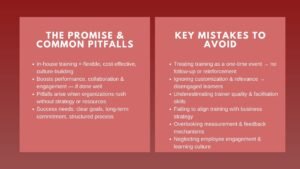
Most of the organizations invest in training and do not realize significant results. Overemphasis on theory is one of such errors. If leadership training in house is limited to lectures and motivational speeches, leaders will not develop practical leadership behavior.
The other error is not supporting training results. Leaders can go through workshops, although without follow-up, accountability and evaluation, new knowledge is forgotten easily. Proper leadership development in house should be accompanied with action plans, progress reviews and coaching.
Another error is that of poor choice of participants. There are those companies where high performers only are sent and others where under performers only are sent. Balanced development would be the most appropriate as leadership training is not a reward or a punishment to the career progression.
Lastly, it is a significant problem to disregard feedback. Leadership programs should be regarded as dynamic systems by companies. Through gathering participant feedback, the organizations would be able to refine the module relevance, training delivery and the general quality of the programs.
Building a Sustainable Internal Leadership Culture
It is not merely a training that a company achieves when it develops leadership training in-house, but rather it is a leadership culture being created. A leadership culture refers to leaders who speak well, facilitate transparently, make teams responsible, and always set an example in showcasing the company values.
In order to create a sustainable process, companies should make sure that the development of leadership is ongoing. There should not be situations where leadership is only developed when there is a crisis or during the annual planning approaches. Instead, the structured training calendars with quarterly refreshers, continuous learning tools and leadership performance check-ins should be implemented in organizations.
This is whereby high in house training requirements come in. The training should be recorded, assessed and refined with time. Promotion criteria and management KPIs should include leadership development.
Organizations are also supposed to develop reward systems that are used to reward good leadership behaviors. Leadership culture is self-reinforcing when leaders are rewarded because of coaching employees, professional conflict resolution, and results delivered in an ethical manner.
Measuring ROI and Results from Leadership Training In House
There is no value that can be demonstrated by a leadership program which lacks measurement. The definition of the success metrics at the outset is one of the most significant in house training requirements.
The companies are to measure the short-term and long-term results. Some short-term indicators encompass assessment scores, satisfaction of the participants and training completion rates. The long-term indicators are the gains, as shown by better performance ratings, employee engagement, low turnover, and higher productivity.
The 360-degree feedback is another useful technique. This is a method that seeks the contributions of supervisors, colleagues and subordinates. It is among the surest methods of gauging improvement in actual workplace conduct by house-based leadership training.
Other improvements in operations that can be monitored by an organization are speedy decision-making, enhancement of teamwork and rental of conflicts within an organization. When leadership growth yields the following quantifiable results, executives become confident enough to go on with more training programs.
Advanced In House Training Ideas for Modern Leadership Challenges
The demands of leadership are changing at a very fast pace. Managers today are faced with the challenge of dealing with hybrid teams, cross-generational communication, digital transformation, and more mental health issues in the workplace.
This is the reason why firms require current in house training concepts that can respond to new leadership issues. The development of leaders into frameworks of change management is one of such advanced strategies. Leaders need to know how to sell change, minimize resistance, and keep productive throughout the change.
The other progressive strategy is to train leaders on emotional intelligence, and psychological safety. They are becoming essential leadership competencies, as they determine the involvement of teamwork, innovation, and trust at work.
Digital leadership is also necessitating itself. Contemporary in house training concepts involve training leaders to lead remote teams, apply digital productivity, and communicate with each other in virtual platforms.
Lastly, it should have leadership ethics and compliance. Ethical leadership minimizes the risk to the organization and helps to build the company reputation. These superior subjects make the leadership training inside the house not obsolete in the current business setup.
Conclusion
Businesses that desire to grow in the long run cannot afford to overly depend on the acquisition of talent. A culture of sustainable success requires growing leaders within an organization in a structured, consistent, and result-oriented program. In-house leadership training offers companies an effective way of building robust pipelines of leadership, aligning teams to the aims of the company, and enhancing the culture in workplaces.
Nevertheless, the success of training lies in implementation. The companies need to provide explicit in house training requirements, such as competency mapping, facilitator preparation, well-defined learning paths, outcomes that can be measured, and continuous reinforcement. In the absence of these, training becomes useless and it does not cause behavioral change.
The adoption and execution of strategic ideas of in house training through simulations, mentoring, coaching, and scenarios-based learning can help organizations to produce leaders who are confident, responsible, and capable of handling actual business challenges.