If a company invests S$10,000 in a training programme, then the next obvious question is: was the money spent to create business value? Answering that question reliably requires a structured training ROI measurement rather than a general sense that the training “went well”.
Training effectiveness and training ROI are connected, but not synonymous: Training can be effective, and yet, it might need more analysis to be sure that the financial impact can be seen.
What Is Training ROI?
ROI of training can be associated with the financial returns of a learning programme and the cost of the programme. Instead of reporting the satisfaction of employees taking a course, ROI is the ratio between a company’s investment and the measurable returns it has received.
The underlying formula is straightforward:
Training ROI = (Training Benefits − Training Costs) ÷ Training Costs × 100
A positive result means that benefits were greater than costs. If the result is 0%, benefits were about the same as the costs, and if the result is negative, identified benefits have been less than the company’s costs. But ROI shouldn’t be the sole measure of success in training; skills like leadership or employee confidence, for example, might be fairly valuable but hard to quantify into dollars.
Why Measuring Training ROI Matters
Justifying L&D Budgets
Having a clear measurement framework provides L&D teams with a common language with finance and senior management. A framework should be used to help answer the questions: Why should the company continue to invest in training? Which programmes are yielding the best results? Where should the budget be spent? What programmes should be improved or discontinued? Rather than relying on impressions, a framework can help to answer these questions.
This matters most when a company runs several employee training programs at once and needs to decide which ones deserve continued investment.
Demonstrating Business Value
Training must be linked with measurable business goals and not be a business activity in itself. The benefits that can be expected relate to increased sales, fewer errors, increased productivity, decreased operating expenses, increased customer satisfaction, and decreased employee turnover. The best way to measure starts with a business problem, not tracking the number of employees who completed a course.
Improving Future Training Decisions
Historical ROI data can be used over time to compare programmes with each other. A company may discover that training on technical skills yields quicker increases in productivity, training in leadership yields longer-lasting retention benefits, training in digital skills yields quicker reduction in process time, or training in sales yields increased conversion rates. When applied in this manner, ROI is not just a reporting process but becomes a decision-making tool.
How to Calculate Training ROI
Identify Training Costs
An accurate training ROI calculation depends on capturing the full cost of a programme, not just the trainer’s fee. Costs are usually split between direct costs such as trainers’ fees, course materials, learning platform costs, venue hire, technology, and content development and indirect costs, most importantly employee time. Employee time is extremely important in corporate training, as their time is taken away from their usual work and it can be easy to underestimate the cost.
- Trainer fees and course materials
- Learning platform or LMS costs
- Venue and travel costs
- Employee time away from regular duties
- Technology and administration
- Content development and follow-up coaching
- Assessment costs
Identify Measurable Benefits
The next step is to determine what financial return on the training is reasonable to expect. Typical outcomes of training are improved productivity (completing the same process more quickly after training), fewer errors (rework and operational costs are cut), higher sales (higher conversion rate or revenue per employee), lower attrition (development opportunities are one of the contributing factors), and decreased compliance or operational risk (due to increased knowledge reducing avoidable incidents). It is important that companies have a sensible and documented strategy to be responsible for these benefits solely to the training and not take for granted that all improvements are training-related.
Calculate Financial Return
After the costs and benefits are determined, this formula is simply used as applied: Total measured benefit – total training cost/total training cost × 100 = costs and benefits. All components need to be documented in a clear way so that the finance team can review the assumptions that go into the calculation of a training ROI, as the credibility of the training ROI calculation relies on the transparency of the numbers.
Compare Results Against Baseline
It’s important to assess the post-training result, but if you don’t have a baseline measurement prior to training, you cannot demonstrate real results. The table below illustrates a typical before-and-after comparison used to support a training ROI calculation.
| Metric | Before Training | After Training |
| Average processing time | 60 minutes | 45 minutes |
| Error rate | 8% | 4% |
| Sales conversion | 10% | 13% |
Evidence of change can be found in a comparison of performance before and after the changes occurred, but other factors could also have contributed to the outcome (e.g., new tools, new processes, or changes in demand because of the season). Organisations should not assume that all improvements are due to training.
Training ROI Calculation Example
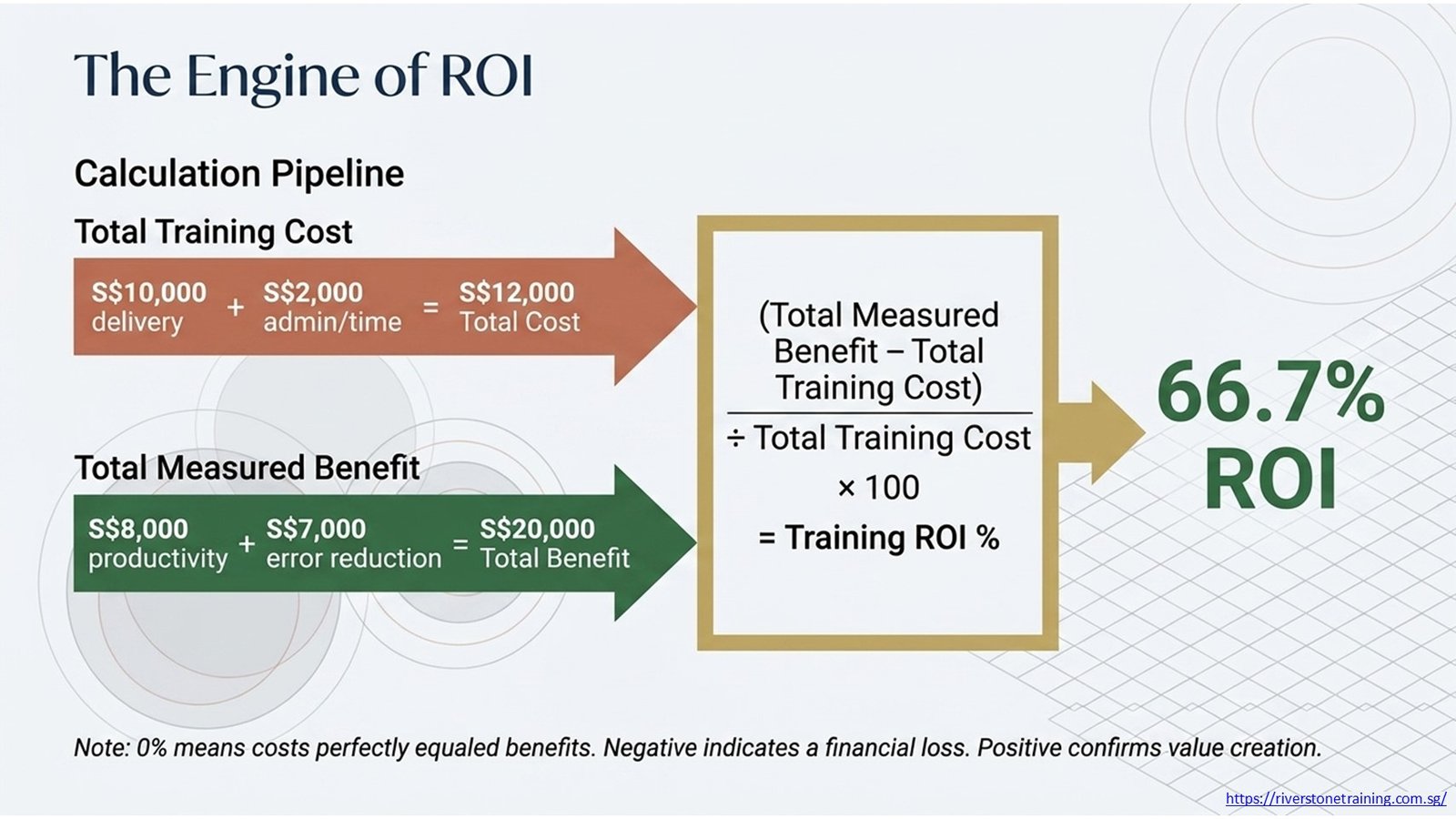
An easy-to-follow example is provided to explain how the numbers can be put together in practice. Suppose a business incurs a training delivery cost of S$10,000 plus an additional S$2,000 for company time and administration to run the training. Say a business has a training delivery cost of S$10,000 and an additional cost to deliver the training of S$2,000 due to the company time and administration it needs to run the training.
The company estimates that it will gain S$8,000 in productivity, S$7,000 in error reduction and S$5,000 in measurable gains for the business after the training; for a total measurable gain of S$20,000.
| Item | Amount (S$) |
| Training delivery cost | 10,000 |
| Employee time and administration | 2,000 |
| Total training cost | 12,000 |
| Productivity gains | 8,000 |
| Reduced errors | 7,000 |
| Additional measurable business benefits | 5,000 |
| Total measurable benefit | 20,000 |
ROI = (S$20,000 − S$12,000) ÷ S$12,000 × 100 = 66.7%
The result was 66.7%, indicating that the benefits measured were significantly higher than the cost of the programme. It does not imply that all the benefits of the training were S$20,000 — the attribution assumptions, the period of measurement, etc. must always be indicated along with the benefits.
What Training Metrics Should Companies Track?
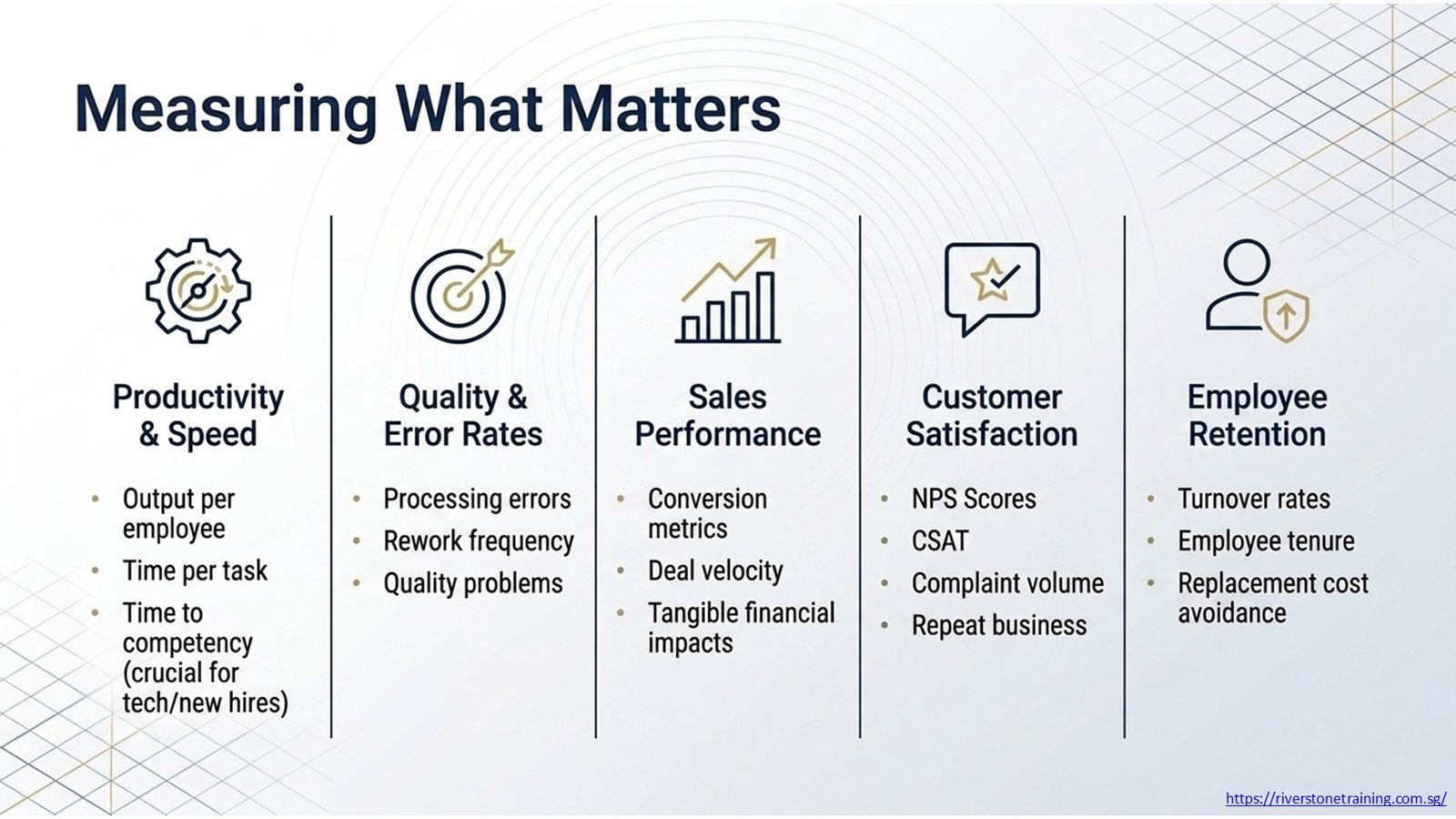
ROI should not be the sole indicator and should be placed at the end of a larger measurement system. There are a few other metrics that contribute to a believable ROI.
Productivity
- Output per employee
- Time per task
- Processing speed
- Revenue per employee
Error Rates
Useful indicators include processing errors, rework, quality problems, and customer complaints—reduction in errors may be a cost savings in some cases once the cost of the error is determined.
Sales Performance
The following metrics are typically monitored:These are the typical metrics tracked: Some areas of sales training have more tangible, direct financial impact than other forms of training.
Employee Retention
Here, turnover, retention rate, employee tenure and replacement costs come into play, but the link between training and retention must be used with care: there are a number of factors which influence employee retention.
Customer Satisfaction
- Customer satisfaction scores
- Net Promoter Score (NPS)
- Complaint volume
- Repeat business
Time to Competency
It is a measure of how fast employees can do their job without assistance after training and is especially important to measure for new hires, new systems, new processes and technical jobs.
Kirkpatrick vs ROI Measurement
One of the most popular training models is the Kirkpatrick Model, which consists of 4 Levels: Reaction, Learning, Behaviour, Results. This framework is supplemented by a financial perspective provided by ROI.
| Measurement | Main Question |
| Reaction | Did participants value the training? |
| Learning | Did participants gain knowledge or skills? |
| Behaviour | Did they apply what they learned? |
| Results | Did workplace performance improve? |
| ROI | Did the financial benefits justify the investment? |
Not every programme will have a monetary ROI for companies. A full financial calculation may not be the most suitable measure for some initiatives, whilst behavioural or business outcome measures may be more appropriate.
How In-House Training Can Improve Measurable Outcomes
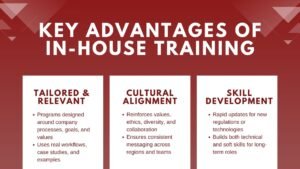
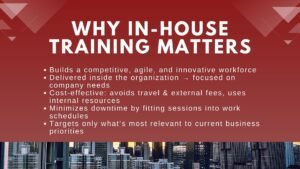
Practicality of measurement can be increased by using customised in-house training, which can be tailored directly to existing business processes, company KPIs, department goals, individual employee roles, problems encountered, and technology systems in use.
The training is tailored to the actual workplace needs, allowing organisations to set up before and after assessment points more precisely than they would be able to with generic, off-the-shelf training. Well-structured employee development programs can then be evaluated using both short-term performance metrics and longer-term capability outcomes. While in-house training may not necessarily yield a higher ROI, ensuring that there is alignment and measurement can make a significant difference in the business impact of in-house training more measurable.
Common Mistakes When Measuring Training ROI
Measuring Attendance Instead of Outcomes
Completion rates do not represent changes in performance or business value, only the fact that the course occurred.
Ignoring the Full Training Cost
Trainer fees are not the whole investment, as employees’ time, materials and administration are also part of the investment.
Failing to Establish a Baseline
It is impossible to prove the results of the change in performance without pre-training measurements.
Attributing Every Improvement to Training
In addition to training, results can be affected by market conditions, new technology, management changes, pricing changes, staffing changes and seasonality.
Measuring Too Early
Results, especially those relating to behaviour change or retention, take weeks or months to become apparent.
Using Too Many Metrics
Measuring all you can data points will diffuse the focus. Too many KPIs are not as helpful as just some that are related to the training goals.
How to Build a Training ROI Measurement Framework
The following nine-step framework can be reused across different programmes and departments.
- Define the business objective — for example, reduce customer-service errors by 20%.
- Establish the baseline by measuring current performance before training begins.
- Define the training intervention and what employees need to learn.
- Set success metrics and the KPIs that will indicate improvement.
- Measure post-training performance using comparable data.
- Convert relevant outcomes into financial values where reasonable to do so.
- Calculate ROI using the agreed formula.
- Review attribution and consider whether other factors contributed to the outcome.
- Use the findings to scale, modify, repeat, or replace the programme, or invest elsewhere.
How Can Companies Improve Training ROI?
There are a number of practical levers that can make the return on an investment in training good. Training should be targeted at a specific capability or performance issue and relate to the business objective, not be offered because of its popularity. In addition to the content, it is important to target the right employees: spending training money on employees who do not require a certain capability will not yield appropriate results.
The use of workplace-relevant real-life scenarios enables staff to practice what they have learned right away, and reinforcement of the learning following training, through coaching, practice, manager support, follow-up assessment and refresher learning, is often key to ensuring new learning leads to changed behaviours at work. The acquisition of knowledge is not necessarily followed by behavioural change; thus, the behaviour should be measured directly and not taken for granted. ROI may be immediate in some cases or take months to come in, so it’s important to assess it over a suitable period of time.
When Should Companies Invest in Employee Training Programs?
Structured employee training programs tend to be most justified when a company faces persistent skill gaps, new technology adoption, leadership capability gaps, compliance requirements, poor productivity, changing customer expectations, new business strategies, or expansion into new markets.
Investments should be based on the problem that is being solved in the business and the desired results that the company wants to get, not on what is the popular training topic of the day.
Building a Business Case for Employee Development
HR and L&D teams have a valuable advantage when proposing training to high-level management – a business case rather than a blanket request for funds. A strong case for employee development programs typically covers ten elements: the current performance problem, its business impact, the capability gap involved, the proposed training intervention, expected outcomes, the measurement method, estimated training cost, expected financial benefit, ROI assumptions, and the post-training review period.
By presenting employee development programs in this manner, decision-makers have a clear basis for approving the program, and a framework in place to review the results after the program has been completed.
When Should Companies Use Professional Training Support?
When an organisation requires tailored learning goals, role-specific training, finance training, leadership development, training on digital skills, sales capability development, structured assessments and/or post-training evaluation, professional training support can be of benefit. To help to shape learning towards specific business goals, it’s possible to involve external trainers, but it’s important to draw out, before the training begins, what business result the programme is intended to bring about.
This is especially true of niche topics like leadership development, corporate sales training and digital skills training, where specialisation can mean quicker tangible benefits. HR training programmes can be used in a similar way when the goal is to enhance the broader capability of the employees and people-management within the organisation.
Training ROI Calculation Checklist
Before starting a new programme, it can help to work through a short checklist:
☐ Define the business objective
☐ Identify training costs
☐ Establish baseline metrics
☐ Define measurable outcomes
☐ Track post-training performance
☐ Convert relevant benefits into financial values
☐ Calculate ROI
☐ Review attribution
☐ Compare against expectations
☐ Use results to improve future training
Conclusion
While calculating training ROI is not just a matter of putting a dollar sign in front of everything you teach, it is difficult to put a price tag on individuals’ learning. A sound measurement process links training investment to learning, learning to behaviour change, behaviour change to business outcomes and business outcomes to financial impact.
The best training ROI measurement begins before training even begins with objective setting, baseline measures, measurable KPIs and setting up and agreeing on how results will be measured. Prior to embarking on another programme, it is worthwhile to reflect on whether existing training programmes are clearly linked to quantifiable business goals or whether this link still needs to be created.