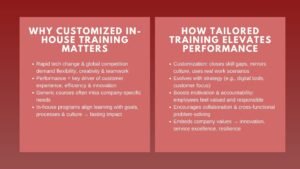
Tailored Training allows organisations to fill industry-specific skill gaps with customised learning objectives, content, examples and activities—ones that address their specific needs instead of generic material.
While generic training can offer a broad, foundational understanding, there may be specific gaps in the skills needed within a specific role, industry, or organization that require customised training.

What Are Industry-Specific Skill Gaps?
A skill gap in the industry is where workers do not have the technical skills, industry knowledge, digital skills, leadership skills, financial skills, compliance knowledge, communication skills, and/or analytical skills necessary to work to their full potential. Unfamiliarity with role-specific processes and processes of the company itself, or with the company tools and systems not covered by generic training in sufficient detail, is also a gap that can be present.
The same job title may need to include different capabilities based on the industry, business model, size, technology, regulatory landscape, strategic priorities, organizational processes, and other factors of the organization. A financial professional working in a manufacturing firm, for instance, might have various practical skills, such as manipulating cost accounting information related to manufacturing, compared to a financial professional working in a financial services firm.
Table 1: Generic vs Customized Training
| Factor | Generic Training | Customized Training |
| Learning Objectives | Broad | Organization-specific |
| Examples | General | Industry/workplace relevant |
| Participant Roles | Often broad audience | Specific roles |
| Case Studies | Standardized | Customized scenarios |
| Business Alignment | General | Directly connected to objectives |
Why Can Generic Training Fail to Address Specific Skill Gaps?
Don’t think that generic training is without value, or that it is ineffective – generic training can be highly valuable for developing basic skills that can be used in all industries and occupations. It can be challenging for employees to relate the content to their work when it’s applied across broad learning goals, is limited to general examples, and has few industry-specific scenarios.
Generally, a generic program is developed for a broad spectrum of skill levels among the participants and is not likely to represent a specific company’s processes, tools, or specific business issues. Tailored Training can be particularly valuable for organizations that need specialized, context-specific, and role-specific skills that a generic training course could never provide.
How Can Companies Identify Their Training Needs?
Organizations will typically rely on a variety of methods for determining the skills they need before they design a custom program, including skills assessments, employee surveys, manager interviews, performance reviews, job competency frameworks, direct observation, business performance data, knowledge assessments, and process audits. These methods, when combined, can help to draw a picture of whether someone has the capacity to perform the role or not.
The process is very simple: current capability, required capability, identified gap, and training intervention. Training does not automatically fix all performance problems as well – for some problems, it may be a lack of processes, resources, outdated systems, unclear responsibilities or lack of management support that is causing the problem, so the organization should first understand what the problem is and design the training accordingly.
Table 2: Skill Gap Identification
| Method | What It Identifies |
| Skills Assessment | Current capability |
| Manager Interviews | Performance challenges |
| Employee Surveys | Learner needs |
| Performance Data | Observable gaps |
| Job Competency Framework | Required capabilities |
How Does Tailored Training Address Different Employee Roles?
Different training methods may be necessary for different groups of employees in the same organization. The finance team might need financial analysis, forecasting, budgeting, financial modelling, management reporting, etc., while the managers are more likely to need delegation, coaching, performance management, and decision-making support as part of their day-to-day operational needs.
A sales team, on the other hand, could be more useful with client communication, negotiation, relationship management, and consultative selling, and digital teams are generally in need of data analytics, digital tools, automation, AI literacy or cybersecurity awareness. Tailored Training enables organisations to customise the depth and use of content for each audience, not just each and every person in the role.
How Can Training Content Be Customized to Workplace Challenges?
Tailored Training may include modifying learning objectives, the curriculum, examples, case studies, exercises, evaluations, delivery format, difficulty level, learning materials, duration, and workplace scenarios to address what employees encounter in the workplace. Customization does not necessarily mean that an entire course has to be designed from scratch; instead, it could be a program that is modified to align the structure and main content of the program with the organization’s needs.
This sort of adaptation is what makes customised in-house training different from a regular course that is delivered unchanged. If an organisation does not need to do a complete overhaul of a program, there are ways they can make the content meaningful that don’t require a full change.
How Do Real Workplace Scenarios Improve Training Relevance?
Customized training is made even more relevant by the addition of company processes, industry challenges, typical customer scenarios, internal workflows, financial scenarios, leadership scenarios, compliance scenarios, and realistic decision-making exercises in real workplace scenarios. A customized program might employ a simplified version of the organization’s forecasting process, rather than a generic example.
This method can help students relate classroom or digital learning to their job duties, which can then be translated into action by the student. If scenarios are similar to situations employees already encounter, training will be more pragmatic than abstract.
How Can Customized Training Align With Business Goals?
Customized training must be aligned with specific business goals like enhancing productivity, minimizing errors, building leadership pools, better budgeting and decision-making abilities, aiding digital transformation, better customer service, better compliance, or positioning employees for new roles. If this does not exist, training may not be seen as a catalyst for organisational performance but as a standalone activity.
It can be stated in the following sequence: business goal, capability requirement, skill gap, training objective, learning activity, workplace application, and measurement. Leaving the chain visible when designing a program helps to keep Tailored Training in line with outcomes that are meaningful to the organization and not just a learning exercise.
How Can Finance Training Be Customized for Different Organizations?
A Customised Finance Training Programme can be adapted depending on an organization’s specific needs across areas such as financial modelling, budgeting, forecasting, financial analysis, management reporting, corporate finance, investment analysis, cash flow management, and financial decision-making. Since the responsibilities of finance roles are diverse across industries, a finance course that fits all may fall short of providing the practical detail an employee needs.
For instance, a company training managers for budget management might want to build up more practical budgeting exercises that are based on its own cost centres and reporting periods, whereas one focused on investment may need more sophisticated modelling and valuation exercises around the transactions they actually conduct. By tailoring the material to these differences, the training is immediately relevant to the tasks of each group.
How Can Customized Leadership Training Develop Future Leaders?
The training can be tailored to the context and the group being trained. For new managers, delegation, communication, feedback, and team management skills may be more appropriate, whereas experienced managers may find the strategic decision-making, coaching, change management, and performance leadership content to be more relevant to a senior level of responsibility.
Senior leaders, by contrast, are usually expected to have skills in strategic thinking, organizational transformation, stakeholder management, and executive decision-making. When scenarios are realistic, rather than hypothetical, they are more useful for leadership training – you don’t have to worry about a hypothetical scenario that’s not relevant to your organization’s leadership issues; you only need to be concerned with a real scenario that is relevant.
How Can Tailored Digital Skills Training Support Transformation?
Personalized digital skills instruction can fill particular needs for technology adoption, including data analytics, Excel, AI applications, digital collaboration, automation, digital finance, data visualization, and cybersecurity awareness. Not everyone requires the same set of digital skills, and a one-size-fits-all approach to digital training can be a waste of time, as it can lead to the duplication of effort in training people on tools that won’t be used by other teams.
For a finance team, you might need more advanced Excel and financial analytics skills, whereas a sales team might need CRM and customer data skills. Tailored training can be designed to specifically focus on the tools and workflows that employees use in their daily work, which boosts the chances of new digital skills being utilised and not forgotten.
How Does Corporate L&D Training Support Customized Learning?
Customized learning fits into broader corporate L&D training by connecting skills frameworks, employee development plans, leadership pipelines, digital transformation initiatives, business strategy, and performance objectives into a coherent learning approach. These programs are not a one-off project, but can be integrated into a broader workforce development program that a corporate L&D team can use as a building block.
This enables the discussion to stay in the realm of customisation instead of e-learning technology. The value lies in how much L&D teams are being purposeful about aligning specific content to the organization’s larger skills and development objectives, rather than just having a learning platform.
How Can Organizations Measure the Results of Customized Training?
The question of whether or not custom training measures an actual skill deficit has several stages of measurement. Learning measures indicate if employees have absorbed the material (e.g., scores on an assessment, knowledge checks, or practical exercises), and application measures indicate whether they are using this material in practice (e.g., employees apply the skills, managers observe application, or employees perform in the workplace).
There are more pieces of evidence in business measures related to productivity, error reduction, decision quality, process improvement, customer outcomes, and compliance performance measures. Training completion is not an indicator that a skill gap has been met, and the best assessment is not simply attendance and completion statistics, but a link between the training objective and a workplace result.
Table 5: Measuring Training Outcomes
| Level | Example Measure |
| Learning | Assessment score |
| Application | Skill usage |
| Performance | Error reduction |
| Business | Productivity improvement |
| Strategic | Progress toward business objective |
What Are the Benefits of Customized In-House Training?
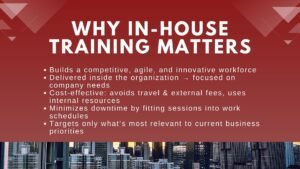
Customized in-house training can provide more relevant learning, role-specific training, contextual examples, relevance for business goals, practical application, better contextual learning, and consistent organizational language across teams. It also offers great flexibility in delivery and a more direct link between learning and work performance than a standard course would.
However, the customised training does not invariably cost less, is faster, or is more effective than training that could be delivered in a more generic way. The actual effectiveness of the program relies on the design and the specific need/skill gap the program addresses, as well as the program’s alignment with the organization’s needs.
Table 3: Customized Training Examples
| Area | Possible Customized Focus |
| Finance | Forecasting and financial analysis |
| Leadership | Managerial decision-making |
| Digital Skills | Organization-specific technology |
| Sales | Client and industry scenarios |
| Compliance | Relevant regulatory procedures |
How Can Companies Build an Effective Customized Training Program?
The steps for creating a customized program are typically to understand the business need, understand the capability gap, set learning goals and understand the learning audience by role, experience, and responsibilities. Then, organizations tailor the material to fit their specific organization, choose the delivery approach, and incorporate realistic scenarios from the workplace that employees will be able to relate to.
The remaining steps are to evaluate learning through hands-on activities or knowledge tests, evaluate workplace application to see if employees can apply the new capability and improve the program via feedback and performance data. Every step of this approach is grounded in evidence, not assumption.
Table 4: Customization Process
| Stage | Key Activity |
| Needs Analysis | Identify skill gaps |
| Objectives | Define required capabilities |
| Content | Adapt learning materials |
| Delivery | Select suitable format |
| Assessment | Measure learning |
| Evaluation | Measure workplace application |
How Can Tailored Training Support Long-Term Workforce Development?
Tailored Training can be done outside of the classroom and can be delivered through: • Instructor-led workshops, • In-house training, • E-learning, • Blended learning, • Virtual instructor-led sessions, • Case-based workshops, • Coaching, or • Simulations, which makes it applicable to long-term workforce development. The format is up to the organization, depending on the learning goals, the location of employees, the difficulty of the subject matter, the amount of time available, the need for interaction, and the need for the skill to be applied in practice.
Imagine a company that is expanding and finds that its middle managers possess a significant degree of technical expertise, while having poor financial decision-making abilities. Instead, it could gauge what it has already accomplished, design a financial situation around its own company choices, incorporate budgeting and forecasting exercises with real-life examples, and track improvements in decision-making effectiveness over time—an approach much more likely to plug that real hole than standard instruction.
Conclusion
Customized training can overcome industry-specific skill gaps by linking learning outcomes, content, and examples directly to an organisation’s workforce, industry, roles, and business goals and objectives, as opposed to using generic training material that was not designed for that industry.
Tailored Training is most beneficial when it comes from a real gap with actual opportunities for employees to practice the skills learnt. This is dependent on having robust needs analysis, role-specific content, practical workplace scenarios, business alignment, and continuous evaluation of outcomes.
If an organization is looking for training that will actually bridge the gaps in their employees’ capabilities, they should develop the training course around the specific skills needed for their employees to be effective in their workplace context, as opposed to hoping that any given training course is applicable universally.