Time Management and Productivity: Onsite Training for Teams
With multitasking and information overload being the new rule of the day, time has already become the most precious, and most poorly managed resource at the workplace. Lack of effective systems to prioritize, plan, and perform effectively is the main reason why most professionals find it hard to perform well as they have the capability to.
One such solution to this issue is with Time Management and Productivity Onsite Training in Teams. It also enables teams by offering viable structures and methods to regain their time helping to lessen stress and improve effectiveness. This initiative does not stop at generic tips; it is the way of reconsidering how the employees approach productivity, attaching it to focus, discipline, and work habits that are result-fulfilled. This approach also aligns well with team building in-house workshops for businesses in Singapore, creating stronger collaboration and long-term efficiency.
Understanding the Time-Performance Connection
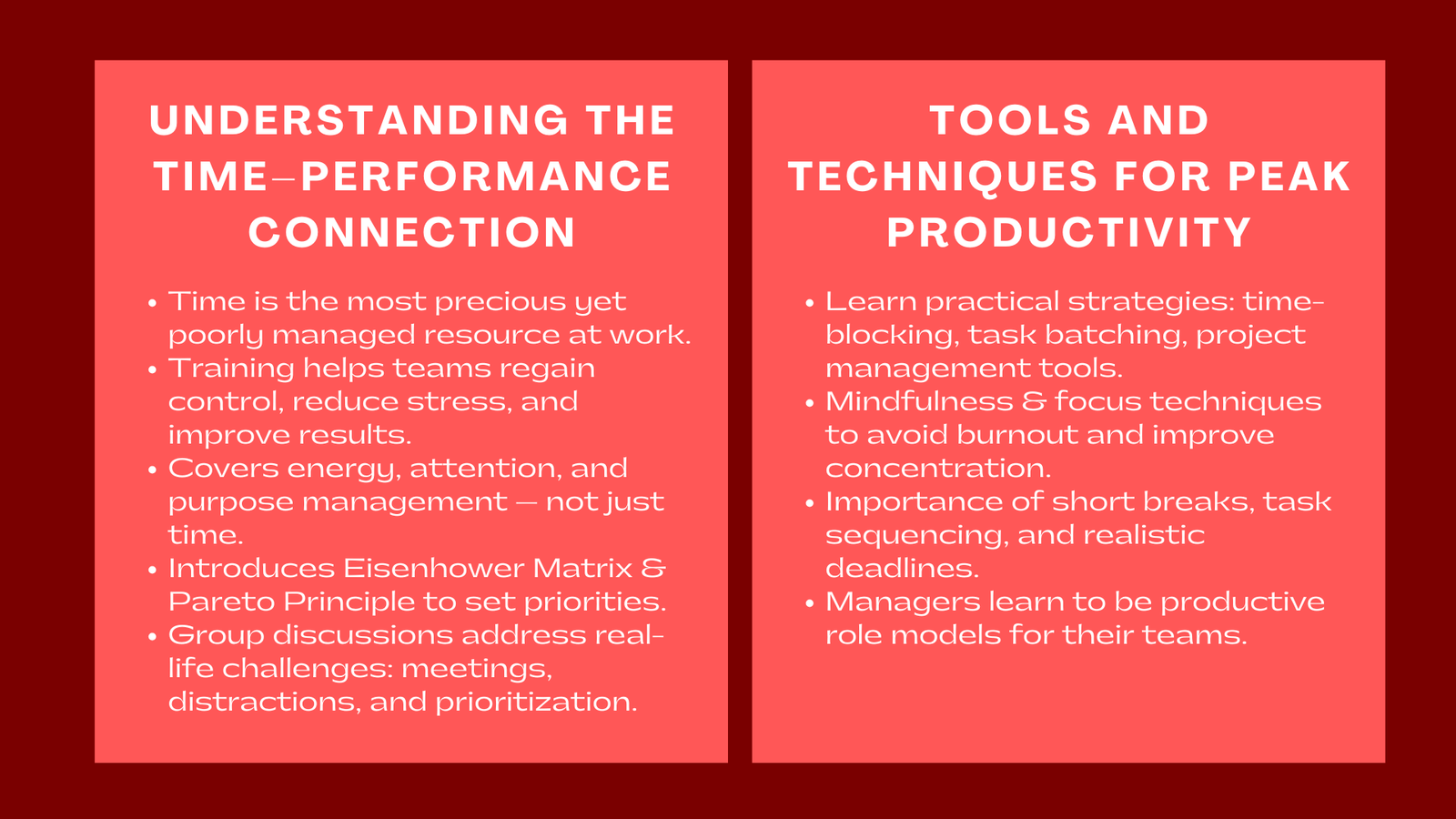
The training will commence with assisting the participants to know the psychology behind productivity. Time management is not only about time management but it is energy, attention, and purpose management. This is achieved by the participants evaluating their work patterns and determining where they have been wasting time either through procrastination, interruption or poor prioritization.
They become familiar with such frameworks as Eisenhower Matrix and Pareto Principle and are taught how they may help to differentiate between urgency and importance. Other secrets of the session are the science of attention span and decision fatigue that teams use to organize their days to achieve maximum output. This practical and structured approach is also a key component often integrated into team building in-house workshops for businesses in Singapore, helping teams develop shared strategies for better focus and collaboration.
Group discussions allow employees to talk about the practical difficulties encountered in real life: back-to-back meetings, work priorities, and digital distractions among others and collaborate on individual time plans to work within the roles.
Tools and Techniques for Peak Productivity
This section is dedicated to the use of organized systems and computer technologies that are used to help in being more efficient. The participants are taught effective time-blocking, similar tasks, and project management tools practices which prove to be useful.
Mindfulness training and concentration techniques are also incorporated in the training and educate the teams to increase the level of concentration and avoid burnout. Taking short breaks, setting boundaries and task sequencing enable the employees to know how to perform in the long-term.
To the manager, the course offers ways of planning the workloads, unique realistic deadlines, and avoiding over-scheduling. The leaders are also advised to be productive role models, because team behavior more often resembles that of the management.
Building a Culture of Accountability and Efficiency
The culture of accountability is healthy in terms of productivity. The last part is coordinating the habits of the team with the organization aim. On its part, the participants talk about how to set quantifiable goals, develop key performance indicators (KPIs) and come up with transparent reporting mechanisms that facilitate accountability, which also aligns with the benefits of employee training for finance teams in building clear performance structures.
Through mutual exchange of time management methods in various teams, it is possible to break siloes, decrease redundancy and minimize workflows. Another aspect brought out in the course is that regular productive routines would raise morale- when employees feel that they have control of their time, engagement and job satisfaction levels would increase tremendously.
Conclusion to Time Management and Productivity Onsite Training for Teams
Time management is not only a life art, but it is a company asset. This work on the job training will change the face at which the teams will undertake the work by not being busy but rather effective.
By the end of the program, the participants come out with a new understanding, practical resources and a mutual determination to be efficient. The practices over time accrue to quantifiable performances, less stress, and enhanced teamwork. In the world where things never stand still, it is time management, which enables the teams to proceed effectively and accurately.
Companies that include their employees in time management training invest in sustainability productivity and the well being of their employees. The spread of ripple is much further, since the individual performance is impacted, teams get to be more aligned, communication advances, and projects proceed with ease. This organizational culture of deliberate concentration in the long run increases the capacity of the organization to adapt and innovate to survive in a high paced business world where time is indeed money.