Corporate Training on Developing Effective Leadership Skills for Managers
Introduction to Leadership Skills Training for Managers
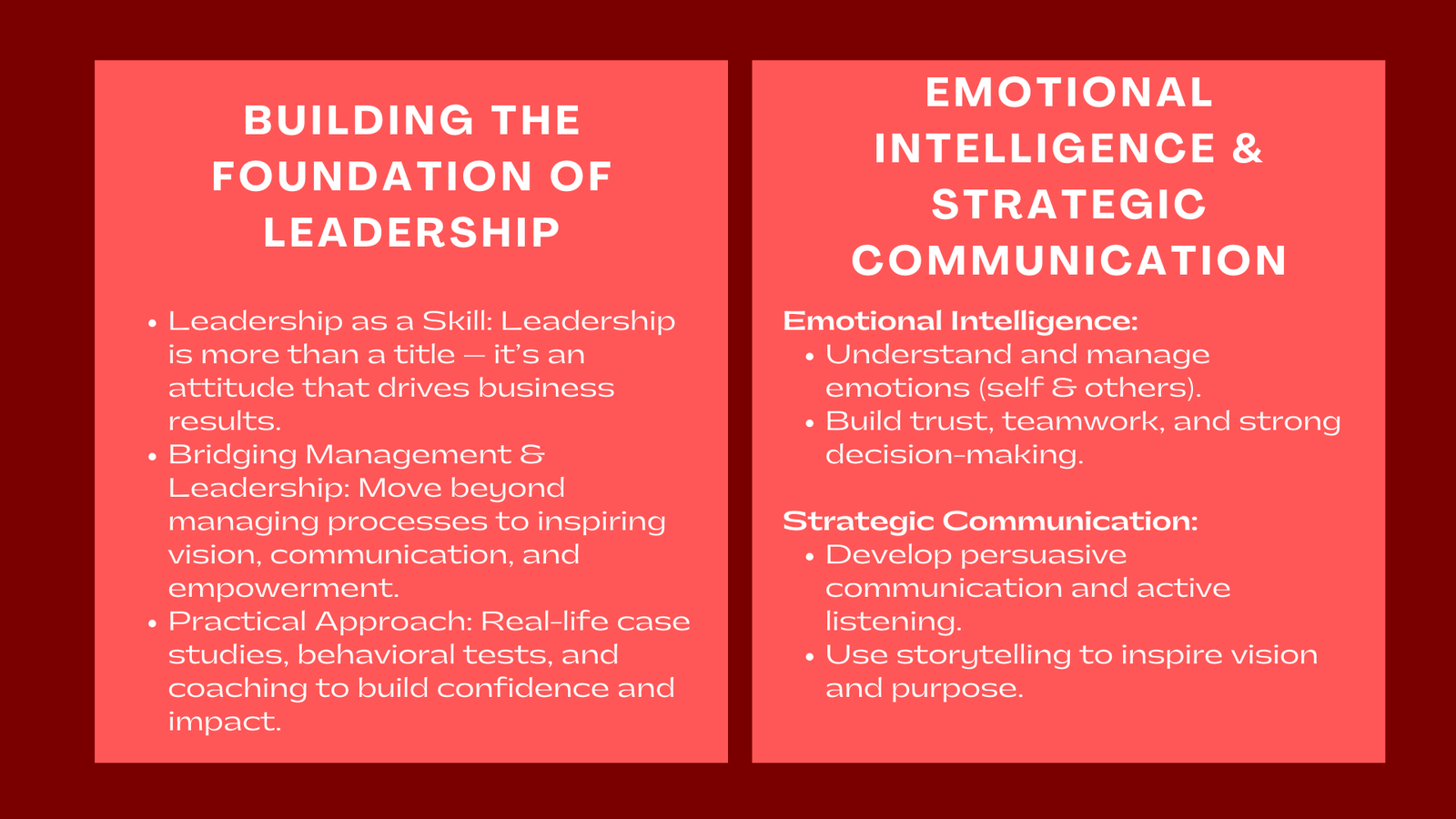
In the modern dynamic world of corporations, leadership is not a position, but an attitude, and a skill that had a direct correlation on the business results. With the increased number of organizations and the diversification of the teams, the need of managers with leadership skills that create a desire to inspire and make strategic decisions has never been greater.
Corporate Training Singapore on Developing Effective Leadership Skills to Managers can also be used to bridge the gulf between management and leadership. The management is concerned with the processes and performance whereas leadership is concerned with the vision, communication, and empowerment. With the aid of this program, which aligns with corporate in-house leadership training Singapore, managers are able to build a sense of self awareness, emotional intelligence and strategic thought, which can change them into leaders compared to being supervisors, who make organizations grow, and evolve.
This is not just some kind of training. It dwells on practical leadership based on case studies in real-life situations, behavioral test and coaching activities, which aid in the creation of confidence and impact.
Building Emotional Intelligence and Self-Awareness
Emotional intelligence is one of the main pillars of leadership; it is the skill to perceive and control personal as well as other individuals feelings. The training commences with enabling the participants to evaluate their emotional triggers, communication styles as well as interpersonal strengths.
With the help of guided activities, managers obtain skills to be able to perceive the impact of emotions on the decision-making process and group dynamics. They discuss ways of dealing with stress, coping with pressure and positively facing conflicts. High emotional intelligence leadership helps a leader to create trust and teamwork, which are the key factors of a high performing team.
It is also important to be self aware. The managers are taken through exercises of 360-feedback and personality tests that indicate their blind spots in leadership style. Knowing their natural leadership style the participants are able to adjust themselves better to the demands of their teams and the various business circumstances.
Strategic Communication and Influencing Skills
The success of a leader lies in the fact that a leader must be able to convey vision and inspire others. The given part of the training is devoted to the development of persuasive communication as well as active listening skills that help to establish credibility and influence.
The participants are taught to make messages that will be felt and not just in a one on one conversation in a team meeting or in overall presentation in the company. The training has put special focus on storytelling as a leadership strategy, where exchanging experience and values can bring passion and purpose, similar to how the importance of in-house finance training for companies Singapore emphasizes tailored communication for maximum impact.
Also, managers are coached on how to use different communication styles to different audiences executives, subordinates or cross-functional group. They are known to employ negotiation and persuasion tactics in order to deal with opposition and gain buy-in to organizational projects.
Empowering Teams and Driving Organizational Results
Good leaders understand how to make the best out of their people. This part of the program educators managers on the values of proper delegation, creating clear expectations and developing performance based accountability systems.
Situational leadership and servant leadership that focus on flexibility and empowerment are some of the leadership models that the participants explore. They also get to know how to combine task orientation as well as empathy, which motivates employees to own their jobs.
Team activities and simulations help the participants to implement the learning experience into practice in a way that would recognize how to drive innovation, enhance collaboration, and align personal ambitions with organizational purposes.
Conclusion
Leadership cannot be fixed in one place; one constantly changes in accordance with challenges and opportunities. It is through this corporate training Singapore that managers become empowered, awake, and equipped to lead in a very authentic and an effective way. They get to know that leadership is not a matter of authority, but it refers to influence and impact.
Investing in leadership development, organizations establish the culture of responsibility, belief, and constant improvement. This training turns managers into individuals who are capable of making complex decisions, operations of diverse teams and inspiring the employees of a common vision to succeed. The end result is robust leadership which would be the force that pushes the organization toward sustainable development and sustainability.
As leaders develop so does the whole organization develop. Their effectiveness in communication and motivation of others as well as their skill to acclimate into change predetermines the success or failure of a working environment. This training makes the point that great leadership is not a point of destination, but an ongoing activity, the one that builds culture of a company, builds teamwork, and guarantees further success in a constantly altering business environment.