
How Technology is Transforming In-House Training Programs
How Technology is Transforming In-House Training Programs
Understanding How Technology is Transforming In-House Training Programs
Training of employees has been one of the main pillars of organizational development. Organizations that invest in learning and development would have better employee performance, employee retention, and long term competitiveness. Traditional training methods, however, with classrooms, workshops, and printed manuals, were prone to scaling, engagement, and flexibility problems. Due to the rapid introduction of digital technologies, the process of in-house training is radically changing. Rather than being an occasional or responsive practice, it is emerging as a constant, interactive, and data-driven process that helps the employees in all the steps of their career development.
Technology is also not only improving training, but transforming the whole landscape in a way that enables companies to design tailor-made, hands-on and affordable training programs. This is why many firms are adopting the best in-house training programs in Singapore Riverstone, recognizing the importance of in-house training for businesses Singapore that aim to grow sustainably and remain competitive.
Digital Platforms and the Rise of Learning Management Systems
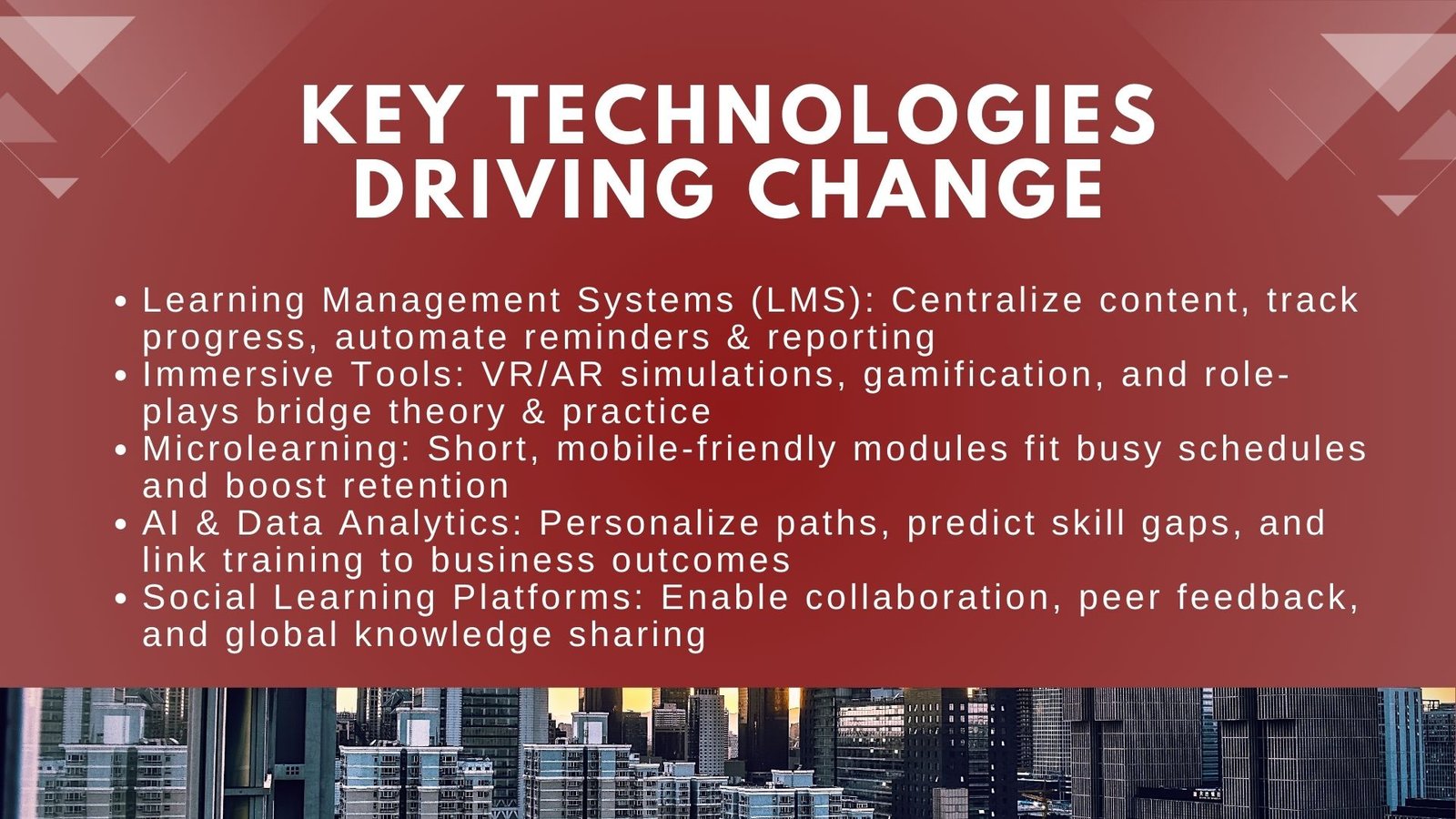
Learning management systems (LMS) have become one of the most influential shifts in in-house training. These systems have centralized training materials, employee monitoring, and give the managers information on learning. Rather than organizing disjointed workshops or hiring trainers to track the involvement part-by-part, an LMS enables organizations to conduct learning on a large scale. The training modules are accessible at any time or place and this flexibility is indicative of the flexibility of work itself and this is particularly true in hybrid and remote workplaces. In addition, LMS platforms can integrate with eLearning content creation for businesses Singapore, ensuring that companies deliver localized and customized digital training effectively.
In addition to convenience, LMS platforms are personalizable. The agency employees are able to select their learning courses according to their career objectives, whilst managers are in a position to designate certain modules according to the skills shortage or job demands. There is also the aspect of automation whereby systems can send reminders, monitor completion rates and give reports without having to do the work by hand. This not only helps save time, but also the results of training become more transparent through accountability. The technology has turned training into a permanent cycle of development that responds to the needs of the organization as well as the aspirations of employees, and is no longer a one time event.
Interactive and Immersive Learning Technologies
Whereas LMS platforms are providing the structure, new technologies are changing the very learning experience. Simulation of real-life situations in training environments is becoming feasible through the use of virtual reality (VR) and augmented reality (AR). As an example, VR can be used in a manufacturing company to provide training of the employees on how to handle equipment without the risks of operating a machine that is alive. On the same note, AR can be used to superimpose instructions on devices or equipment and show employees how to do tasks in real time.
These simulations are more than engagement, they enhance knowledge retention and application. It is a consistent finding that experiential learning results in the development of profound learning over and above the normal lecture-based training. Such technologies as simulations, gamification, and role-plays platforms do not only make the learning process more engaging but also more applicable to real-life work. These tools are useful in closing the gap between theory and practice as organizations find ways to equip employees to play up-to jobs with more complex tasks.
Microlearning is another main innovation in which the training is presented in quick and narrow modules instead of long training sessions. Technology allows making microlearning available on mobile devices, so that employees can learn during a break or even in the course of commuting. This is a change to bite sized content which takes into consideration the attention span in the modern world, and it makes learning easily fit into the busy work schedules. Collectively, these innovations show that technology is not merely computerizing the existing practices but is inventing whole new forms of knowledge delivery.
Data-Driven Insights and Personalization
The revolution of data analytics is the most radical effect of technology on in-house training, perhaps. Any interaction between the employees and training platforms produces valuable information. This data has now allowed organizations to gauge effectiveness, understand what they do not know, and optimize content over time. To illustrate, when the employees are always having problems with a certain module, it could be an indication that they need to redesign such content or even to give them extra materials.
Personalization is also being boosted by artificial intelligence (AI). However, AI-powered systems can suggest paths of training to the individual employees by examining their learning patterns. One applicant who is interested in becoming a leader may be referred to management courses whereas a different employee who gives priority in being technical could be advised to attend advanced software training. Such a high degree of personalization was almost impossible in the old training practices but is increasingly becoming a norm with digitally empowered training settings.
Predictive analytics can also be used to enable organizations to forecast training requirements in advance before problems happen. As an example, when turnover analysis reveals that employee turnover in a certain job category is low because of poor growth prospects, predictive tools can identify this, and HR can implement special employee development programs. Integrating training and workforce analytics allows businesses to connect learning to business performance, so that training does not become a cost but an investment.
Collaboration and Social Learning in Digital Spaces
In-house training programs are also allowing collaboration with the use of technology. Social learning systems motivate employees to give information, seek answers, and give feedback. These platforms emulate the social media dynamics, whereby they form interactive communities in which knowledge sharing occurs naturally. Employees no longer perceive training as a top-down process that is managed exclusively by HR or trainers; they are actively involved, and together they are part of the shared learning.
Cross-functional knowledge sharing is also made better by collaboration tools. A marketing practitioner can be enlightened by the observations of a product developer and financial teams can get insights on operations specialists. Such a cross-pollination of ideas makes organizational culture strong and promotes innovation. Technology is what guarantees these interactions to be not bound by geography and that global teams can learn in real time with each other.
Also, video conferencing and virtual workshops enable the subject-matter experts who are at different sites to play a part in in-house training without logistical challenges. Employees get the benefit of exposure to different views and organizations save time and resources which would have been used in travels and coordination. Technology enhances interaction and entrenchs the notion that training is a collective process and not a solo undertaking by creating an environment of mutual learning.
The Future of In-House Training: Continuous and Adaptive
In the future, it is even expected to get more integrated as technology is going to further in-house training. Training programs will be more adaptable as AI, machine learning and natural language processing technologies evolve. The systems will be in a position to evaluate the performance of the employees in real time and provide immediate corrective feedback and training will become an on-going process, not an event scheduled.
The other trend is integration of learning and work itself. The future of training does not exist outside of the realm of day-to-day tasks but is entrenched directly inside workflows. Employees can be shown onscreen notices, contextual materials or they can even use AI assistants to walk them through activities as they perform them. This learning in the flow of work methodology is designed to make training not disruptive but flowed within the productivity.
Sustainability will also contribute. In an effort to improve cost and environmental efficiency, digital training solutions present a greener alternative to paper-based resources and face-to-face training that needs travel. Cost saving is not the only long-term payoff; it is also an identification with greater corporate social responsibility objectives.
After all, the future of in-house training is personalized, continuous, and technology-driven growth. Those organizations that will embrace such a transformation will not only be upskilling their employees but also creating a strong workforce that will respond to the changes in the market.
Conclusion: Technology as a Catalyst for Learning Excellence
Technology has taken in-house training way outside its customary limits. The digital revolution is changing the way organizations train, engage and develop their employees through LMS platforms and immersive environments such as VR, data-driven personalization and collaborative learning environments. What was previously a logistical problem has been turned into a strategic asset in that it has allowed organizations to provide learning, which is accessible, flexible and aligned to business goals.
The real strength of technology in training consists in the possibility to render learning an ongoing process and an inseparable part of everyday work. With the rate of change and growing complexity in organizations, the skill of quickly adapting to changes as they occur, through continuous learning is critical. Technology offers the means to realize such a vision so that training does not continue to be merely an HR activity but a source of innovations, performance and sustainable development.