There is no clear winner in the debate between in-house training and outsourcing – depending on the circumstances, one might be a better option than the other: in-house training may be advisable if the business needs specific content, on-the-job training and alignment with work processes, or greater control over the training process, whereas outsourcing might be preferred if specialist knowledge or external experiences are needed. Which option is best will depend on the goal of training, funding, available internal resources and staff size.

What Is the Difference Between In-House Training and Outsourcing?
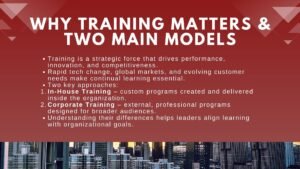
In-house training is the development and delivery of the training by the organization’s own trainers or contracted trainers delivered within the context of the organization, while outsourced training is delivered by an external provider with its own trainers, training materials, methods and subject-matter experts. The answer is who owns the content, delivery and customization of learning.
In-House Training vs Outsourcing
| Factor | In-House Training | Outsourced Training |
| Customization | Highly adaptable to company needs | May use standardized content |
| Internal Processes | Can directly reflect company workflows | May require additional customization |
| Expertise | Depends on internal capabilities | Access to external specialists |
| Cost | Can be efficient for recurring training | Can be cost-effective for specialist topics |
| Scheduling | Greater internal control | Depends on provider availability |
| External Perspective | Limited | Stronger external viewpoint |
| Scalability | Depends on internal resources | Can provide additional training capacity |
As the table indicates, in-house training may result in greater customization and scheduling flexibility, whereas outsourcing may yield a greater range of specialist knowledge and an external perspective. A closer comparison of these trade-offs, including how they apply across different training scenarios, is covered further in this guide to in-house training vs outsourcing.
Why Do Companies Choose In-House Training?
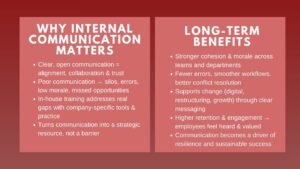
In-house training is generally favoured by companies because the material can be developed directly based on the company’s processes, systems and terminology. This enhances the relevance of the training as employees practice the skills in the context in which they’ll be deployed on the job.
For companies that have regular training requirements, like onboarding new employees or re-training existing employees to maintain compliance, it can be more convenient to have an in-house program that can be repurposed and captured as time goes on. This is in contrast to a one-off specialist course where internal capability building might not be cost-effective.
What Are the Main Benefits of In-House Training?
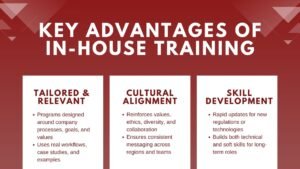
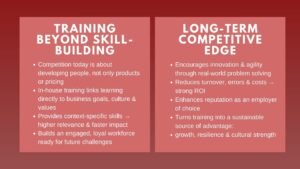
The primary in-house training benefits are the ability to deliver tailored learning content, link training to the company objectives and use real workplace examples to train employees, instead of generic case studies. Employees can also be trained directly on internal systems, processes and policies, thus minimizing the learning-to-application gap.
These benefits rely heavily on the organization’s ability to provide an effective program, as internal resources, trainers and time are essential to the program’s success and can deny the organization these benefits if they are not in place. A more detailed look at how these advantages support employee development and workplace performance is available in this overview of in-house training benefits.
When Can Outsourced Training Be More Effective?
When a business has a specialist need, a wider view of the industry or a lack of subject knowledge within the business, then outsourced training may be more effective. Sometimes a provider teaches more than one organization in the same niche and has materials and experience in place, which would take a long time to come up with.
For one-off or sporadic training requirements, outsourcing can be more appropriate as constructing internal training capability might not be cost-effective. An external expert might be more beneficial than building up a knowledge base from scratch if a company is introducing a new requirement for the first time.
How Does In-House Training Improve Customization?
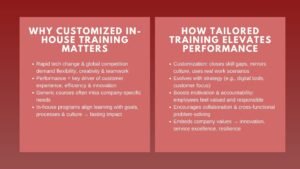
In-house training makes the training more customized because the content is developed based on real processes, clients and challenges in the organization and not generic scenarios. This type of customised training includes staff on internal financial processes, leadership expectations for managers for the company or training scenarios for customer service situations that mimic actual customers.
Customization can go beyond that to ensure compliance training is based on real company policies, training on internal software or a module on a particular skill shortfall uncovered in performance reviews. This is a level of relevant course that is not replicable in a standardized course that is outsourced without a great amount of adaptation.
How Does Outsourcing Provide Access to Specialist Expertise?
Outsourcing gives employees access to specialist expertise as their trainers are focused on a specific subject, technology or industry. Such trainers are more likely to bring along successful materials that have been proven to work and to have practical experience from various organizations rather than just one company.
This is especially useful if the field is a technical one that is constantly changing, and an external trainer will be better placed to keep up with the latest changes than a trainer with other duties. The downside is that this knowledge is likely to be less detailed about the company’s operations.
Which Option Gives Companies More Control Over Training?
The main advantage of in-house training is that companies have more control over the size of the group and the pace of the training, as well as the level of customization of the training content to the company’s processes. Since it runs delivery directly, sessions are flexible and can be fine-tuned according to operational requirements or at the last minute.
This is not as flexible in outsourced training, as the course schedule and content structure will typically be influenced by the availability of the outsourced provider and the typical course format. But, despite the quality of the subject areas provided, companies with fluctuating operational needs may find this a worthwhile limitation.
Is In-House Training More Cost-Effective Than Outsourcing?
The cost of in-house training depends on the trainer’s cost, but it is not limited to that; the trainer should also consider training materials, training technology, training venue, employee training time, preparation time for the trainers, and administrative costs. Outsourcing costs, in turn, cover the provider’s fees, but it typically saves on preparation time and administrative burden.
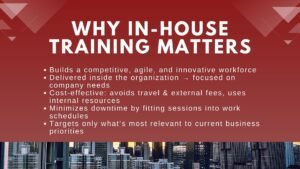
In-house training can be more cost-effective when an organisation trains large numbers of people on a regular basis, as the materials and trainer time can be used repeatedly. Where extra training and learning are needed, which may be done on an occasional or more specialised basis, outsourcing may be more cost-effective, as it may take longer and be more expensive to build up the needed skill internally than an extra one-off engagement.
How Does Each Approach Affect Employee Engagement?
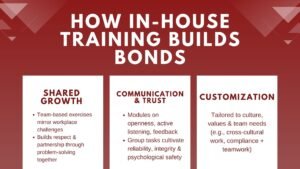
In-house training is one way that can help to build employee engagement, as it is more relevant to their work, and the participants can ask questions specific to their work. Knowing other members of the workforce in the room and familiar trainers can also help make a discussion easier for some employees.
The increase in engagement can also happen in a different way using outsourced training – the trainer could be energising, fresh, offering a new perspective or be more credible due to their training experience in a different facility. Other workers are more receptive to change, even if the material is more difficult to adapt to the particular role.
Which Approach Better Supports Company-Specific Skills?
In-house training is more likely to help the development of the skills of the company since the content can be created specifically in accordance with the internal procedures, tools and culture. An outside provider is less likely to be able to replicate a training on a proprietary system without extensive customization.
Outsourced training is likely to be more effective on skills with wider industry relevance that can be transferred across organisations, e.g. general project management processes or commonly used software applications. When the training approach is matched with the company-specific knowledge required, mismatched expectations are avoided.
How Do In-House and Outsourced Training Compare for Scalability?
If the organization has the trainers, materials and infrastructure needed to repeat their training sessions, in-house training can scale efficiently when there are a lot of employees. After a course is developed, it can frequently be implemented for multiple cohorts with minimal extra expense.
When internal training capacity is limited, or the need to train is higher than the capacity that can be provided by the internal team, there is a need for additional training capacity, which can be achieved through outsourcing. This renders outsourcing a viable choice for organizations that need to scale training in a short time frame without growing their in-house training department.
How Does Training Quality Depend on the Delivery Approach?
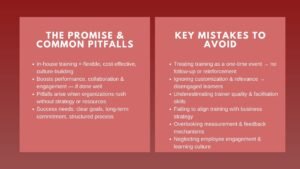
It isn’t as much about in-house versus outsourcing training, but rather it’s about having a professionally designed training program. A successful course, whether delivered online or offline, should have clearly stated learning goals, a well-considered course outline, competent instructors, hands-on activities, evaluation and feedback.
Informal training by an experienced employee is not a guaranteed method of effective employee training, because it lacks actual examples, assessment or reinforcement after training. This foundation is essential to any in-house or outsourced program if the desired results in terms of learning are to be measured.
When Should Companies Combine In-House and Outsourced Training?
In-house and outsourced training should be used together for a company to leverage the various skills required for each component of a learning need, such as having specialists from outside the company deliver technical certification while in-house trainers deliver company-specific process training to others. This hybrid method allows organizations to reap the advantages of both without being forced to choose between the two options.
For example, a business may hire an external facilitator to teach them leadership theory and then deliver leadership theory sessions within the company using internal case studies and workflows. This mix can yield more effective results than using either one or the other.
How Can Businesses Choose the Right Training Approach?
Both in-house training and outsourcing have their pros and cons, and this is where the flexibility of the choice of training approach helps businesses determine which method is appropriate for their context. Several general guidelines are provided in the table below for typical business scenarios.
Practical Decision Framework
| Business Situation | Potentially Better Option |
| Company-specific processes | In-House Training |
| Large recurring employee groups | In-House Training |
| Highly specialized technical subject | Outsourcing |
| Need for external industry perspective | Outsourcing |
| Internal trainer expertise available | In-House Training |
| No internal training resources | Outsourcing |
| Sensitive internal processes | In-House Training |
| One-time specialist training | Outsourcing |
The following are general guidelines, which should not be interpreted as rules, and final decisions should still consider the training budget, in-house capacity and specific training goals of the organization.
What Should Companies Consider Before Selecting a Training Model?
Some questions companies should ask themselves before choosing a training model: What’s the skill gap you want to address? Is the knowledge company-specific or not? Will you have trained personnel on hand? How many employees need to be trained? Will the training be repeated?
Other questions that could be asked are: will specialist external expertise be needed, how much customisation does the subject require, what would the cost of each option be, how will the learning outcomes be assessed, and is it possible to reuse or update the training over time? These questions enable HR and L&D teams to make a reasoned, evidence-based choice, instead of choosing out of habit or convenience.
Conclusion
Is in-house training really better than outsourcing? Not automatically. In-house training tends to be the stronger option when organizations need customization, close alignment with internal processes, scheduling flexibility, and support for long-term employee development within their own systems and culture.
Outsourcing, on the other hand, can be the stronger choice when a company needs specialist expertise, an external perspective, or training capabilities it does not have internally. The in-house training benefits of customization and workplace relevance are real, but they only translate into results when the organization has the internal resources to deliver the training well.
Ultimately, organizations should choose their training approach based on learning objectives, employee needs, internal capabilities, cost, customization requirements, and the expertise required to achieve meaningful workplace outcomes, rather than assuming one model is always better than the other.