AI In-House Training with Data Analytics
The past five years have seen the workplace transforming quicker than it has been over the past 20 years. Companies in all sectors are struggling with the growing skills gaps, employee demands and the growing need to justify the worth of each dollar invested in training. Within this context, AI in business training is no longer a fad, but a strategic requirement. Firms which previously depended on annual classroom training and standardised e-learning courses are now considering intelligent, data-driven systems which are responsive to individual learners, reveal real-time insights, and are constantly enhanced by time.
This transition is a call and an opportunity to junior to mid-level professionals. Regardless of whether you are pursuing a career in learning and development (L&D), finance, operations or people management, it will make you unique to know how technology in in-house training programs works. It is not merely the application of a new tool but the way of thinking differently that is, the process of training as a process is no longer an event but a data-driven, continuous learning process.
This article researches the impact of artificial intelligence and data analytics on the reimagination of in-house training, as implemented by organisations. It includes the processes underlying it, real-life scenarios, the pitfalls and the lessons that practitioners have learned in the process. It also gives very practical advice to individuals who intend to use the approaches in their respective organisations or professions.
Why Data Analytics Is Reshaping Corporate Learning
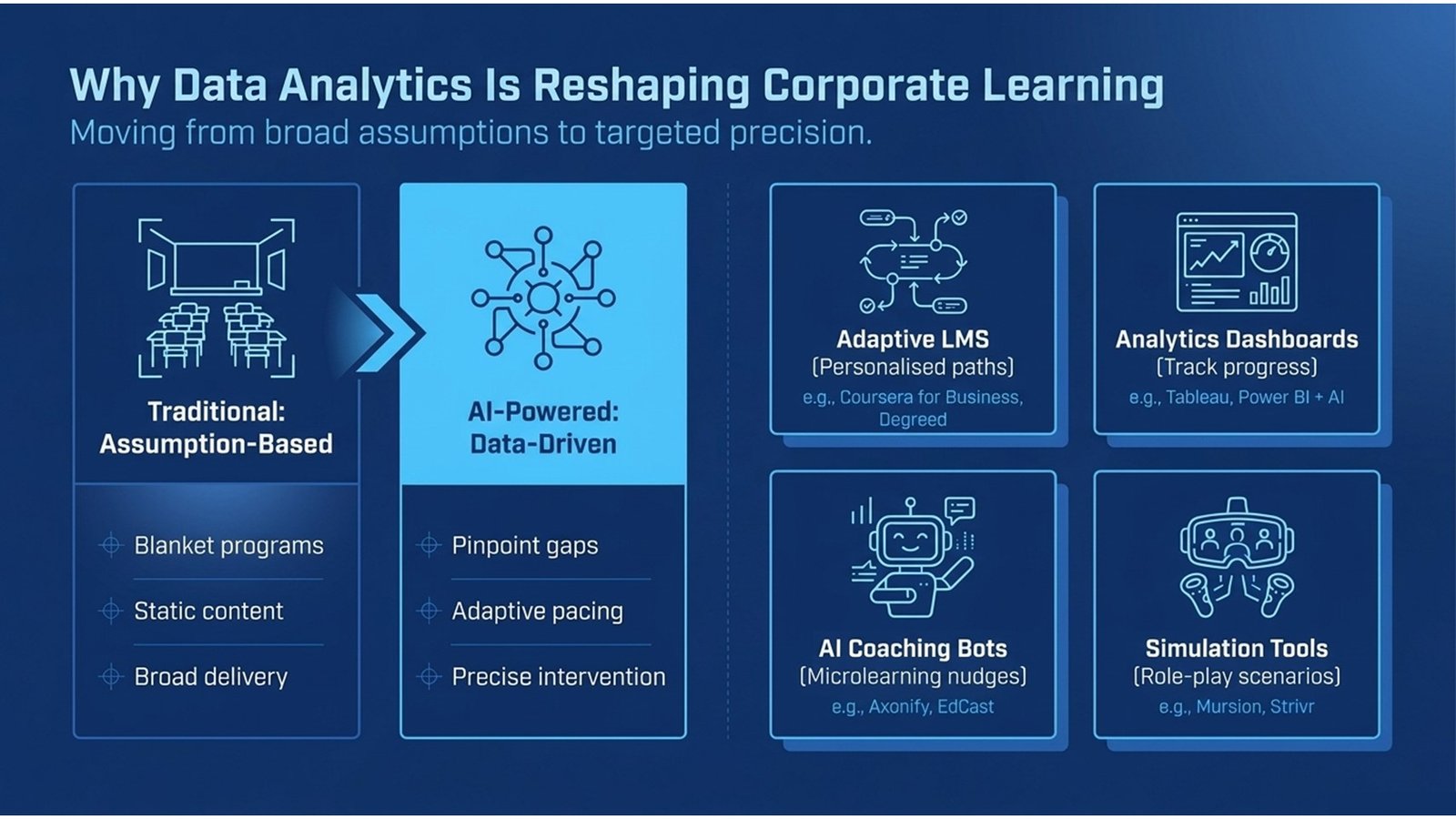
The traditional training programmes used to be created on assumptions- what HR believed they required, what the industry surveys indicated, or what had worked previously. The thing is that assumptions are hardly likely to represent the reality on the ground. The starting points of employees are different, their learning rates are different and gaps are different. All these variations cannot be covered through a blanket training programme and organisations end up consuming lots of budgets on contents that fail to move the needle.
This is the case with data analytics. Using the information gained based on performance reviews, job evaluations, learning management system (LMS) logs, and even customer satisfaction ratings, organisations are able to identify precisely where the skills are deficient and who they concern. This is where AI in corporate training is potent – AI algorithms are able to handle such data at scale and can detect trends that would take a human analyst weeks to detect. As an illustration, a financial services company may find out that its middle-level analysts are always scoring lowly on situation-driven cash flow queries, which may indicate a particular deficiency in advanced financial analysis training that can be resolved in a more focused manner than in a generalized manner.
Analytics can be used to perform continuous monitoring in addition to diagnosis. Real-time dashboards can provide training managers with the information on which modules employees are evading, which tests are failing over and over, and which students are in danger of being disengaged. This makes training more of a living programme than a frozen exercise that reacts to the reality on the ground, and not that which was planned months ago.
Table 1: Common AI-Powered Training Tools and Their Applications
| Tool Category | Example Platforms | Primary Use | Best For |
| Adaptive LMS | Coursera for Business, Degreed | Personalised learning paths | Onboarding, upskilling |
| Analytics Dashboards | Tableau, power BI + AI. | Tracking learner progress | L&D managers, HR teams. |
| AI Coaching Bots | Axonify, EdCast | Microlearning nudges | Busy professionals |
| Simulation Tools | Mursion, Strivr | Role play/scenario training. | Sales, finance, leadership |
How In-House Training Programmes Are Being Redesigned
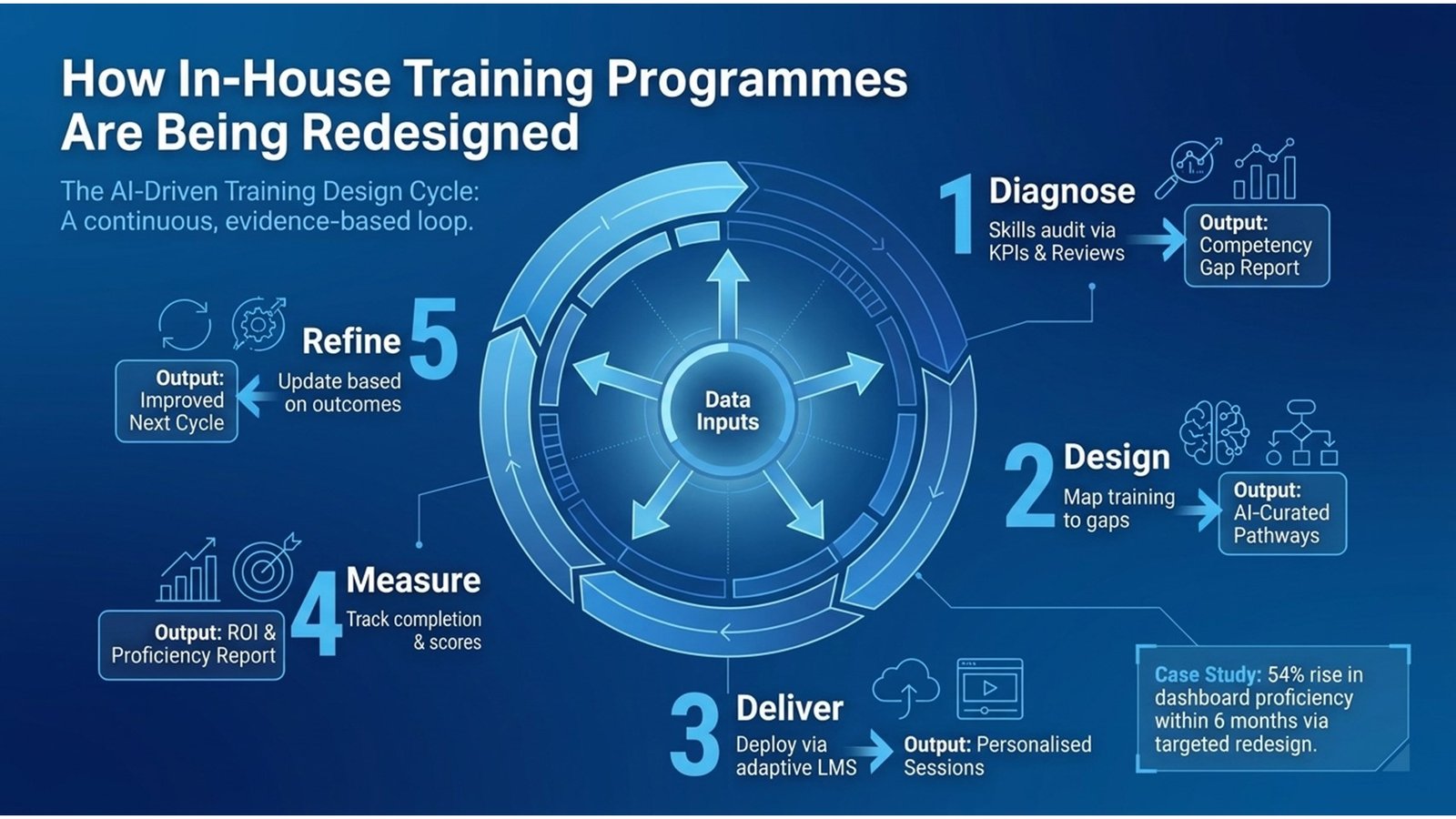
Redesign of in-house training is not a one-off event but rather a systematic process through which organisations go through phases. The change to technology in in-house training programs needs a clear picture of the present situation, a view of the desired situation and a strict policy of how to get between the two. The following process flow is how the majority of organisations manage to do this journey.
Process Flow 1: AI-Driven Training Design Cycle
| Phase | Key Activities | Data Inputs | Output |
| 1. Diagnose | Assessment of skills gap, employee survey. | Performance reviews, KPIs | Competency gap report |
| 2. Design | Training to competencies gaps. | Profiles of roles, business objectives. | AI-curated learning pathways |
| 3. Deliver | Deliver content through LMS using AI prompts. | Learner engagement data | Personalised training sessions |
| 4. Measure | Track completion, evaluation scores. | Post-training evaluation data | Proficiency ROI and skills report. |
| 5. Refine | Revise material on the basis of criticism. | Learner feedback, business outcomes | Enhanced follow-up training plan. |
A practical example in the real world is through a multinational logistic firm in Germany. Following an observation that its warehouse supervisors had been having difficulties with operational reporting, the firm used a skills audit, which is data-driven and has been done using the current HR information system. The audit found out that less than 3 out of 10 supervisors were able to correctly read KPI dashboards. To address the situation, the organisation redesigned its in-house programme with the help of an adaptive LMS that tailored the content to the current level of literacy of a particular supervisor. In 6 months, the level of dashboard mastery in the group increased by 54%.
The discipline of diagnosis stage was what made this case instructive. The company did not think that it was aware of the issue it allowed the data to talk. This is a strategy, which starts with facts, rather than with hunch as the characteristic of a good AI in the training implementation of corporations. It also emphasizes a bigger fact: the technology is not the solution. The quality of the data that is feeding the system and how clear the questions are to the system, define the quality of the outcome.
Five Key Steps to Implementing AI-Powered Training with Analytics
To practitioners charged with the responsibility of developing or enhancing an in-house training department, the five steps listed below will offer a useful guide. Every step is made informed by what other organisations that have led the pack have found out through experience what works and what does not.
Step 1: Establish a clear data infrastructure. Any AI tool cannot be implemented without a solid data base in the organisation. This implies, that HR systems, LMS platforms and performance management tools are linked and inputting into a central repository. The AI recommendations will not be reliable without clean and consistent data. Most organisations do not take this step and think why their AI-based tools are not effective..
Step 2: Define the training outcomes you want to measure. This may sound to be a no-brainer but it is regularly ignored. AI and analytics have the ability to measure nearly everything, which is why the question is what is important. Organisational training metrics must be directly linked to business results not completion rates or satisfaction levels, actual job performance changes, error rates, or client results. An example is that, in advanced financial analysis training, one of the significant results could be a decrease in the number of mistakes in spreadsheets or better results at quarterly forecasting.
Step 3: Select tools that fit your context, not the latest trend. Technology has saturated the market of in-house training programs with platforms that are making exaggerated claims. The correct option will be determined by the size of your organisation, the nature of the roles to be trained and the technology ecosystem which is in place. The needs of a 200-person professional services firm are different than the needs of a 10,000-person manufacturer. By piloting a tool, organisations can learn and not overcommit in the process before deploying it fully.
Step 4: Train your trainers and L&D teams first. The failure point of AI in corporate training is one of the most prevalent aspects since the implementation of technology occurs without the development of human capability to utilize it effectively. The L&D professionals must know how to interpret analytics dashboards, AI-generated recommendations, and develop content that takes advantage of the personalisation capabilities of adaptive systems. This is both change management issue and a technical issue.
Step 5: Build in a continuous improvement loop. Training based on AI is not something that should be set and forget. The best programmes involve regular review cycles at least once every quarter when training managers analyze the data and discuss on-the-job performance with line managers and make changes based on this discussion. Companies that do this always record a compounding growth over a period, whereby the training group will always have an improvement in performance as compared to the previous one.
Integrating Data Analytics Into the Training Workflow
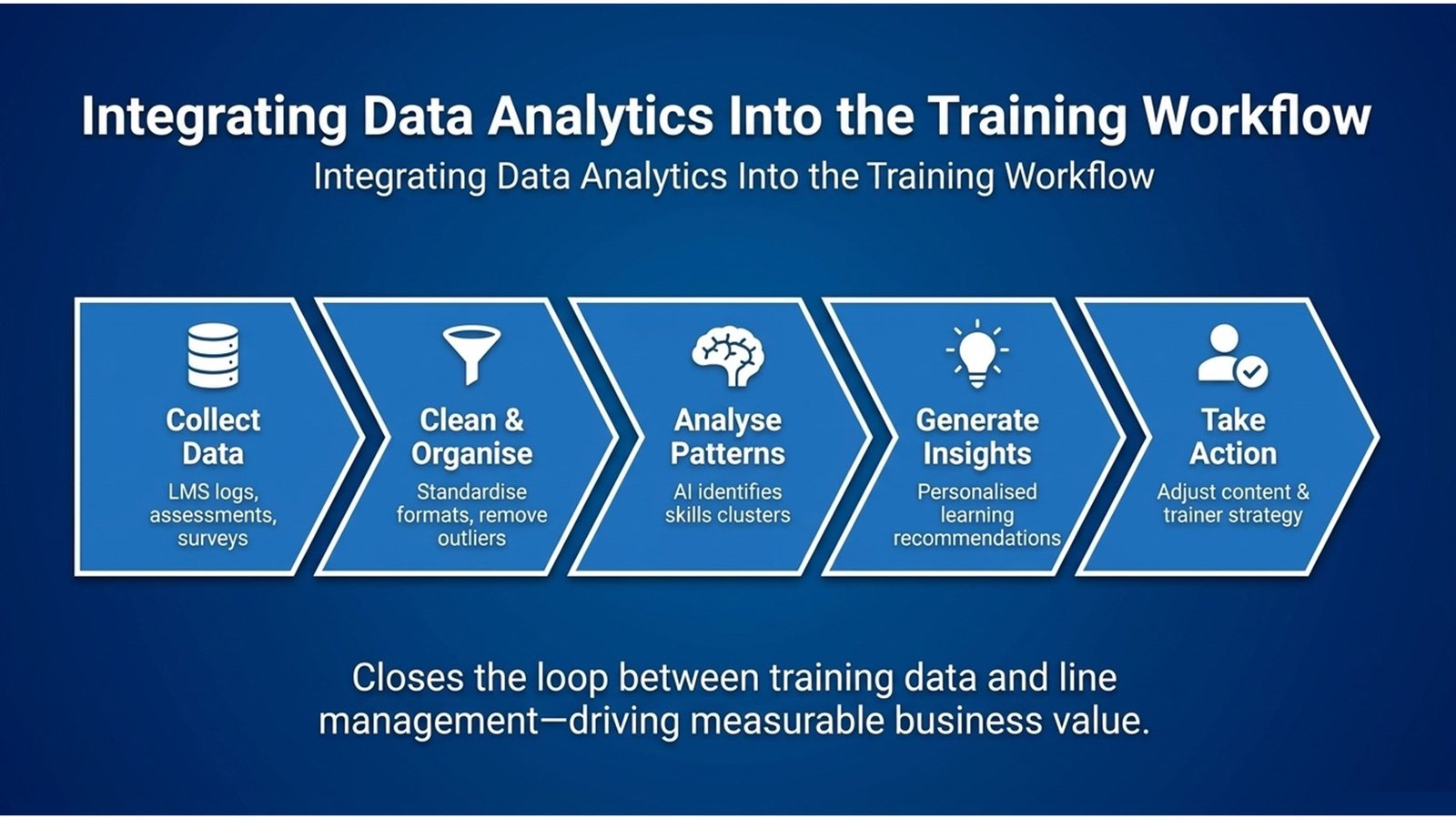
The use of data in financial or operational settings is not a new concept to many organisations and the use of the same rigour when it comes to training remains uncharted by most organisations. The addition of analytics to the training process needs a shift in mindset of perceiving training as a cost centre to training as a source of quantifiable business value. This is particularly so when the one is seeking further training in financial analysis where the subject matter and mode of delivery are the same; the handling of complex data sets.
Process Flow 2: Data Analytics Integration Workflow
| Step 1 | Step 2 | Step 3 | Step 4 | Step 5 |
| Collect Data | Clean & Organise | Analyse Patterns | Generate Insights | Take Action |
| LMS logs, assessments, surveys | Normalise data, format standardisation | AI comes up with skill clusters. | Personalised learning recommendations | Modify content and instructor plan. |
A practical example of this integration comes from a UK-based professional services organisation that rolled out a technology in in-house training programs initiative for its analyst cohort. The company has integrated a data analytics layer into its LMS, enabling managers to view in real time the analysts who were having difficulties with certain modelling methods. Instead of waiting till the end-year performance review, the managers could act within weeks after recognizing a gap. This led to cutting operational time of new analysts by 40% to achieve full productivity.
The most important lesson that was obtained in this case was the necessity to provide the loop between training data and line management. Technology is able to unearth insights, yet, it is up to a human to take action. The best implementations coupled the analytics dashboard with a well-defined protocol – who gets the data, who is expected to take action on the data, and in what time frame. In the absence of this, the most powerful analytics tool would be noise.
Table 2: Common Challenges and How to Address Them
| Challenge | Impact | Recommended Response |
| Data Privacy Concerns | Staff opposition and legal opposition. | Implement clear data governance policies |
| Lack of Buy-In | Low adoption rates | Involve leaders as champions |
| Integration Complexity | Delayed rollout | Staged implementation of phases. |
| Trainer Capability Gaps | Poor content quality | Pre-rollout training of the trainers. |
| Budget Constraints | Limited to a single department. | One team pilot, followed by scaling. |
Challenges, Lessons Learned, and the Human Element
None of the technology-based initiatives can be successful without resistance, and AI in the corporate training is not an exception. In organisations that have employed such programmes, there are a stable range of challenges that come out. The familiarity with these issues would provide a great benefit to professionals when they have to find their way through their own implementations.
The initial and the most tenacious issue is the privacy of data. The employees do not like the fact that their learning behaviour in terms of the amount of time spent on a given module, the number of times that it took to pass an assessment, etc. are being tracked and examined. Companies that have previously managed this successfully are open at the very beginning: it should be clear what data they are gathering, how these are used, and what are the protective measures. In a number of organisations in Europe where the GDPR is applicable, posting a clear policy of data use actually improved the employee participation in training programmes as it was seen that the organisation had nothing to hide.
The second issue is the temptation towards excessive use of AI suggestions and neglecting human judgement. This was found out by one insurance company in Canada, which implemented an AI-based LMS that started suggesting the content only based on the scores of assessments. The system had constantly been pushing increasingly technical content to high scorers, and failing to consider their interest in developing as leaders. Staff became fed-up, and participation declined. The solution was simple enough, offering employees the right to determine their own learning courses in the frames of AI-proposed parameters, however, the lesson was learned: technology in in-house training programs must support, not to substitute, human agency.
The third and least recognized problem is the skills gap among the L&D itself. Numerous training practitioners joined the industry unintroduced to the concept of data analytics, and the transition to AI in business training demands that they become proficient in interpreting dashboard, assessing model results, and creating data-driven training programs. Companies that have invested in training their own L&D teams, either by taking data literacy courses, or by certifying on learning analytics, or by working with analytics vendors, have also achieved much more successful results than companies that thought that their existing teams could learn on their own.
Conclusion: Turning Insight Into Action
One of the greatest changes in the development of people in organisations has been the convergence of AI in corporate training, data analytics and technology in in-house training programs. This does not seem a far off trend that junior and mid-level professionals can look at with their eyes on the prize, it is a reality that is being practiced, job roles, expectations of performance and career paths are being redefined in real time.
These strategies benefit organisations in the most by not benefiting the most technologically advanced organisations. It is they who have been most rigorous in integrating concrete business goals with quality data, considerate human management and a true belief in constant improvement. They are the values that you will find most useful whether you are creating a training programme, attending one, or trying to establish a career in this area.
The applicability of AI-based, analytics-driven methods to advanced financial analysis training is specifically acute to people working or who want to work in the financial field. Learning how to use data, adjust to the new information and execute analytical skills in practice in real-world situations is the material of the contemporary financial training, as well as the most effective means of teaching it. The practitioners who have a clue to this and can negotiate the human and the technical aspects of the learning environment will be the ones that will be in a better position to lead in the years to come.
Actionable insights: Begin with an audit of the training data that your organisation already gathers and where the gaps lie. Push towards greater transparency in analytics data usage. Make your own data literate – even a basic knowledge of how to read a dashboard or understand a regression result will make you stand out in most jobs. You are able to impact the design of the training, demand outcome-based metrics instead of completion rates. And most importantly, keep in mind that the best application of AI in training is not to substitute the human connection and judgement, it is to make it more precise, quicker and focused on what people really need.