In-House Training for Hybrid Workforce
The manner in which human beings work has been revolutionized. In industries such as financial services and manufacturing, healthcare and retailing, organisational teams are working on-site and remotely, or both at the same time. This transformation has not just altered the location of work, but also the manner in which individuals learn, work collaboratively, and develop. To junior or mid-level professionals who need to operate in this terrain, or to those about to take the plunge, the way firms design and deliver in-house training Singapore is more pertinent than ever.
Training a hybrid workforce is no longer an additional activity but a fundamental business operation. In cases where the employees are widely distributed or on an alternate timetable, the conventional method of having all the employees in a meeting room just does not work. Companies that do it well experience better retention of employees, more definite team orientation, and quicker capability development. The latter rarely experience knowledge gaps, ineffective performance, and communication failures that are costly to resolve.
This paper will discuss the way organisations are developing and providing in-house training Singapore to hybrid teams. It addresses the procedures, the real-life problems, the practical instruments, as well as the teachings that specialists have learned and developed over the last couple of years. This guide is both practical in its approach, based on the realities of how things work, whether you are an expert seeking to know what good training should be, or you are developing your own case on why better workplace learning must be.
Why in-house training Singapore Matters More Than Ever in a Hybrid World
Pre-hybrid work, companies could count on proximity before the extensive use of hybrid work. The new employee would be placed next to an experienced employee and absorb the information naturally. An example could include a 2-hour skills workshop with a group of people on a Tuesday afternoon. Informal learning occurred during corridors and lunch. With a hybrid environment, such informal scaffolding is largely removed, and whatever it is replaced with must be much more intentional.
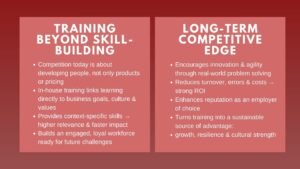
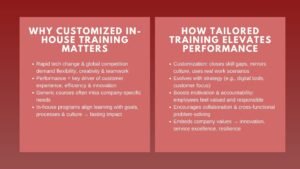
In-house training- programmes created, financed, and delivered by the organisation have a number of benefits over external courses. It can be tailored to the context of the company, its culture, and priorities. It develops institutional knowledge and not generic skills. And it gives the employees the indication that the organisation is investing in them, and this directly influences engagement and loyalty. In the case of mid-level professionals specifically, the availability of pertinent, in-house learning opportunities is always mentioned among the best job satisfaction factors.
Successful companies developing internal training programmes in relation to hybrid teams say that there is one thing in common, namely, that the technology is not often the issue. Video learning platforms, live virtual learning classrooms, and online tests are extensive and fair in cost. The more difficult part comes in the design, determining what to teach, the order of teaching, the person to teach it, and the way to assess whether or not it has brought about a behavioural change in the job. To get that design right, it takes not only strategic thinking but also a real-life comprehension of the adult professional learning process.
Designing a Training Programme That Works Across Locations
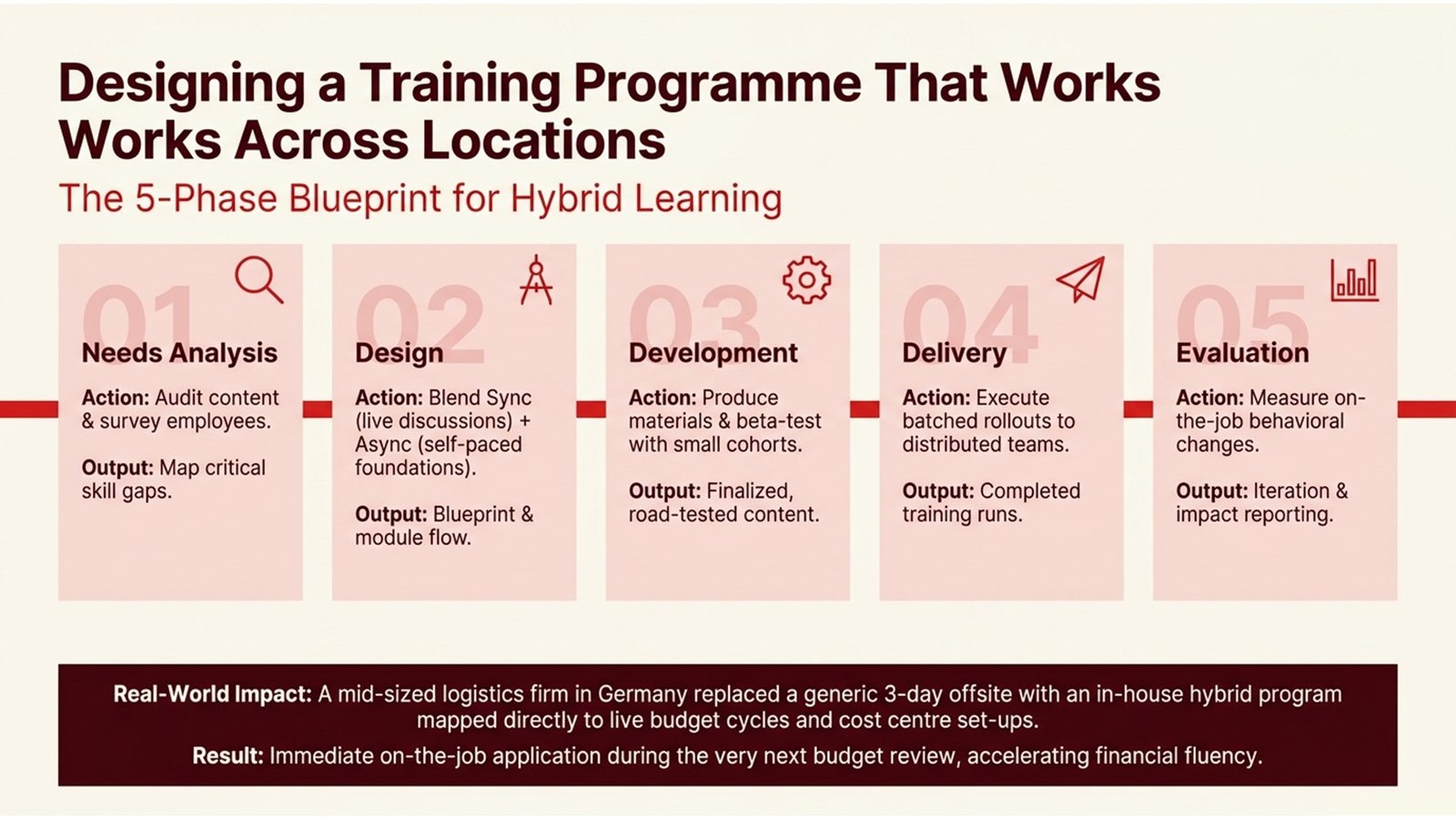
The first step to effective hybrid workforce training is a learning needs analysis. This is the process of determining the gaps between the existing capabilities and what the business needs. It is a process of surveying employees, interviewing managers, reviewing performance data, and, in some cases, auditing the existing training materials to get a glimpse of what is already available and what is lacking. Lack of this basis means that training programmes normally result in training what one perceives to be important and not what employees require.
After identification of the gaps, the design phase identifies the structure and method of delivery. Hybrid programmes are generally a combination of synchronous and asynchronous. Live training in real time (in-person or virtual) is effective when discussions, case studies, and activities need to be in real time. Asynchronous content, like videos recorded, written instructions, and self-paced modules, is more effective as a foundational knowledge that employees can revisit at their own speed. The art is in understanding what works well in what format and in what order to present the material in such a manner that it coheres towards a learning outcome.
Process Flow 1: Designing a Hybrid in-house training Singapore Programme
| Phase | Key Activities | Output |
| Needs Analysis | Interview managers, audit existing content, and survey employees. | Determined areas of skill shortages and priority. |
| Design | Establish learning objectives, select format (sync/async), and chart content flow. | Blueprint and module plan of training. |
| Development | Produce/edit content, develop tests, and test with a small group. | Finalised training materials |
| Delivery | Implement batched rollout to teams, live sessions, and self-paced modules. | Completed training runs |
| Evaluation | Gather feedback, evaluate retention of knowledge, and gauge on-the-job change. | Report of evaluation and iteration. |
This can be well exemplified in a real-world scenario. A medium-sized logistics organization in Germany chose to implement a cross-functional finance literacy programme among its operations and supply chain managers. Instead of taking them all to a three-day out-of-company course, they created an in-house one. The material was directly mapped to their respective budget cycles, cost centre set-ups, and reporting templates. The programme emerged as a model of professional finance for non-finance managers that is provided in context- relevant, immediate, and practical. The managers were able to put into practice what they had learned in the very next review of the budget, and this strengthened the learning process much more than any course would have done.
Key Steps to Building an Effective Hybrid Training Initiative
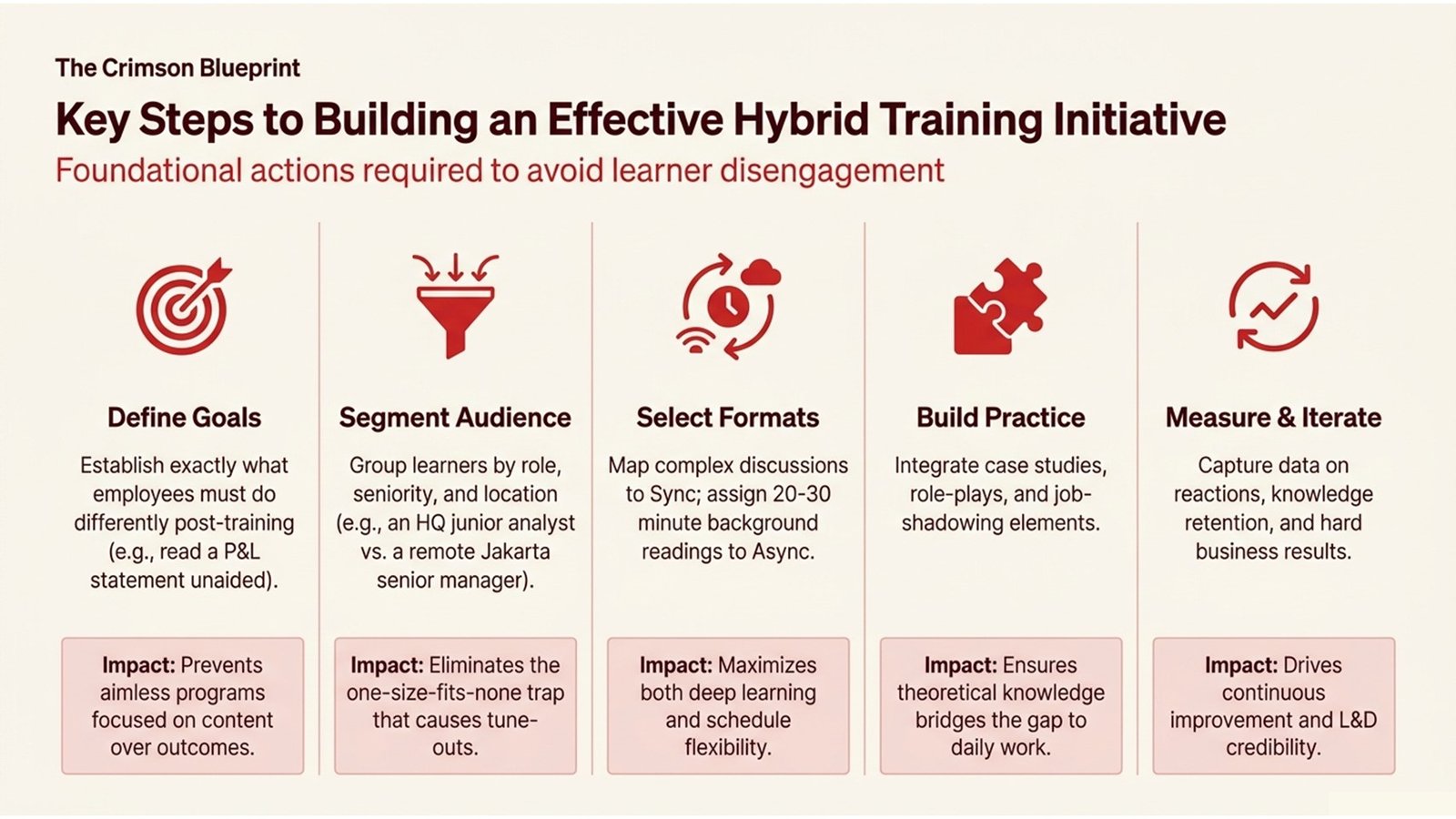
There are a number of steps in designing and launching a hybrid training initiative, which are interdependent. Any of them missing is likely to affect the effectiveness of the entire. The five steps below are a synthesised perspective of what works, as per organisational experience and best practice of learning development.
Five Key Steps to Building a Hybrid Training Initiative
| Step | What It Involves | Why It Matters |
| Define clear learning goals | Write down what employees can do differently upon training. | Avoids poor programmes that cannot be defined in terms of outcome. |
| Segment your audience | Assign learners to groups based on role, level and place to focus content accordingly. | Eschews blanket delivery that checks out learners. |
| Select the appropriate forms. | Pair up synchronous sessions with discussion-intensive subjects; asynchronous with background material. | Maximises learning and flexibility of schedule. |
| Develop practice experience. | Incorporate case studies, role plays, assignments, or job-shadowing elements. | Make sure that the skills are transferred to the actual work, not only theoretical knowledge. |
| Measure and iterate | Gather information at various levels: reactions, knowledge, behaviour, and results. | Facilitates a continuous process of improvement and credibility of the organisation. |
The initial one -setting clear learning objectives- may seem easy, but it is often neglected. Most of the training programmes start with content as opposed to outcomes. The question to take a better beginning is: what does a participant need to be different after six weeks of this training? In the case of a finance literacy course, one may aim that a non-finance manager will be able to read and understand a profit and loss statement without a guide or that they will be able to construct a simple budget on the company’s standard template. With such specific goals, all the other elements, such as content, assessment, and format, become a lot easier to design.
It is also important to segment the audience. A junior analyst in the headquarters has different learning needs, constraints, and expectations compared to a senior manager who works most of the time as a remote worker in Jakarta. Training hybrid workforces that attempt to satisfy both in one programme usually helps to satisfy neither. Organizations that make such light investments in segmentation as merely categorizing cohorts by job role or seniority have reported improved completion rates and post-training performance.
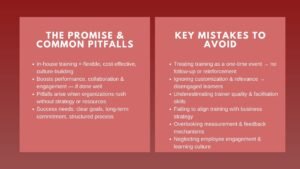
The most common step that is skipped in a hurry is measuring and iterating. Organisations tend to take the delivery of training as the culminating point when it is in fact the beginning point of assessment. The best in-house programmes design evaluation into the programme at the start of the design decision of what data will be gathered, how, and by whom. This is not merely a matter of demonstrating that training occurred but rather knowing whether the training was effective and improving the same in the subsequent group.
The Role of Internal Communication in Training Success
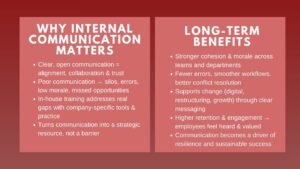
The most well-planned training programme will not work unless there is good communication surrounding it. When employees are not made to understand the reason as to why they are being requested to undergo training, the content of the training, and how the training is related to their day-to-day activities, the likelihood of them engaging meaningfully is much lower. It is here that internal communication training can become a much-needed enabler, not only to the employees that are being trained, but also to the managers, HR teams, and facilitators who will be carrying out the training.
Internal communication training will provide the professional with the necessary skills to communicate effectively, target information to the right audience, and balance the two-way traffic of information that hybrid working requires. This applies in the context of training rollouts through ensuring that launch communications are made to explain the rationale and benefits, managers are briefed and feel confident in their position as champions, and that the participants are informed and motivated with continued updates through the programme.
Process Flow 2: Internal Communication for a Training Rollout
| Stage | Communication Action | Channel | Owner |
| Pre-launch (4 weeks out) | Short form senior sponsors; draft programme announcement. | Email, town hall | HR / L&D Lead |
| Pre-launch (2 weeks out) | Invite participants; programme overview and expectations. | Email, intranet | L&D Coordinator |
| Week 1 | Introduction, greetings, and establish community rules. | Online meeting, chat program. | Programme Facilitator |
| During programme | Nudges of weekly progress; discuss important learnings across modules. | Email, internal chat | L&D Coordinator |
| Post-programme | Publicize completions; publish impact information; solicit comments. | Email, intranet, and briefing of managers. | HR / L&D Lead |
This was a lesson learned the hard way, as a European manufacturing company rolled out a six-module course in internal communication training to its team leads working in a hybrid team. The content was good and well planned, yet the rollout communication was scant. No context was provided on the calendar invitation that was sent to team leads. The attendance was less than half in the first two sessions. The re-launched programme, with an appropriate communication campaign, i.e., a video message by the CEO, one-page explanations, and live Q&A prior to the start date, increased the completion rates to eighty-seven percent. The information was the same, the discourse had been transformed.
Challenges, Lessons Learned, and What Practitioners Wish They Had Known
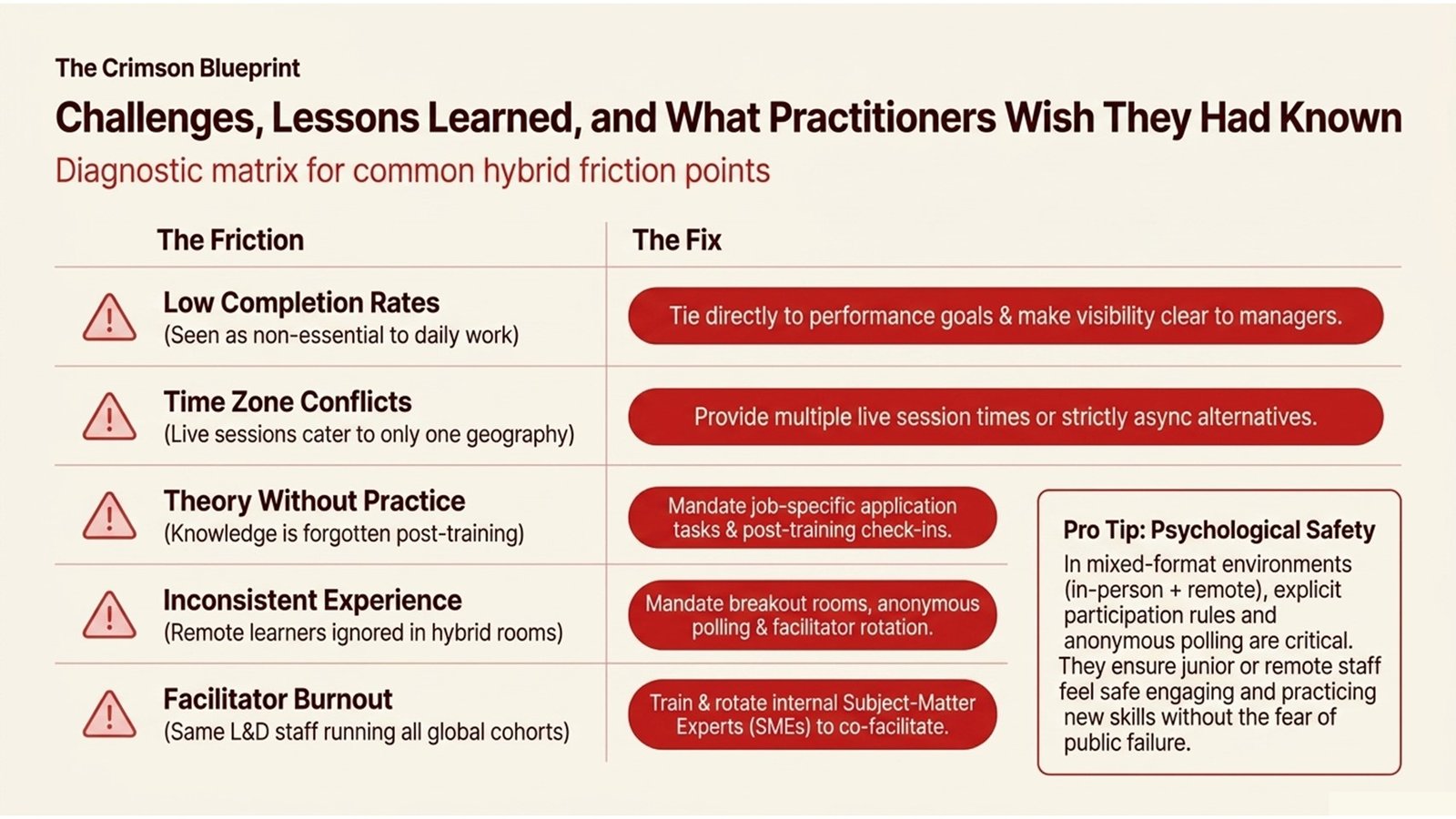
Any person who has been in charge of a hybrid training implementation will be able to attest that the barriers are not imaginary and can be startling at times. Time zone disparity poses a problem for real-time meetings. Workers who are at home are influenced by conflicting pressures, resulting in increased difficulty in allocating time to learning. When managers are not sold on the programme, they can send some silent messages to the teams to indicate that training is not compulsory and, in effect, undermine participation. And digital exhaustion (too many video calls, too many platforms, too many pings) reflects that the design of virtual training needs to be intentional and recognizable as a significant development experience; it will seem like yet another meeting.
Lessons that have been consistent among practitioners who have sailed through such challenges can be listed. To start with, simplify it. The number of clicks to access the training platform should be as low as possible. The content must be in manageable bits to ensure that an employee can accomplish something significant within a period of twenty or thirty minutes, if that is the time he or she has. Second, engage managers at an early stage and intentionally. The linking of training and application is the manager’s responsibility. When they know the programme, are convinced of its usefulness, and go out of their way to support whatever employees are learning, the transfer of the skills to the job is high. Third, do not attempt to do it all at the same time. Specific programmes that have a narrow focus are always better than broad-based multi-topic programmes that thinly spread learning.
Common Hybrid Training Challenges and Practical Solutions
| Challenge | Root Cause | Practical Solution |
| Low completion rates | Training is non-essential or unconnected with everyday work. | Connect training with performance objectives; make it visible to the managers. |
| Time zone conflicts | Live classes held at the convenience of one area. | Record or provide multiple session times to view asynchronously. |
| Knowledge not applied | Training involves theory training but not practice transfer. | Add job-specific tasks and post-training check-ins. |
| Inconsistent learner experience | Less facilitation attention is given to the remote participants. | Apply breakout rooms, online polling, and facilitate rotation. |
| Facilitator burnout | All cohorts are run by the same facilitators across multiple time zones. | Co-facilitate and rotate with train internal subject-matter experts. |
A good example of the most educative case study is a case study of a mid-sized Australian professional services firm that implemented a hybrid workforce training programme that focused specifically on professional finance for non-finance managers. The company had expanded rapidly and discovered that project managers, marketing heads, and operations coordinators were finding it difficult to contribute effectively to a budget discussion, cost analysis or profitability. A bottleneck was financial fluency. Their internal programme was eight weeks in duration with a combination of fortnightly virtual group sessions, weekly self-paced modules, and peer discussion prompts. A quarter of the way through the programme, managers who had undergone training were identifying cost variances sooner, posing more substantive questions during financial reviews, and the finance team was handed over to a much lesser extent. This had a quantifiable, observable impact on business performance.
The other key learning that practitioners have been repeating is the significance of psychological safety in a hybrid learning setting. Whenever the employees fear that they might be labelled as ignorant or fail when questioned by other employees, they are less likely to engage actively, ask questions, or practice new skills. This is particularly the case in in-person sessions that mix formats, that is, some participants are present in a room, and other participants are connecting through video. The design of good facilitation accommodates this dynamic. through anonymous online polling, small breakout groups, and explicit guidelines regarding participation. Facilitators can make it possible to have a situation where every learner feels safe to participate, no matter where they are or their rank.
Conclusion: Turning Training into a Strategic Advantage
The issue of in-house training Singapore of hybrid teams is not to be resolved once and left on its own. It is a continuous organisational capability that needs to be invested in, undergo iterations, and be a deliberate design. The most successful companies in doing it are not always the ones that have the biggest budget or have the most advanced technology. It is they who know the actual learning requirements of their people, communicate effectively on what training is, why it is important, and measure results in an honest manner to be able to continuously improve.
To junior and middle-level professionals, the concept of how training of the hybrid workforce is to be designed and provided can be a form of literacy in itself. It assists you in identifying quality learning when you come across it, promoting improved training in your own company, as well as making the most of the available programmes. And to people creating training programmes, these principles can be directly applied into practice: begin with needs, design with outcomes, communicate intentionally, and never cease measuring.
Of all the things that have been discussed in this article, three actionable insights can be distinguished. To start with, internal communication training should be invested in as a core competence, rather than an additional one; it will not only enhance training uptake but also team performance. Second, design professional finance/programmes give non-finance managers a real business context embedded in them; non-contextual financial literacy material is hardly ever netted into the job, as contextualised material is. Third, consider training of a hybrid workforce as an ongoing programme rather than a single event. Create feedback loops, swap facilitators, keep the content current and fresh, and use each cohort as a learning experience to learn something new about what your organisation requires. When it is done in-house, training correctly is among the best investments that a business can make in its employees.