Corporate sales training programs also enhance client relationships by equipping salespeople with the hands-on tools needed to communicate better with clients, practice consultative selling, have a better understanding of their clients’ needs, and build trust and long-term client management. Good sales training in the company leads to client conversations that are more productive and leads to a measurable increase in customer retention.
What Are Corporate Sales Training Programs?
A corporate sales training program is a course or series of courses aimed at enhancing the selling techniques, communication abilities and client relationship skills of salespeople within a company. Corporate programs immerse their students in a learning environment that reflects the business’s products, markets and customers, and provide learning content that is directly relevant to the workplace. The programs usually address the entire sales process – from prospecting and discovery to negotiation, closing and account management.
Good corporate sales training isn’t about the delivery of technique. Leading programmes include skills training, practice, role play, coaching, and real-life application to make sure that learning leads to consistent behaviour change on the sales floor. Structured and continuous sales development efforts are associated with regular improvements in client engagement, conversion rates, and customer satisfaction, according to consistent reporting from organizations that make them a regular part of their sales and business development processes. Regular, structured sales development efforts are regularly linked to improved client engagement, better conversion rates and higher satisfaction scores, according to consistent reporting from organizations that make it a regular part of their sales and business development process.
Why Are Client Relationships Important in Modern Sales?
In today’s competitive business landscape, sustainable sales performance is rooted in client relationships. Consumers are flooded with information and options as compared to any time in history, and that makes it difficult to compete with just price and product. Relationships — understanding the client’s business, seeing what they need, and always providing them value — is what the client will increasingly stick with, expand, or walk away from.
The research has consistently demonstrated that keeping a customer is much cheaper than getting a new one and loyal customers make more money via repeat business, larger contracts and referrals. A sales professional who focuses on developing relationships with people and making it a trust-based relationship has established a more formidable barrier than any product feature or price. That’s why the fundamental element of any successful corporate sales training is relationship building.
How Do Sales Training Programs Improve Communication Skills?
Sales training programs enhance communication abilities by training sales representatives to construct discussions, ask more questions, listen actively, and adjust their communication style to suit various client personalities and situations. Structured training gets sales teams away from pitch-led conversations (salesman talking at the client), and onto dialogue-led conversations (where the client shares issues, priorities, and decision-making criteria, which the salesman can address with relevant solutions).
Sales training generally focuses on communication skills, which include verbal communication, non-verbal communication, written communication (proposals and email follow-ups), and presentation. Experts with better communication skills form connections more quickly, avoid miscommunication, set expectations, and connect with their clients in a professional, respectful, and productive manner every single time.
Table 1: Sales Skills Developed Through Corporate Training
| Sales Skill | Workplace Application | Client Relationship Benefit |
| Active Listening | Fully understanding the client’s needs before responding | Clients feel heard and valued |
| Needs Analysis | Identifying specific business challenges and priorities | Solutions align closely with client goals |
| Consultative Selling | Positioning products as solutions to problems | Builds credibility and long-term trust |
| Objection Handling | Addressing concerns constructively and confidently | Reduces client hesitation and builds confidence |
| Negotiation | Finding mutually beneficial deal structures | Strengthens partnership and commercial outcomes |
| Relationship Management | Regular account reviews and proactive follow-up | Increases retention and repeat business |
| Emotional Intelligence | Adapting communication style to client personality | Deepens rapport and reduces conflict |
| Storytelling | Using case studies and examples to illustrate value | Makes complex solutions easier to understand |
How Does Active Listening Help Build Stronger Client Relationships?
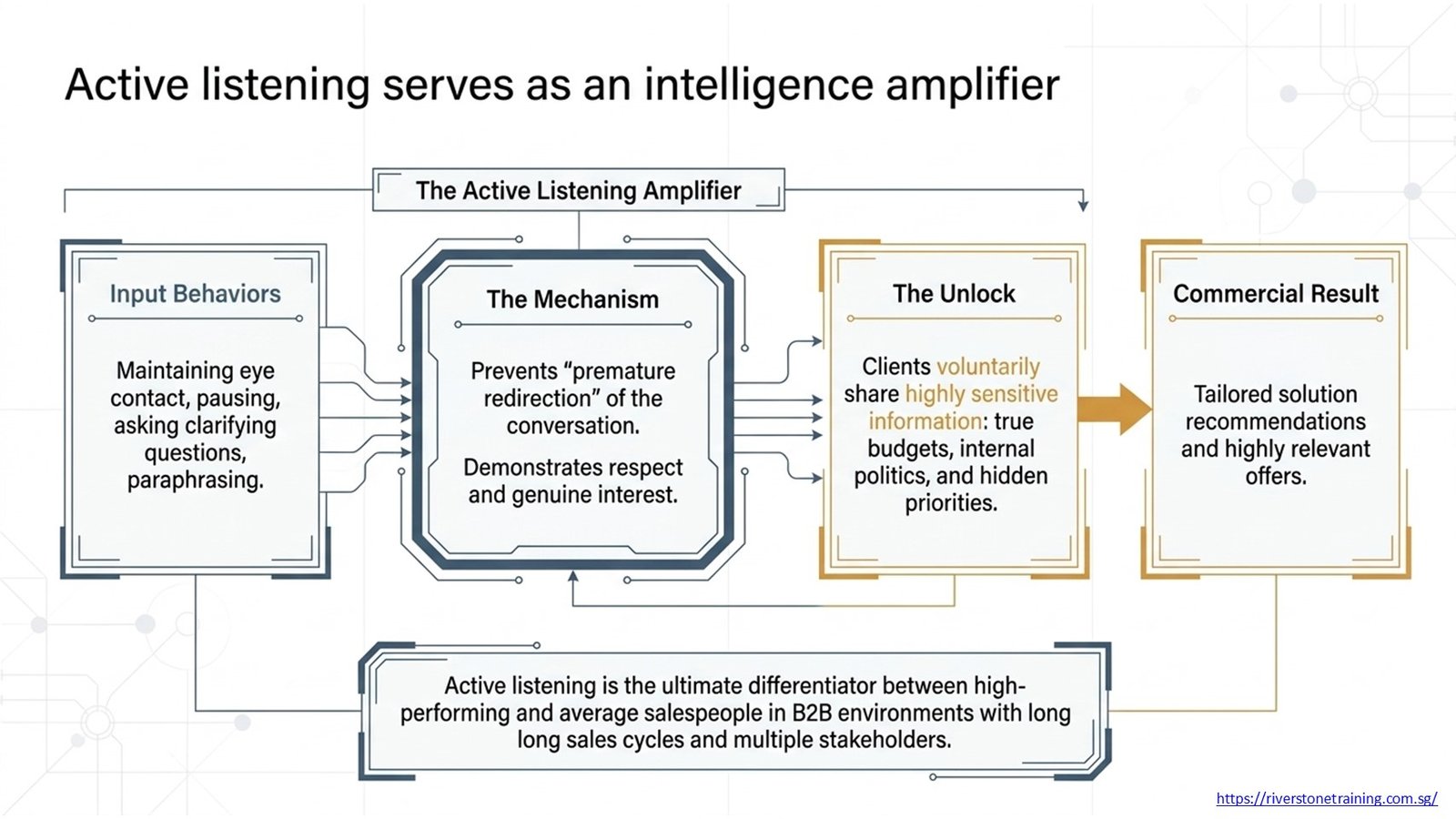
Perhaps no skill is as precise and as underutilized in sales as active listening. It is not just about listening to what a client has to say; it is about processing, reflecting, and responding in a way that shows the client you understand and are interested. Active listening is a technique that sales pros use to make up for the absence of words in the client’s voice; they ask questions, paraphrase, and don’t interrupt or redirect the discussion too early. These behaviours indicate to the client that his/her needs and concerns are valued.
Active listening has a major commercial impact. People feel listened to when they are feeling listened to, and they’re more likely to share their budget, politics, internal priorities, and other sensitive information with the sales professional who will make it easier for the salesperson to make the right solution recommendations and make their offer more relevant. Active listening is always a big differentiator between high-performing and average salespeople in B2B sales environments with long sales cycles and multiple stakeholders.
Table 2: Client Relationship Building Activities and Required Skills
| Relationship Activity | Sales Skill Required | Client Benefit |
| Initial Discovery Meeting | Needs analysis, open questioning | Aligned understanding of client priorities |
| Solution Presentation | Consultative selling, storytelling | Relevant, credible recommendations |
| Proposal and Negotiation | Value communication and negotiation skills | Fair, transparent commercial terms |
| Regular Progress Reviews | Account management, relationship management | Ongoing trust and service improvement |
| Problem Resolution | Emotional intelligence, communication | Faster recovery and stronger loyalty |
| Strategic Planning Sessions | Key account management, advisory skills | Long-term partnership and growth planning |
| Post-Sale Follow-Up | Proactive communication, service orientation | Higher satisfaction and referral likelihood |
How Do Sales Professionals Develop Trust With Clients?
It takes time to build trust in client relationships by being consistent, competent, and honest. Trust-building behaviours are taught in sales training in the following ways: A professional sells through commitments, communicates proactively when there is an issue, never overpromises, and cares about the client’s interests even if this is commercially unfeasible. Clients are able to easily tell the difference between salespeople who sell goods and services, and those who truly serve as a business partner.
Common strategies taught in corporate sales programs that allow you to build trust are to set expectations clearly from the beginning, make small promises and follow through before making big asks, share relevant information proactively (industry trends, updates on regulations, your perspective on the competition, etc.), and have regular review meetings that are not geared towards sales targets but towards client outcomes. Over time, these behaviours build trust, loyalty, and resistance among customers to competition.
How Does Consultative Selling Improve Customer Engagement?
Instead of the conventional product-push method, consultative selling is a customer-oriented strategy that aims to grasp the customer’s requirements before offering a solution. Consultative selling qualified sales people start with discovery in order to understand the client’s business context, strategic priorities, challenges, and success metrics. Once they have developed this understanding, they place their product/service as a relevant solution to identified problems.
This can have a substantial impact on customer engagement. Clients who experience consultative selling report increased satisfaction with the selling process, increased confidence in the selling process recommendation, and increased understanding of the salesperson’s business. It works best in high-value or complex sales situations, such as professional services, technology solutions, financial products, and training, where client needs are complex and a one-size-fits-all sales approach is not particularly persuasive.
How Do Sales Training Programs Improve Needs Analysis Skills?
Needs analysis is the systematic procedure of determining a client’s context, outcome, and the gap between the two. Sales training programs enhance needs analysis abilities by helping salespeople master methods of diagnostic questioning, like the SPIN Selling model (Situation, Problem, Implication, Need-Payoff), or GROW (Goals, Reality, Options, Ways). These frameworks give a structure to the conversation and avoid going off-topic or feature-level selling.
The abilities of the needs analysis process yield two major advantages. They first help salespeople know what is the best solution to offer for the client to maximize his/her satisfaction and deal size. Secondly, they produce client-specific language and evidence that can be utilized during the entire sales process from Proposal through presentation and negotiation, so that the solution has been built around the client’s circumstances, not created as a template.
Table 3: Communication Techniques and Their Effect on Client Relationships
| Communication Technique | How It Is Applied in Sales | Effect on Client Relationship |
| Open-Ended Questions | Ask ‘what’, ‘how’, and ‘why’ questions to explore needs | Encourages the client to share priorities freely |
| Active Listening | Maintain eye contact, paraphrase, and avoid interrupting | Demonstrates respect and genuine interest |
| Clarification | Restate client statements to confirm understanding | Reduces misalignment and expectation gaps |
| Empathy Statements | Acknowledge client concerns before presenting solutions | Builds trust during difficult conversations |
| Structured Feedback | Summarise meeting outcomes and next steps clearly | Ensures shared understanding and accountability |
| Storytelling | Share relevant success examples and client case studies | Makes value proposition tangible and memorable |
| Silence | Allow the client time to respond without rushing | Creates space for honest, considered responses |
How Can Relationship Management Increase Customer Retention?
Relationship management is the continuous effort involved in maintaining, developing, and deepening clients’ relationships after the sale. Sales training programs that work on developing relationship management skills teach the salesperson to go beyond just taking orders or solving problems to establish a strategic dialogue that meets the client’s needs, finds opportunities for growth, and makes the salesperson a trusted advisor and not a supplier contact.
In practice, relationship management behaviors involve the ability to schedule regular review meetings (quarterly business review sessions, annual strategic sessions), keep client preferences and history up to date, introduce clients to appropriate internal specialists, and share market information and/or competitive intelligence proactively. Companies with trained sales teams that understand structured relationship management have been proven to experience significant gains in Net Promoter Score, client churn, and the amount of upsell and cross-sell revenue generated from their current client base.
What Role Does Emotional Intelligence Play in Sales Success?
Emotional intelligence in sales is a competency of recognizing, understanding, and controlling one’s own emotions and the emotions of others, namely, clients. They have a better understanding of the client’s mood and energy and adjust their approach on the fly; they are better at dealing with their own frustration or anxiety during tough negotiations, and they bounce back from rejection or conflict with a nonchalant attitude. These capabilities have a direct impact on client experience and quality of relationships.
Corporate sales training uses scenarios, role-play, and reflection exercises to build emotional intelligence. When emotionally charged sales situations arise, such as negotiating for a better price, handling a client’s complaint, or pitching to a competitor, sales professionals who have learned how to develop EQ are more likely to stay focused on the client’s needs rather than getting defensive. More and more, EQ is being seen as a better overall indicator of long-term sales success than product knowledge in relationship sales.
How Do Sales Professionals Handle Objections More Effectively?
Handling objections is the skill of addressing customer objections – whether they be about price, timelines, competition, risk, or fit – in a positive manner without defensiveness or without ending the sales process. Objection handling techniques are introduced in sales training courses to encourage salespeople to view objections not as an obstacle, but as an opportunity to engage with the client, listen to the concern, agree with the client’s point of view and solve the problem by providing evidence, empathy and alternative solutions where appropriate.
Good objection handling contributes to the client’s satisfaction because the salesperson is confident, ready, and willing to solve the problem instead of selling. Responses to common objections — “your price is too expensive,” “we’re satisfied with our existing supplier,” and “now’s not the right time” — are different for each of these objections and can be developed into training programs that professionals can deliver naturally without sounding scripted or deflating the client’s objection.
How Can Sales Teams Improve Long-Term Account Management?
To provide long-term account management, salespeople must adjust their thinking to focus on the relationship and investment aspects of their role rather than the transaction. It is not about making just one sale, but it is about making the client the preferred partner for a long-term and evolving partnership with the client. Sales training programmes build up account management skills by focusing on structured account planning – profiling key accounts, mapping stakeholder relationships, identifying growth opportunities, and setting up proactive strategies to engage key accounts based on their strategic value.
Key account managers who have been taught in structured programmes understand how to categorize their accounts by value and potential – they spend their time accordingly, rather than simply in response to their clients’ requests, and they know what their clients need before they even ask. This proactive approach to account management delivers tangible results that can be measured, such as lower churn from high-value clients, higher wallet share through product/services expansion, and an improved account referral pipeline with long-term clients.
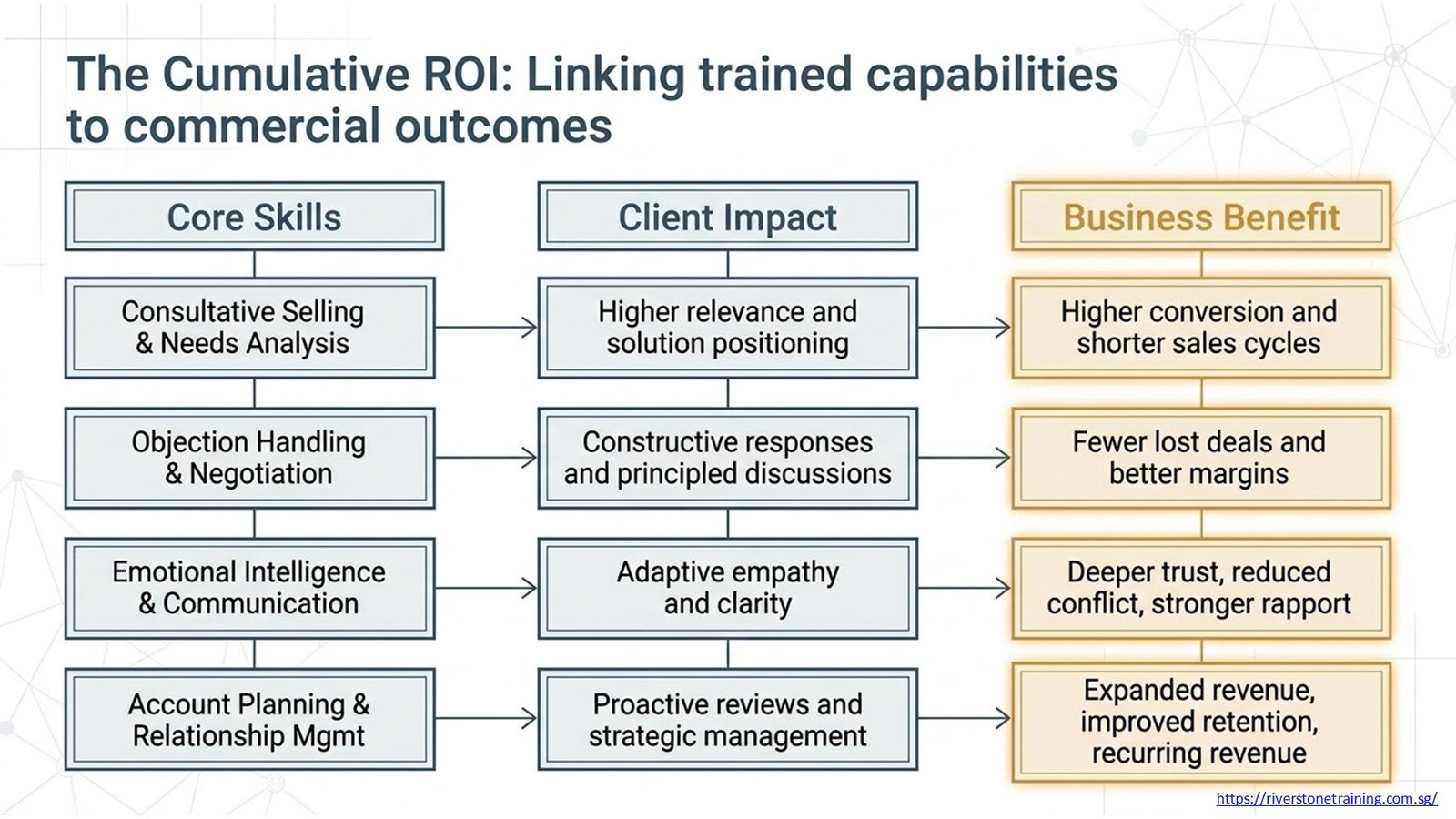
Table 4: Sales Training Learning Areas and Business Benefits
| Training Learning Area | Skill Developed | Business Benefit |
| Communication Skills | Clearer, more confident client conversations | Stronger first impressions and rapport |
| Consultative Selling | Needs-based solution positioning | Higher conversion and client satisfaction |
| Objection Handling | Constructive response to concerns | Shorter sales cycles, fewer lost deals |
| Emotional Intelligence | Adaptive communication and empathy | Deeper trust and reduced conflict |
| Relationship Management | Proactive account management behaviours | Improved retention and recurring revenue |
| Negotiation Skills | Principled, value-focused deal discussions | Better margins and partnership outcomes |
| Account Planning | Strategic management of key accounts | Expanded revenue from existing clients |
| Sales Performance Metrics | Tracking activity, pipeline, and results | Data-driven coaching and improvement |
How Does an In-House Training Framework Support Sales Development?
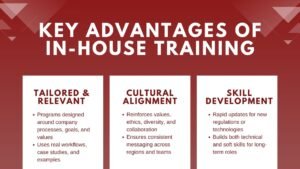
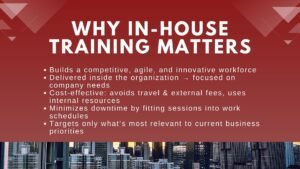
The in-house training framework is used to support sales development, providing structured training that focuses on the specific roles within the business, using real products, real clients, real scenarios, and real sales language that is relevant to the business. In-house training gives facilitators the flexibility to adjust the content of the training to the organization’s sales approach, market situation, and client profile, unlike external open-enrolment training. This relevance can greatly boost the transfer of learning from the training room to real client interaction. If your organisation considers delivering in-house training to be an appropriate choice for your team, you can have a look at the in-house training framework options for sales and relationship management training.
In-house sales training also allows for building the skills of the whole team and ensuring that both new team members and those with experience in the industry will always exhibit the same approach to client interaction, behaviours in relationships and communication methods. This uniformity creates a familiar and trusted client experience across all points of contact, especially for companies with several salespeople involved in a client’s relationship in varying capacities.
How Do Organizations Measure the Effectiveness of Sales Training?
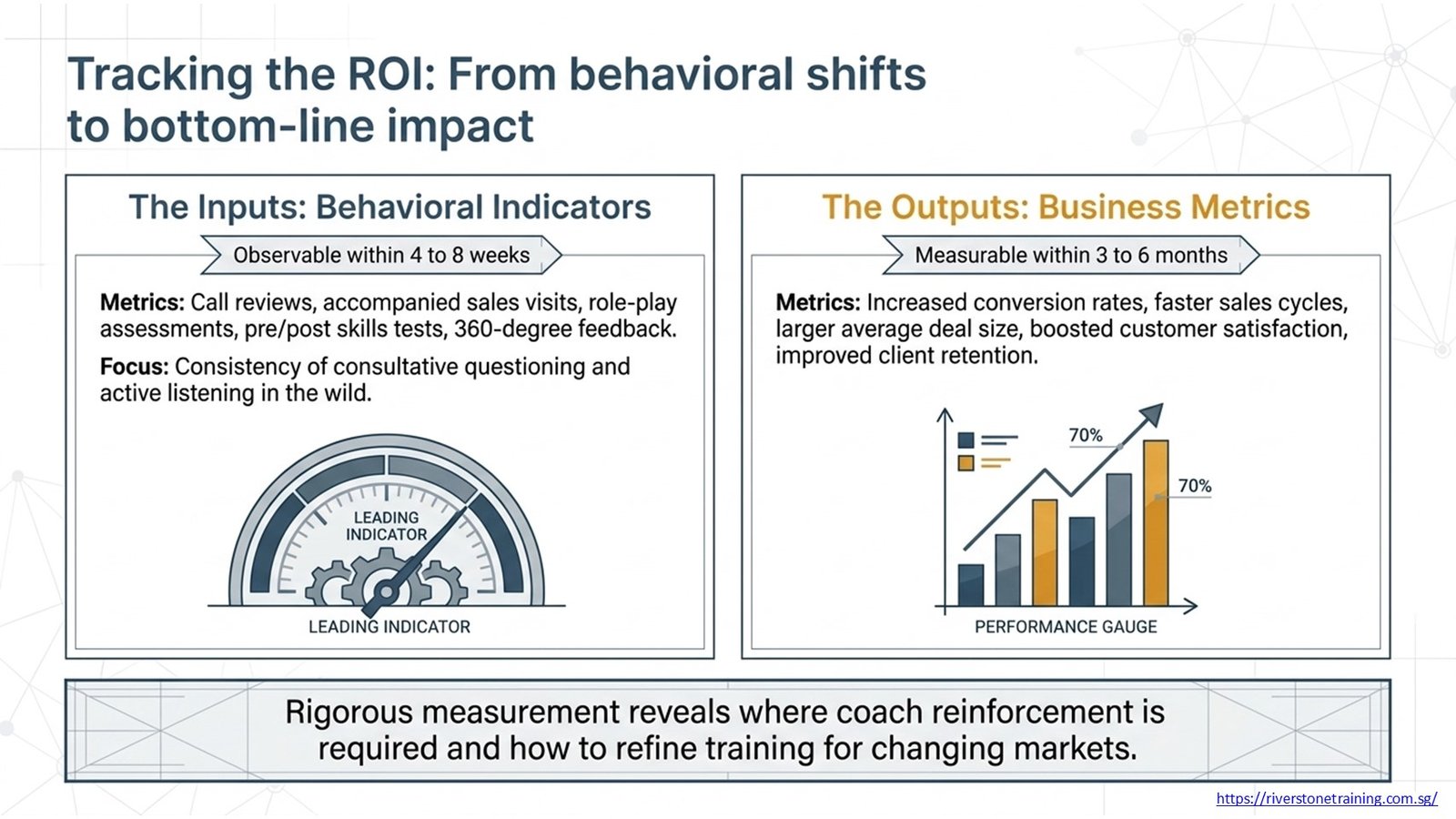
There are various ways of determining the effectiveness of a sales training session, both behavioural and business. Behavioural indicators include observation of client interactions (call reviews, accompanied sales visits or role play assessment), pre- and post-training skills test, and 360-degree feedback from managers/peers. These measures assess the consistency of trained behaviours (consultative questioning, active listening, structured objection handling) within actual client situations.
Business metrics serve as the tangible revenue impact of training, such as increased conversion rates, average deal size, faster sales cycles, boosted customer satisfaction, improved client retention, and revenue from existing accounts. Rigorous training effectiveness measurement allows organisations to better understand which areas of the training program are having the greatest impact, where coach reinforcement is required and how to constantly refine the training design to account for changing market and client requirements.
What Skills Are Developed Through Corporate Sales Training?
Comprehensive sales training programs, corporate teams invest in developing a broad range of interconnected competencies. The basis is communication skills such as questioning, listening and presentation. The client methodology is developed through Consultative Selling, Needs Analysis and Solution Positioning. Objection handling, negotiation and closing skills are the commercial aspects of the sales process. Relationship management and emotional intelligence build the long-term partnership skills that lead to retention and revenue growth, and account planning develops the long-term partnership skills that lead to retention and revenue growth.
The best corporate sales training programs combine these skills in a cohesive and reinforcing manner, rather than presenting them as stand-alone skills. A successful salesperson adapts smoothly between various clients, circumstances, and phases of the selling process; professionals who know how communication is integral to consultative selling, how needs analysis influences negotiation, and how emotional intelligence plays a role in account management are better able to do so.
How Can Sales Training Support Long-Term Business Growth?
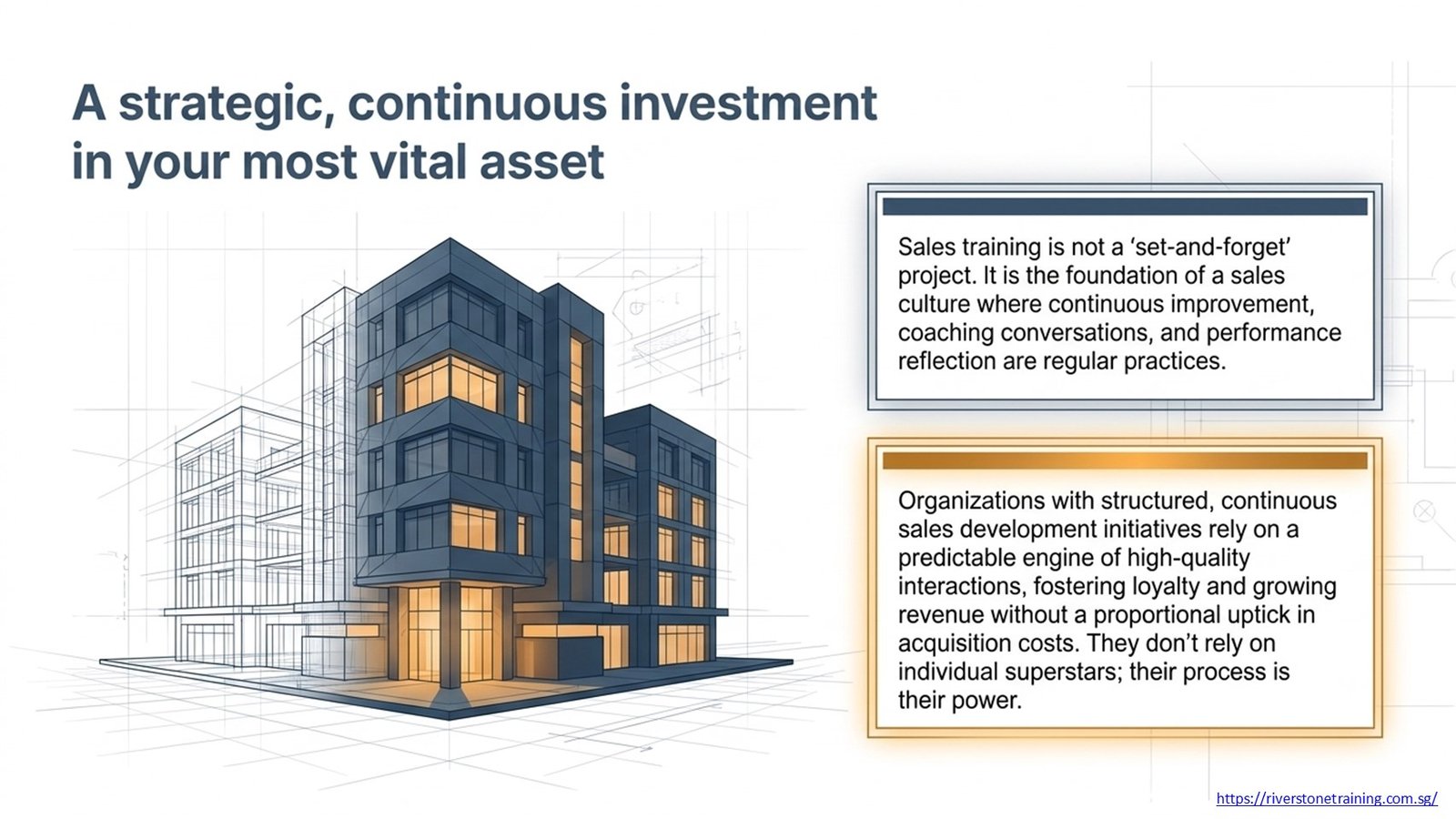
Sales training can help to create a sales team capability that can be built over time and really help a business grow in the long term. Individual skill enhancements, such as improved questioning, stronger listening skills, and more confidence in handling objections, will directly impact conversion rates and client retention. What is a result, however, of a sales team trained, coached, and developed consistently: the ability to consistently provide high-quality interactions, foster loyalty, create referrals, and grow revenue from current relationships, without a proportional uptick in costs of acquisition.
Sales training is not a set-and-forget or one-off project – it is a strategic, continuous investment that creates sales cultures where continuous improvement, coaching conversations, and performance reflection are regular practice. This cultural aspect of training is the key to organisations that will consistently deliver sales success, compared with those that can count on their individual superstars or short-term sales promotions for results.
Conclusion
Client relations are enhanced through corporate sales training that provides skills in communication, consultative selling, needs analysis, establishing client trust, and sales account management, which are most important to clients. This can be seen in every aspect of the client journey: a better initial conversation results in more suitable solutions, a firmer grip on objections decreases the hesitation of the client, and proactive account management creates loyalty and generates more revenue over time.
The link between the investment in sales training and business performance is, in fact, solid. Companies with a structured and continuous sales development initiative have consistently better client retention rates, average deal sizes and revenue from existing accounts than those that don’t. The development of communication skills, emotional intelligence, and relationship management through deliberate and targeted training makes for a client experience that can’t be matched by price, product, or technology.
The best way to improve sales and create lasting client connections is to create an in-house training system that is relevant, practical, and role-specific, and that is designed to address the organization’s actual sales issues. Corporate sales training can be one of the most valuable investments a company can make in its sales skills and client relationships
Table 5: Corporate Sales Training — Summary of Development Areas and Client Impact
| Development Area | Core Skill | Client Relationship Impact |
| Communication | Active listening, open questioning, and clarity | Clients feel understood and respected |
| Consultative Selling | Needs analysis, solution positioning | Higher relevance and conversion rates |
| Trust Building | Consistency, empathy, follow-through | Long-term loyalty and referral business |
| Objection Handling | Confidence, problem-solving, empathy | Reduced hesitation, stronger close rates |
| Account Management | Proactive reviews, strategic planning | Expanded revenue from existing relationships |
| Emotional Intelligence | Self-awareness, adaptability, empathy | Stronger rapport across diverse clients |
| In-House Sales Training | Structured, role-specific workplace learning | Consistent sales behaviours across teams |