Financial Statement Analysis and Reporting: Corporate Training for Non-Finance Managers
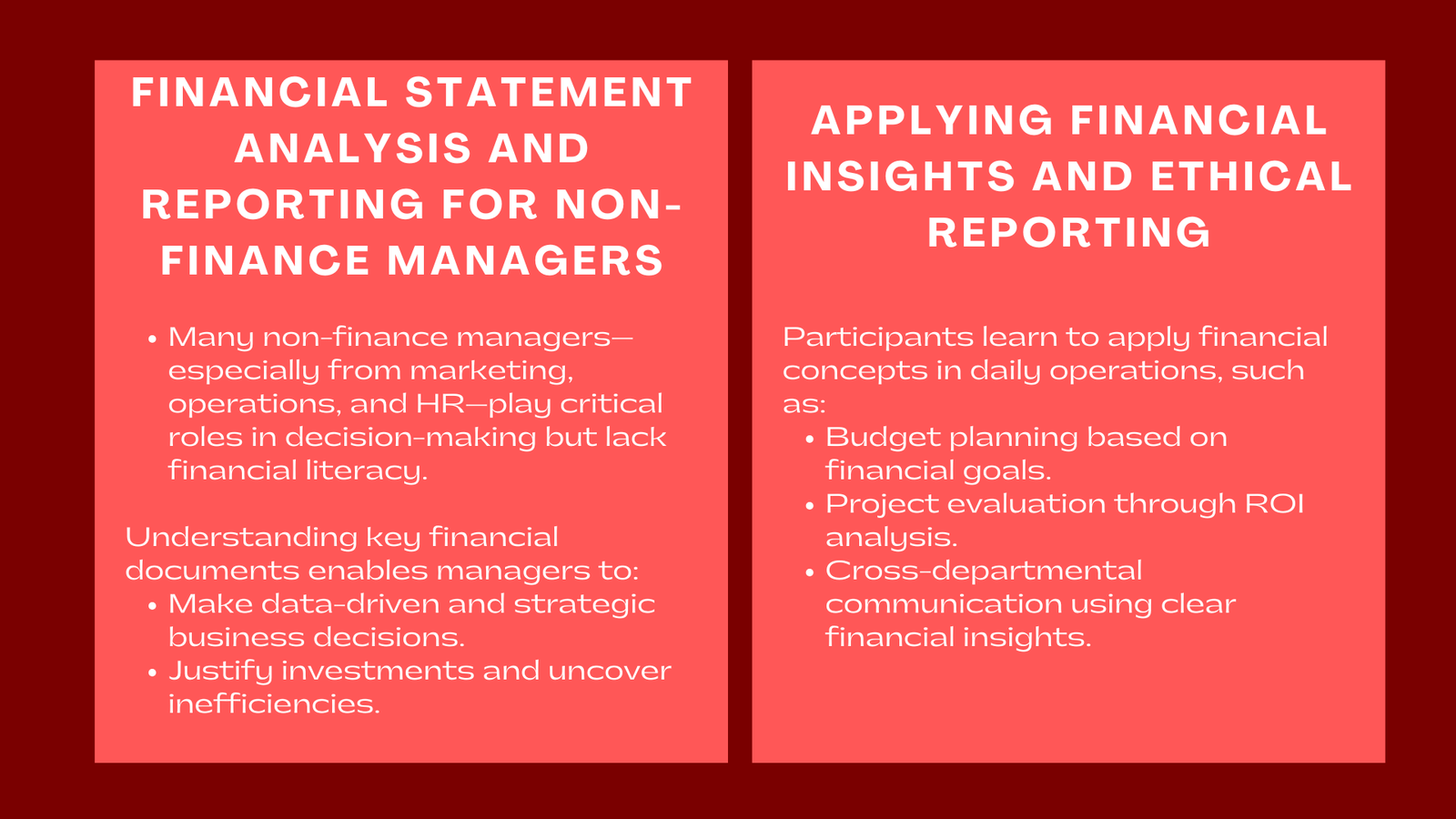
Fidell examines the decision-making roles of managers outside of finance but who are critical to decision-making; many of them do not have the basic financial literacy to read company reports adequately. This is where corporate training in financial statement analysis and reporting comes in; it provides decision-makers from marketing, operations, and human resources to make sound business decisions. Balance sheets, income statements, and cash flow reports are no longer optional knowledge for a manager; they have become an essential managerial competency, which equips non-finance managers with the ability to make informed, strategic business decisions.
This training turns otherwise complicated financial information into usable information. Students are taught how to interpret financial ratios, analyze profitability and cost structure in ways that have direct applications to their departments. Through in-house training Singapore for financial statement analysis & reporting non-finance managers, participants gain hands-on experience in applying these concepts to real business scenarios. By learning financial analysis, managers can turn operational decisions indicative of company goals, justify investments, uncover inefficiencies, and align investments with company goals. By mastering these skills, managers can justify investments, uncover inefficiencies, and ensure that operational decisions are aligned with broader company goals, transforming financial literacy into a strategic managerial competency.
Understanding Key Financial Statements
The training starts with an in-depth understanding of the 3 basic financial statements. Participants understand how performance is reflected on the income statement, how financial health is captured on the balance sheet and how cash flow is reflected on the cash flow statement (liquidity). By forming a link between these documents, management gains a comprehensive insight into the ways in which the activities of the business convert into the economic consequences.
Through interactive case studies, participants dive into actual company filings to discover what makes the bottom line, where the risks are and how the decisions an operation makes affect the bottom line. This practical approach means that learning goes beyond the theory – managers are confident in now being able to read financial reports and make strategic decisions using them. The financial statement training for non-finance managers Singapore also emphasizes the strategic application of financial knowledge. Managers learn how to interpret ratios and key performance indicators (KPIs) derived from the statements, such as return on equity, current ratio, gross margins, and cash conversion cycles, and connect these metrics to operational and strategic decisions. Participants are guided on how to assess the financial implications of investment proposals, cost-cutting measures, pricing strategies, and expansion plans. This enables managers from non-finance functions, such as marketing, operations, and human resources, to make informed decisions that contribute to overall organizational value. By the end of the module, participants gain not only technical competence in reading and interpreting financial statements but also the confidence to integrate financial insights into strategic business planning, resource allocation, and performance monitoring, transforming them into well-rounded decision-makers capable of driving sustainable growth for their organizations.
Applying Financial Insights in Daily Operations
Participants use the financial concepts to manage situations when they have the right understanding of the basic concepts. They are taught how to construct budgets according to financial goals, how to evaluate the feasibility of projects based on return-on-investment calculations, and how to communicate financial findings well across departments of the business.
This training also focuses on ethical and compliance of reporting. Managers become aware of the importance of financial transparency and accountability and the importance of data integrity in maintaining stakeholder trust. The result is a balanced view that will allow a more effective approach to both operational and strategic decision-making.
The corporate financial literacy programs for managers Singapore also address the critical aspects of ethics, compliance, and reporting transparency. Managers gain an appreciation for the role of financial integrity in building stakeholder trust, understanding regulatory requirements, and maintaining accountability. Discussions cover the importance of accurate data recording, adherence to reporting standards, and the potential consequences of financial misrepresentation. By integrating ethical considerations into financial decision-making, participants develop a balanced perspective that combines strategic insight, operational efficiency, and ethical responsibility.
Conclusion to Financial Statement Analysis and Reporting Corporate Training for Non-Finance Managers
Financial literacy is no longer a business function restricted to the finance department – it has become a universal skill that reinforces all areas of business performance. Through this training, non-finance managers are financial fluency professionals that are able to make a meaningful contribution to the company strategy.
By fostering financial literacy across all levels of management, companies create a strong link between day-to-day operations and overarching business strategy. Managers are empowered to make informed choices that support sustainable growth, enhance profitability, and ensure that every operational decision contributes meaningfully to the organization’s strategic vision. Over time, organizations that invest in financial statement training see their collaboration improve, their ability to be data-driven improve, and their costs will be managed better. By having financial language knowledge, managers create a link between operations and the company’s strategy so that all the business decisions impact sustainable growth and profit.