Professional in-house training equips participants with real-life management skills and the ability to tackle challenges and goals in the workplace to enhance team performance.
What Is Professional In-House Training for Management Development?
Management development: professional in-house training is a structured learning programme in the organisation to develop the ability of managers to manage teams effectively. The content, examples, and learning activities are specific to the organization’s industry, culture, and management needs, so the learning is relevant to the participants.
In-house management training is tailored to the organisation’s context as opposed to public workshops or external programmes. The training may vary from one retail or industrial enterprise to another, depending on the requirements of the business, as compared to those of a financial services company. The delivery of programmes may be in the form of workshops, coaching, blended learning, or structured on-the-job learning, as appropriate, based on learning culture and operational needs within the organisation.
Key management skills commonly developed through professional in-house training programmes:
| Management Skill | What It Involves | Business Benefit |
| Communication | Delivering clear direction, active listening, and feedback | Better team dynamics and fewer communication issues. |
| Delegation | Delegating tasks, trusting team capabilities: | Greater productivity and employee ownership |
| Coaching and mentoring | Using Socratic questioning to help develop the person. | Increased worker quality and stability |
| Decision-making | Analysing options, weighing risk, acting decisively | More rapid problem solving and improved outcomes |
| Performance management | Setting expectations, reviewing progress, addressing gaps | More responsibility and effectiveness within teams |
| Conflict resolution | Addressing interpersonal and team disputes constructively | Healthier workplace culture |
| Change management | Leading teams through organisational change | Non-resisting and seamless transitions |
How Does In-House Training Improve Leadership Skills?
In-house training helps to develop the skills of leadership within the context of the manager’s team, organisation and responsibilities. Managers are taught and develop skills that are relevant to the day-to-day situations they encounter, and not generic case studies which may not relate to their context.
In-house leadership programmes are generally focused on behavioural and strategic management skills. These can include feedback, dealing with challenging conversations, creating team psychological safety, motivating team members, setting targets and objectives for the team in line with business targets, and ‘capability building’ over time. For instance, if you are working on a first-time managers programme in a logistics company, it might be based on leadership transition, performance conversations, or effective delegation. Professional in-house training isn’t theory on leadership, but instead skills that can be used in the workplace.
Core leadership competencies developed through in-house management training:
| Competency | Workplace Application | Developed Through |
| Strategic thinking | Making long-term plans, prioritising and aligning goals. | Strengthen and apply scenario planning exercises and strategic workshops. |
| Team leadership | Maintaining performance, developing skills, and keeping people motivated | Coaching skills, framework for giving feedback, team sessions. |
| Conflict resolution | Managing inter-personal conflict and team disharmony | Workthrough, role play, conflict frameworks |
| Change management | Giving direction during restructuring, system changes, and new processes | Change frameworks, communication planning, and stakeholder mapping |
| Emotional intelligence | Self-awareness, empathy, regulation under pressure | Reflective practice, 360 feedback, coaching |
| Coaching mindset | Giving direction during restructuring, system changes, and new processes | Coaching skills training, supervised practice |
| Decision-making under pressure | Acting with incomplete information in time-sensitive situations | Case studies, decision frameworks, simulation exercises |
How Can Managers Strengthen Communication Through In-House Training?
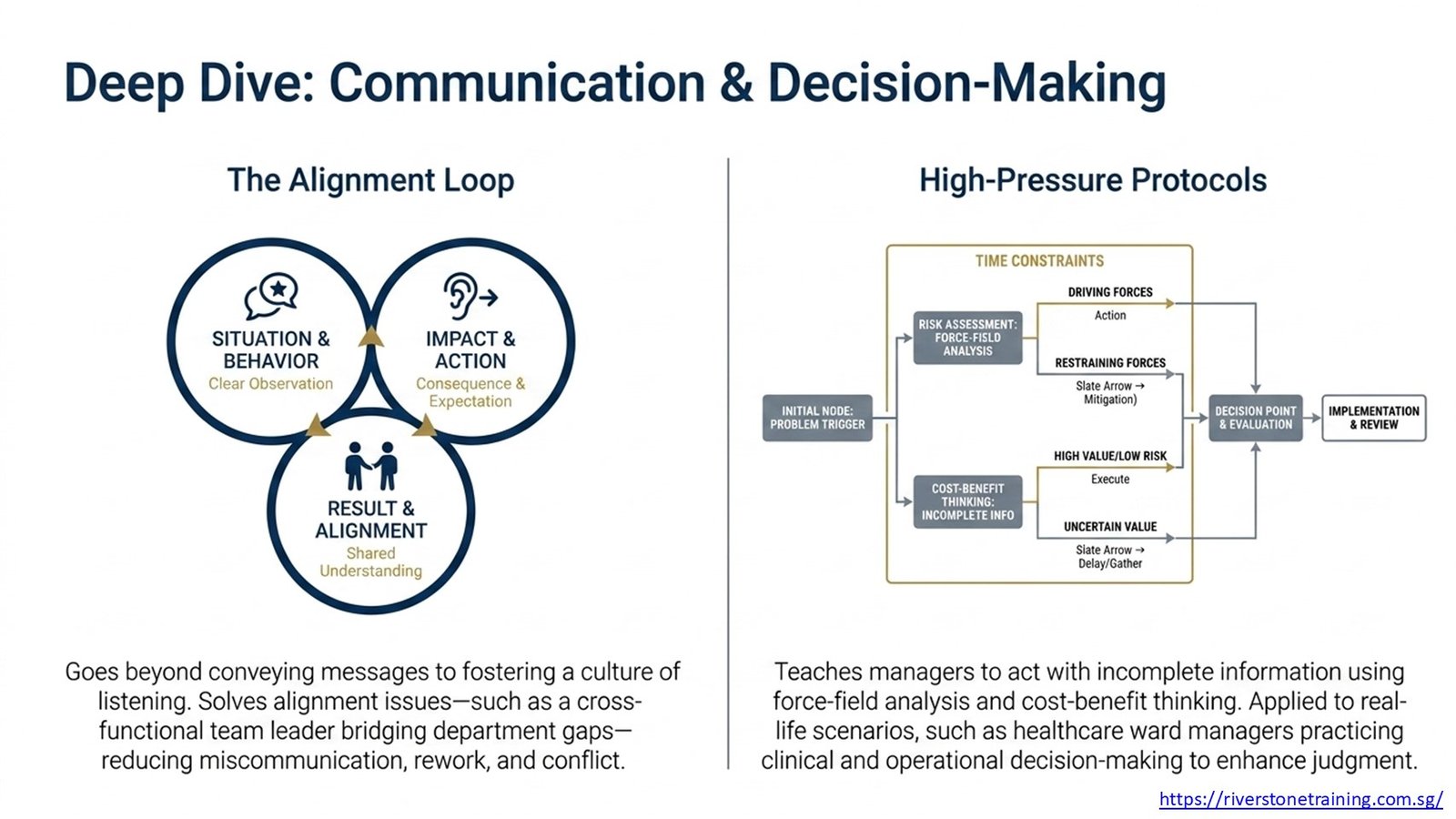
To develop their communication skills, managers are trained in-house, and practice these communication techniques in the context of their culture, team and business language. Management communication is not simply about conveying messages clearly, but also about listening effectively, adapting to various team members, and fostering a culture of listening.
Communication training at work often includes providing structured feedback (STAR or SBI), conducting successful meetings, giving constructive feedback on difficult communication, and setting clear expectations when delegating tasks. A cross-functional team leader who may be struggling with alignment between departments, for instance, could use a Specific Training in Stakeholder communication and influencing skills, due to the communication gaps identified in the organisation. Effective communication can help to boost employee engagement, team understanding and retention, decrease miscommunication, rework, and conflict.
How Does Professional In-House Training Improve Decision-Making Skills?
Professional in-house training enhances decision-making skills by giving managers a framework to help them analyse a problem, evaluate the options, and then make a decision with confidence in the organisation’s real decision-making process. These decisions are never simple, with all the information not always available, priorities conflicting and time pressure.
In-house training is used to develop decision-making skills using equipment such as the DECIDE model, force field analysis, cost-benefit thinking, and risk assessment frameworks, with scenarios taken from the organisation’s situation. Training for middle managers and department heads also covers: When to make decisions independently, when to involve others, and when to involve senior management. For instance, healthcare organisations can adopt real-life incident scenarios to allow ward managers to practise clinical and operational decision-making to enhance their judgement as well as their processes.
How Can Management Training Enhance Team Performance?
Management training helps improve team performance by building the skills managers require to set clear expectations, give frequent feedback, address underperformance, and foster team unity. Management has a direct effect on whether or not a team reaches its potential or not.
In-house management programmes build the skills of effective objective setting, one-to-one management discussions and performance conversations that drive improvement. A training also benefits project managers and team leaders with managing diverse teams, allocating work based on personal strengths, and promoting a culture of accountability and collaboration. These skills are essential for managers who want to create more effective teams and avoid unnecessary performance problems that waste HR resources.
How Does In-House Training Support Conflict Resolution and Employee Engagement?
In-house training aids in conflict resolution, boosts employee engagement, and provides managers with practical skills to manage and prevent issues that can harm team relationships or productivity. Effective conflict management leads to more trusting, collaborative, and engaged teams.
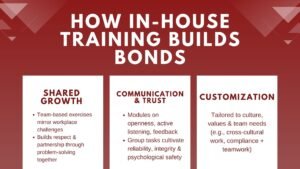
Conflict in the management environment can occur between individuals within a team, or it could be differences in priority, workload, or work approach. In-house training is designed to tackle these issues by using scenarios, which are pertinent to the organisation’s culture and industry, where managers can practice the resolution techniques in advance of any real-life situations. Investing in employee engagement through increased listening skills, recognition, employee development, and employee safety can result in increased engagement and reduced voluntary turnover, which is related to management quality.
What Management Competencies Are Commonly Developed Through In-House Programs?
Most often, the competencies that are cultivated through in-house management programmes fall into the categories of people leadership, operational effectiveness, and strategic contribution. These skills are the ones that decide whether or not a manager is effective in motivating a team to perform and is able to contribute to the overall objectives of the business.
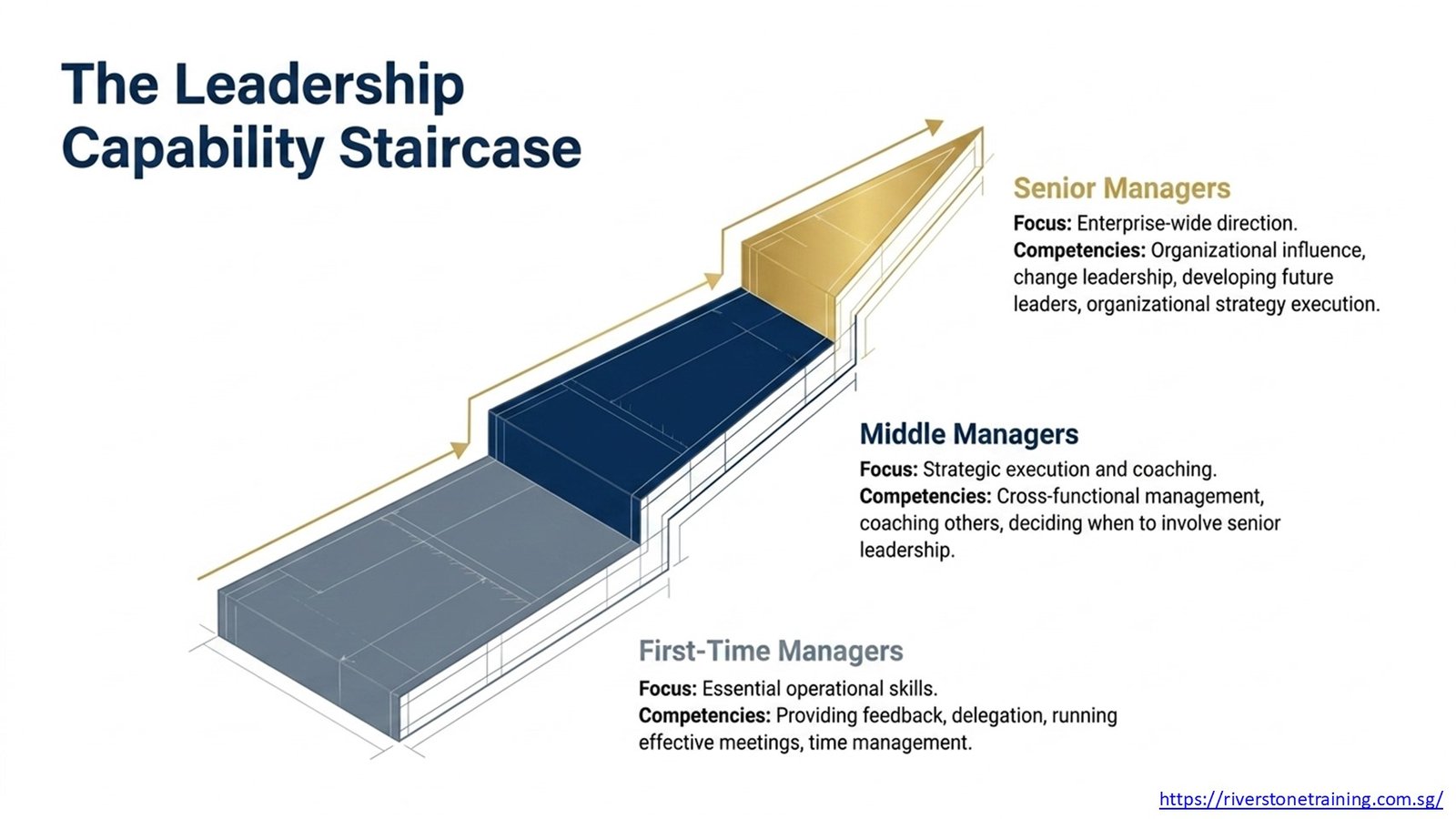
The competencies identified will differ according to the level of management. First-time managers usually have to acquire some essential skills, such as providing feedback, delegation, effective meetings, and being an effective leader with respect to time management. Middle managers are more likely to devote a major portion of their time to coaching others, cross-functional management, and strategy. Senior managers acquire skills relating to organisational influence, change leadership, and how to develop leadership within others.
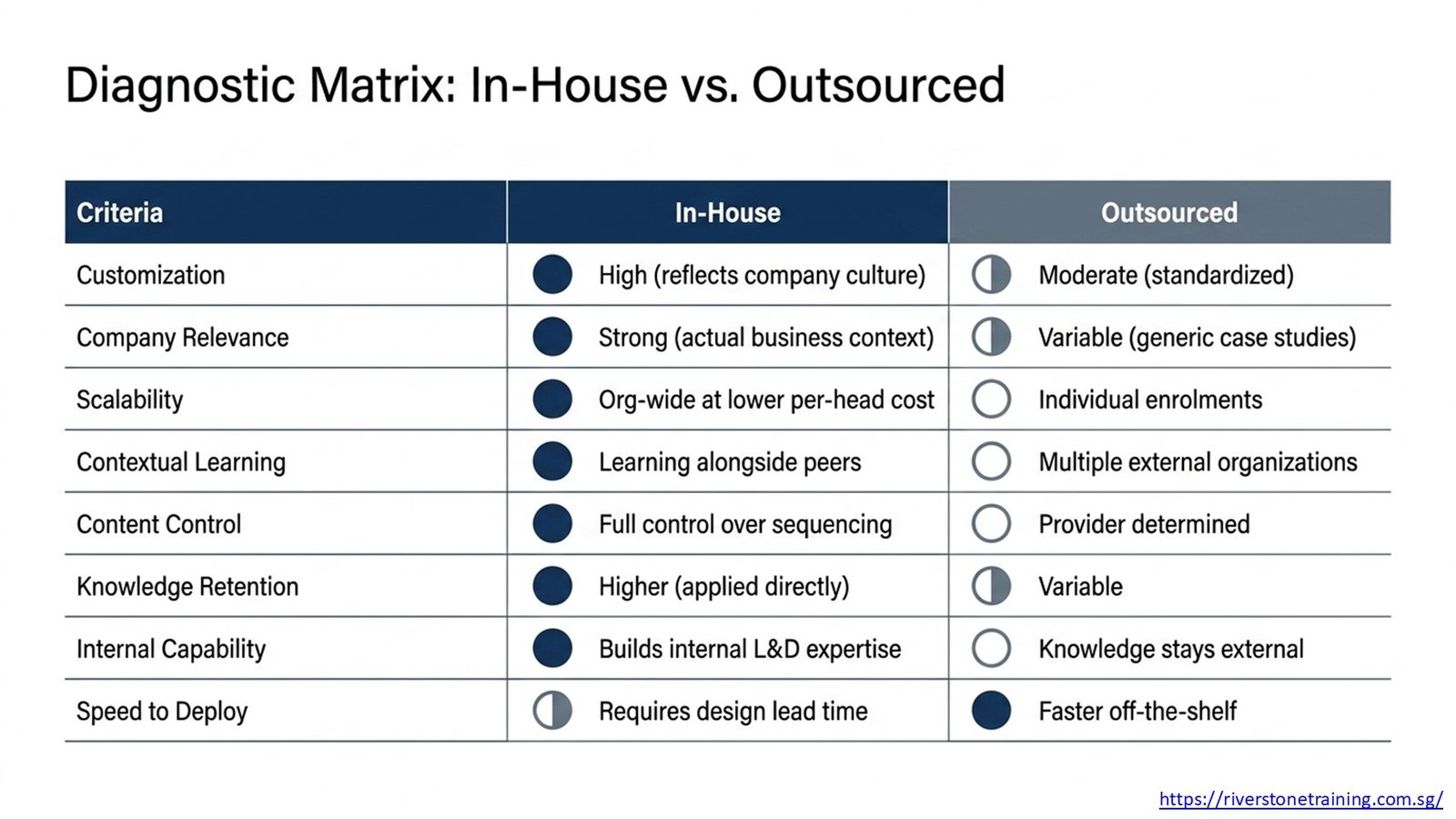
Comparison of professional in-house training versus outsourced management development:
| Factor | In-House Training | Outsourced Training |
| Customisation | High — content reflects company culture and challenges | Moderate — standard programmes with limited adaptation |
| Company relevance | Strong — examples drawn from actual business context | Variable — generic case studies may not apply |
| Scalability | Organisation-wide delivery at lower per-head cost | Programme-dependent; often individual enrolments |
| Contextual learning | Managers learn alongside peers from the same organisation | Learners from multiple organisations, limited internal context |
| Content control | Full control over content, emphasis, and sequencing | Limited — provider determines curriculum |
| Knowledge retention | Higher — learning applied directly to current role | Variable — transfer to the workplace depends on the individual |
| Internal capability building | Builds internal L&D and management expertise over time | Knowledge stays with the provider |
| Speed to deploy | Requires design and planning lead time | Faster if using an existing off-the-shelf programme |
How Does In-House Training Improve Organisational Alignment?
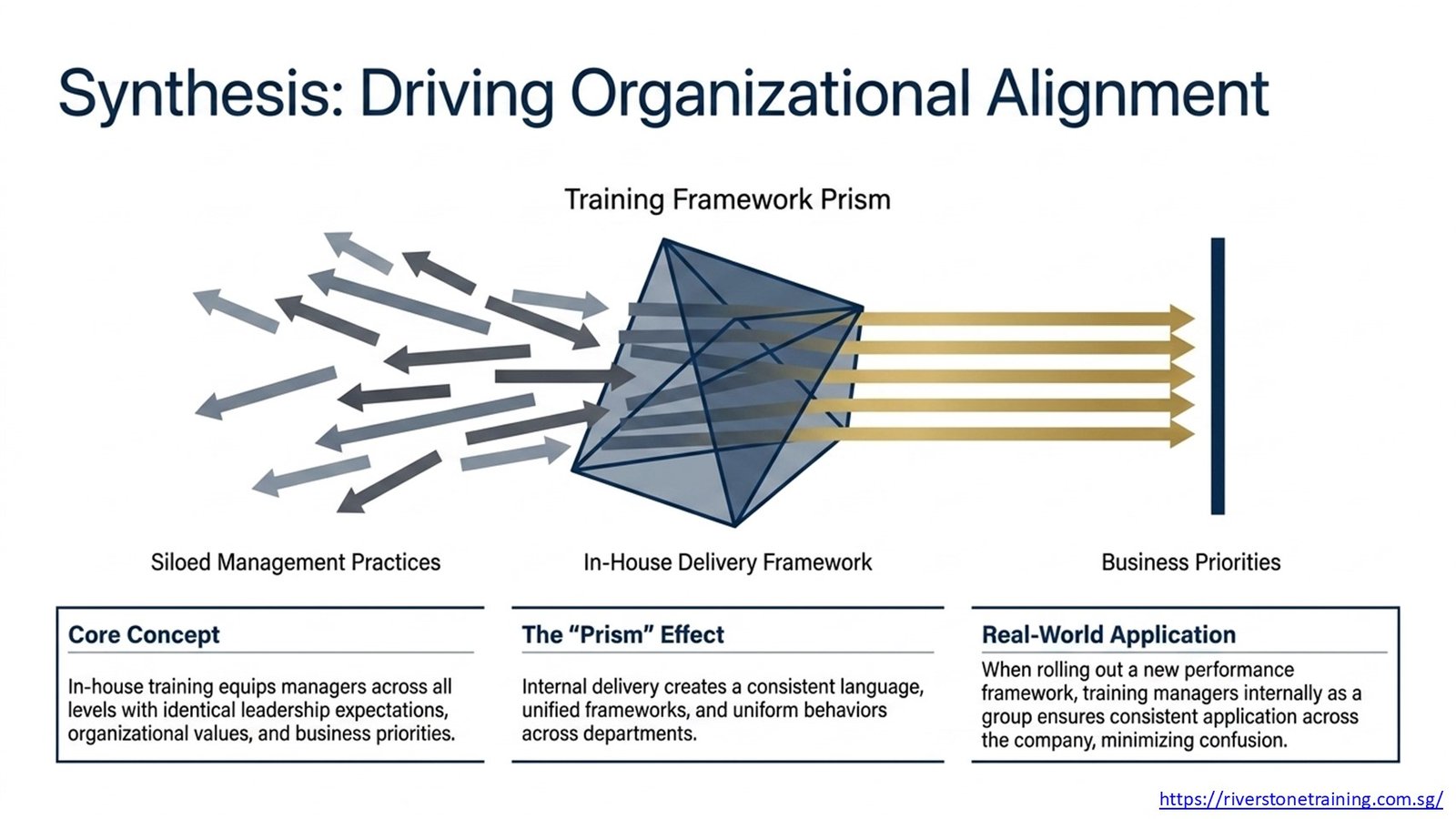
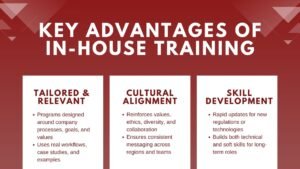
In-house training helps build alignment within the organisation as managers at all levels are equipped with the same leadership expectations, organisational values and business priorities. The internal delivery of the training brings a consistent language, framework and behaviours across teams and departments.
Companies that develop their own management will be more likely to have a better match between the objectives set by their teams and the management of the entire company. If managers are taught the same goal-setting techniques, feedback systems, and performance management, the organisation becomes more consistent and coherent. This is particularly useful during times of change, growth, or cultural shift, as leadership practices align to minimize disillusionment and confusion. A new performance framework, for instance, will be more effective if all managers are trained in-house as a group on the system, and not trained to interpret the written guidance.
How Does In-House Training Compare with External Learning Solutions?
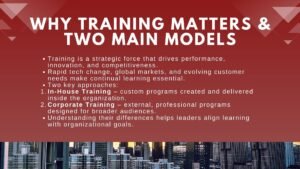
There are many differences between in-house training and external learning solutions, and their suitability depends on the needs of the organisation, the size of the organisation, available budget, and management development. This is because external courses, like public management courses, executive education, or professional qualifications, give a wider range of perspectives and practice from other organisations and industries.
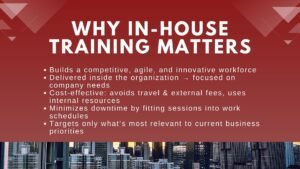
In-house management training, however, offers more of an organisational relevance via customisation, contextual application and business priority alignment. These benefits are usually mentioned when considering in-house training vs outsourcing, especially when building management skills on a large scale. Many organisations combine the two, utilising their own management development programmes to establish management core competencies and the organisational culture and structure, while also engaging in external programmes to support executive development or for the acquisition of specialist skills or for cross-industry benchmarking.
What Should Organisations Consider When Evaluating In-House Training vs Outsourcing?
Organisations can assess if in-house or outsourcing training is the best option in the development of managers by taking the following factors into consideration: the specificity of the learning need, the size of the training, the customisation level required and the level of alignment with business outcomes.
Specific management issues, like the creation of a new leadership model, the introduction of a performance culture, or the care of managers in the context of organisational restructuring, are frequently better solved by in-house programmes, as they must be tailored to the organization’s context, culture, and direction. On the other hand, companies that want to introduce a few high-ranking decision makers to outside perspectives, industry standards, or specialists could be better suited to external programs. The question is whether the need for learning is one that is unique to the organisation, or if there is a value to having an external viewpoint.
Expected outcomes from in-house management training across core development areas:
| Training Focus | Target Audience | Expected Outcome | Organisational Benefit |
| Leadership skills | All management levels | Stronger, more confident leadership | Improved team performance and retention |
| Communication | First-time and middle managers | Clearer direction and feedback | Reduced misalignment and rework |
| Coaching and mentoring | Senior and middle managers | Greater employee development | Stronger talent pipeline |
| Performance management | All managers | Improved accountability and output | Higher productivity and lower attrition |
| Conflict resolution | Team leaders and managers | Earlier resolution of team issues | Healthier culture and lower escalations |
| Decision-making | Middle and senior managers | Faster, more consistent decisions | Better operational outcomes |
| Change management | Senior managers, project leads | More effective change adoption | Reduced disruption during transitions |
| Strategic thinking | Department heads, senior leaders | Greater contribution to business direction | Stronger organisational strategy execution |
How Can Companies Measure the Impact of Management Training?
There are various levels of measurement data companies gather for management training, from satisfaction of the learner, to knowledge and skills acquired, to behaviour change and to business outcomes. The Kirkpatrick Model is a well-adopted approach to this evaluation. At the immediate level, post-training surveys are conducted to see if managers have found the programme relevant, practical, and applicable to their roles, and pre and post-assessments are undertaken to determine the level of improvement in their knowledge and capability.
There has to be evidence beyond the training room to measure behaviour change. 360 degree feedback, observation of managers in action, team engagement surveys and coaching conversations can be used to identify whether managers are consistently using new skills. Team performance, employee turnover, engagement scores, formal grievance cases and productivity measures can then be used as business-level indicators to show whether the training has been the organisation’s return on investment.
Conclusion
Professional in-house training enhances the capacity of management by providing real-world, context-specific training that tackles management issues in the context of the organisation. Whether it’s communication and decision-making, performance management, or conflict resolution, these programmes build the skills required to enhance team effectiveness and business performance. The most effective development of management is achieved where learning is applied, reinforced in time and in line with organisational objectives.
Organisations are considering inhouse training versus outsource as part of their learning and development strategy. Often, in-house training is the preferred choice for management development at scale, offering benefits such as customisation, contextual relevance, and organisational alignment; external training programmes can also be advantageous for specialist expertise and broader perspectives. In the end, the most effective management training happens when there is an emphasis on authentic workplace problems, when it can be sustained, and when it can be evaluated by a relevant, meaningful business outcome.
Summary of how professional in-house training develops management capability:
| Development Area | In-House Training Approach | Management Outcome |
| Leadership skills | Customised leadership frameworks and practice | Confident, capable leaders at all management levels |
| Communication | Feedback models, listening techniques, and facilitation skills | Clearer team direction and stronger relationships |
| Decision-making | Structured decision frameworks applied to real scenarios | Faster, more consistent management decisions |
| Team performance | Performance management tools and coaching skills | Higher-performing teams and greater accountability |
| Conflict resolution | Practical dispute resolution techniques and facilitated role-play | Earlier resolution and healthier team culture |
| Organisational alignment | Shared frameworks, language, and leadership expectations | Consistent management practice across the organisation |
| Employee engagement | Coaching, recognition, and psychological safety skills | Stronger engagement, lower voluntary turnover |
| Measuring impact | Kirkpatrick evaluation, 360 feedback, business metrics | Evidence of training ROI and ongoing improvement |